Choose a company jacket's zipper by how the finished garment works, not by a rule that metal is premium or plastic is cheap. Separate three decisions: the zipper's construction, whether the front opens one way or two ways, and any documented weather-protection claim. Then approve the actual jacket with the layers, hand movements and care routine employees will use.
A jacket can have the right color, logo and fabric yet be frustrating every time someone puts it on. The front closure is a repeated interaction, not just a trim detail. This guide helps a company-store buyer turn “good zipper” into a reviewable requirement without pretending to become a garment engineer.
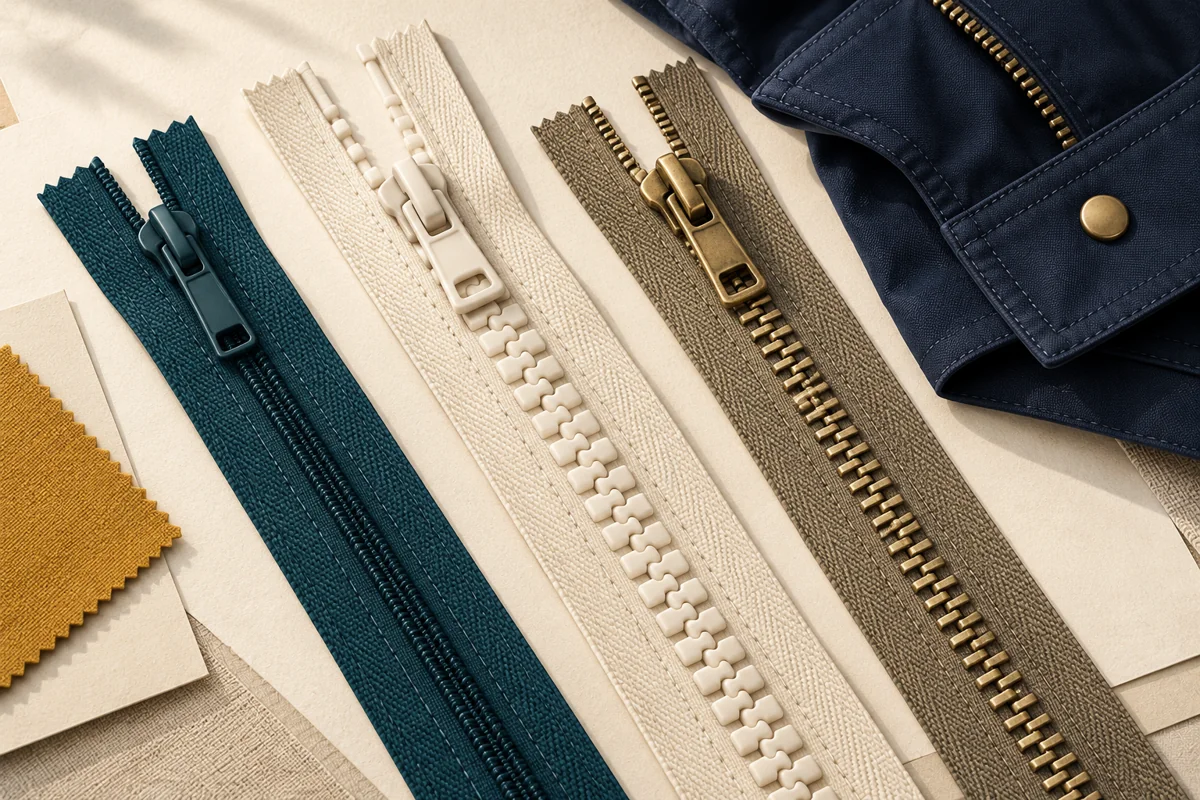
Publisher perspective: Brand Sauce publishes this guide as a company-store and branded-merchandise provider. The evaluation framework is our editorial recommendation, not a laboratory test or a promise about available inventory. Manufacturer sources were reviewed October 30, 2026. The hero is an AI-generated conceptual illustration, not a photograph of specified zipper products.
1. Separate construction, opening and weather claims
YKK's introduction to zipper types identifies coil, metal and VISLON® as three main categories. Coil uses spiral plastic elements, including polyester or nylon. Metal versions use metal elements. VISLON is YKK's name for its injection-molded plastic zipper; the manufacturer describes it as lighter than a metal zipper of the same size.
Those facts describe construction, not an overall quality ranking. A brand name on a slider also does not tell you everything about a complete garment. Ask what closure is supplied on the exact style and whether that specification changes by color, fit or regional version. If the garment supplier cannot identify the component, record it as unspecified rather than filling the gap from a photograph.
| Decision | Question to answer | What it does not establish |
|---|---|---|
| Coil, molded plastic or metal | What construction is installed on this jacket? | A universal durability or premium ranking |
| One-way or two-way separating front | Does the wearer need to open the hem independently? | Weather protection or easy operation for every user |
| Weather-protective closure | What exactly does the manufacturer claim? | A waterproof rating for the whole jacket |
| Pull, surrounding fabric and installation | Can the wearer operate this finished sample comfortably? | A long-term service-life result from one trial |
Start with the job the jacket must do. Our company-jacket climate and fit guide covers the larger garment decision. The closure review comes after that shortlist, before decoration approval or a volume commitment.
2. Use construction as a shortlist filter, not a winner's podium
Coil: consider the actual front's flexibility, appearance and movement against the jacket fabric. YKK describes coil as a soft, versatile construction used across apparel and other applications. That is a reason to assess it, not evidence that every coil-equipped jacket feels the same. Check the finished garment instead of rejecting a discreet closure because its teeth look small in a store thumbnail.
Molded plastic: inspect how the more visible elements fit the intended look, and whether the exact assembly is comfortable in use. Do not describe any molded plastic zipper as VISLON unless the garment documentation supports that identification. Neither a chunky appearance nor a recognizable brand name substitutes for trying the closure.
Metal: decide whether the visible finish belongs in the approved uniform or gift aesthetic. Ask for the actual finish and care instructions when appearance matters. Do not infer a particular metal, corrosion performance or special-use suitability from a silver- or brass-colored photograph. A visual preference is legitimate; presenting it as tested durability is not.
For an ordinary employee gift, several constructions may be acceptable. For a tightly coordinated front-of-house uniform, the visible trim may be a fixed design requirement. Write down which case applies. Otherwise a later substitution can become an argument about whether “equivalent” means functional, visually identical or merely available.
3. Specify the opening behavior in plain language
YKK's two-way zipper explanation distinguishes separating jacket fronts from closed arrangements used in other applications. A two-way separating front can open from the top or bottom and separate completely. Two sliders alone are not a sufficient buying description: closed head-to-head and bottom-to-bottom configurations also exist.
Use a practical requirement such as: “The front must separate completely for dressing, and the wearer must be able to open the lower portion while leaving the upper portion closed.” Have the supplier demonstrate that behavior on the proposed jacket. Avoid asking merely for a “double zipper,” which leaves the intended function unclear.
For a longer jacket, a lower opening may be worth evaluating during seated work or travel. Treat that as a fit trial, not a guaranteed comfort benefit. Have the wearer sit, stand and reach naturally with the intended layers. If a normal one-way front already works well, a second slider need not become a mandatory feature.
A two-way front also introduces an additional operation to learn. Include separating, reconnecting and returning both sliders to the starting position in the trial. Do not measure success only by asking someone to pull an already-connected zipper upward. If users need an explanation, determine whether a short manufacturer-approved instruction solves the problem or a different jacket is the better choice.
4. Keep water resistance separate from the zipper's appearance
A smooth coated-looking closure can invite an oversized claim. YKK distinguishes AquaGuard® water-resistant zippers from AQUASEAL® waterproof zippers and lists AquaGuard in both coil and VISLON constructions. Construction and water protection are therefore separate specification questions; “coil” does not answer the weather question.
The purchasing implication is straightforward: request the jacket manufacturer's wording for the whole garment and any component detail relevant to that wording. Do not promote a jacket as waterproof because one closure looks sealed. Conversely, do not reject a conventional-looking closure without reviewing the garment's complete design and stated intended use.
Keep the store description within the documented claim. If the supplier describes only water resistance, retain that qualification. If a garment has different front and pocket closures, do not imply that a claim about one applies to all. A sample handling session is not a substitute for a manufacturer's performance specification or an independent test.
5. Run a finished-jacket closure trial
This is a usability screen for purchasing, not a standardized durability test. Use the actual proposed style in appropriate sizes, with ordinary layers underneath. Invite feedback without asking employees to disclose medical details. If someone needs another closure arrangement, evaluate an alternative privately rather than treating difficulty as user error.
- Start disconnected. Have the participant put on the jacket and connect the front without a coordinator holding it in position. Record whether the starting point is easy to see and handle.
- Travel the full length. Close and open at a normal pace. Note catches involving the lining, flap or nearby fabric. Stop and inspect resistance rather than forcing the slider.
- Try the real hand condition. If everyday work gloves are part of the intended use, bring those gloves. A bare-handed demonstration cannot answer a gloved-use question.
- Move normally. Sit, stand, reach and check the neck and hem positions. Test the lower opening separately if the jacket has a two-way front.
- Repeat after approved care. Follow the garment label and supplier instructions, document the care performed, then repeat the handling check. Do not invent a wash-cycle durability claim from this small trial.
Record observations specifically: “lining caught near the upper third during two closures” is actionable; “zipper feels cheap” is not. An issue may concern the surrounding garment rather than the elements themselves. Send the supplier the observation and request an assessment before changing the specification.
Keep the closure review alongside, but separate from, the decorated apparel sample approval. Logo approval should not silently approve every construction detail. If a representative undecorated sample was used first, verify that the production garment and decoration process do not introduce an unreviewed change.
6. Put the outcome on a closure approval card
The useful deliverable is a short record the purchasing team can use again. A photo helps identify the sample, but the written function prevents someone from approving a visually similar replacement with different behavior.
| Field | Record before release |
|---|---|
| Garment identity | Brand, exact style, color, fit range, sample size and intended recipient country |
| Construction evidence | Supplier-stated closure type; component brand only if verified; source or specification date |
| Required operation | Complete separation, one-way or two-way front, and any required glove-use scenario |
| Wearer observations | Starting, travel, sitting, neck comfort and any fabric catches; identify unresolved issues |
| Care and claims | Approved care instructions and exact permitted weather wording |
| Substitution rule | Which visual changes are acceptable, which functions are mandatory, and who reviews changes |
Hypothetical example: a workplace team approves a longer jacket because its two-way separating front works for their seated reception shifts. A replacement style has the same navy color and logo area but a one-way front. It is not automatically equivalent. The buyer should rerun the seated-use review or keep the original functional requirement, even if the substitute's metal trim looks more expensive.
For an optional gift collection, the answer might instead be to offer both styles with accurate descriptions. Choice is useful when preferences differ, but it does not excuse missing specifications. Employees should not have to infer the opening mechanism from a distant product image.
7. Carry the requirement into reorders and fulfillment
On-demand decoration can suit staggered orders and reduce the need to hold finished jacket inventory. It does not mean the buyer can select custom zipper hardware on an existing stock garment. Confirm the actual style, sizes, colors, decoration method and destination availability. If a different component requires custom garment production, request a separate feasibility review, minimum quantity, lead time and quote.
Bulk purchasing can make sense for a known uniform rollout when the approved style and size requirements are stable. Receiving a batch together also gives the team a defined opportunity to inspect it. The tradeoffs include cash commitment, storage and unused sizes. A hybrid can reserve an initial uniform allocation while keeping optional apparel on demand. None of these models eliminates the need to check substitutions.
Price the complete decorated garment and fulfillment scope, not an assumed zipper upgrade. Product availability by country and all branded-order pricing remain quote-needed here. This guide does not establish that any particular jacket or component is in Brand Sauce's catalog.
For long-running programs, ask who handles a failed closure and whether repair assessment is available. Do not promise that any local shop can fit a universal replacement slider. Use the exact garment's support route and keep repair decisions within the broader maintain, repair or replace framework.
Frequently asked questions
Is a metal zipper always better for company jackets?
No universal ranking follows from the material alone. Match the finished jacket to the intended use, appearance and care requirements, then review an actual sample. A metal finish can be a design preference without being evidence of longer life.
Does “two-way” mean the jacket front separates completely?
Not by itself. Specify a two-way separating front if that is the required behavior, and demonstrate both lower opening and full separation. Two-way closed configurations also exist.
Can we add a larger pull after buying the jackets?
Ask the garment supplier before making changes. Confirm compatibility, care implications and suitability for the intended activity. Test an approved modification on a sample; do not make a bulk alteration the first experiment.
What is the minimum useful approval?
Identify the exact garment, document the required opening behavior, verify any weather wording, and have representative wearers connect, operate and separate the closure. Record unresolved issues before releasing the order. The goal is a jacket people can use comfortably—not a more impressive adjective on the product page.