Choose an employee-gift blanket by its intended use, finished dimensions, care requirements and decorated sample—not by the word “premium” or a fabric-weight number alone. A compact throw, a full-size couch blanket and a bed blanket solve different problems. For a varied workforce, a washable throw with restrained branding can be a useful option, but employees should have a non-blanket alternative when practical.
The purchasing mistake is treating blankets as apparel without sizes. They avoid shirt-size collection, but they still have fit: coverage, home storage, laundry access, texture preference and whether someone wants a large company logo in their living room. This guide turns those questions into an approval process for HR and company-store buyers.
Publisher perspective: Brand Sauce publishes this guide as a company-merchandise provider. The manufacturer products below illustrate how specifications differ; they are not claims of Brand Sauce inventory, authorized distribution, decoration availability or pricing. Request a current quote for the exact product, destination and artwork.
1. Decide where the blanket is supposed to work
Start with a sentence such as “an adult couch throw for personal use at home.” That is a stronger brief than “a cozy holiday gift.” It gives the supplier a size and care problem to solve and prevents a compact event giveaway from being presented as a generous home blanket.
| Intended use | Prioritize | Do not assume |
|---|---|---|
| Personal couch throw | Useful coverage, comfortable texture, manageable laundering | A folded product photo shows its true size |
| Desk or travel lap blanket | Compact folded dimensions and easy storage | Small means poor quality; compactness may be the purpose |
| Bed layer | Explicit bed-size dimensions and recipient preference | A product called a throw will cover a bed adequately |
| Outdoor event blanket | Documented suitability for the intended surface and weather | A soft indoor throw is a picnic mat or rain barrier |
| Recognition keepsake | Recipient appeal, construction, restrained artwork and presentation | Higher price makes specialized care acceptable to everyone |
Keep this brief to adult personal gifting unless the actual product is intended for another use. An employee appreciation item should not quietly become institutional bedding, protective equipment or a baby gift. Those purchases need their own specifications rather than an extension of a promotional-product description.
2. Compare actual dimensions before comparing softness
Put width and length in the purchasing spreadsheet and the recipient-facing description. Avoid relying on “large,” “oversized” or “one size”: these labels are meaningful only within the supplier’s range. Open the sample fully and try the intended use instead of judging the stack on a table.
For a concrete manufacturer example, L.L.Bean’s Wicked Plush Throw lists a 50-by-60-inch Large and a 60-by-80-inch Extra-Large. Its current specifications identify polyester construction, separate washing before first use and a no-heat drying setting. These are product-specific details, not instructions for every fleece blanket.
Illustrative size calculation: 50 × 60 equals 3,000 square inches; 60 × 80 equals 4,800. The second rectangle has 60% more area. That does not establish 60% more warmth, value or comfort. It simply demonstrates why two “throws” can offer substantially different coverage.
Record whether published dimensions include fringe, whether they describe the item before washing, and what dimensional tolerance the supplier accepts. For employees outside the United States, include centimeters as well as inches. A simple dimensional drawing alongside a product photo is more informative than an adjective.
3. Use material as a shortlist filter, not a quality ranking
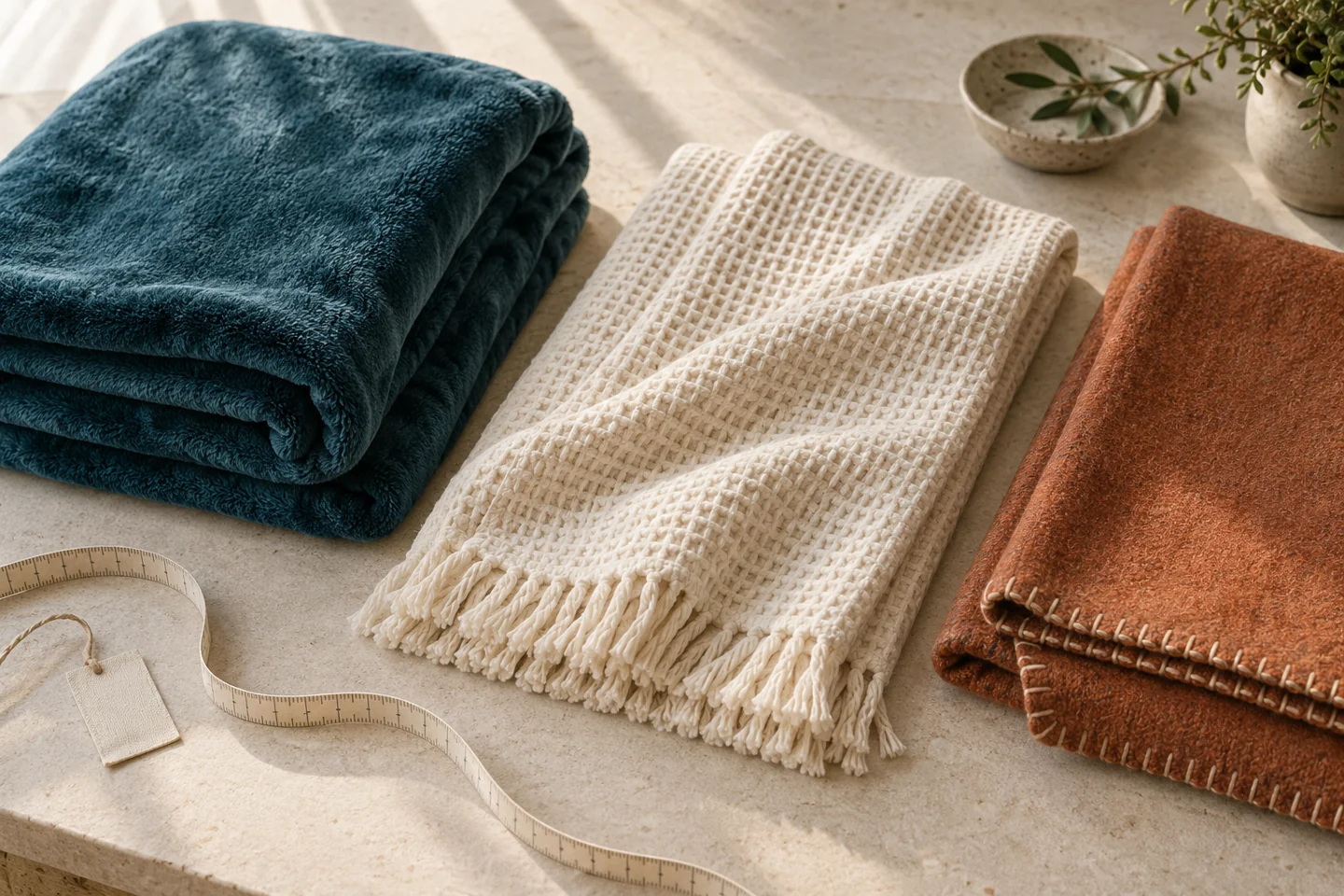
Fleece, cotton and wool should not be arranged automatically from budget to premium. Within any category, construction, finishing and the actual recipient’s preference matter. Ask for the full fiber composition, including the reverse face and trim when they differ. “Sherpa-style,” for example, describes an appearance; it is not enough information to establish the fiber content.
| Candidate construction | Why shortlist it | What to inspect on the exact sample |
|---|---|---|
| Plush or fleece-style throw | For recipients seeking a soft, pile-textured blanket | Both faces, loose fibers, edge finish, logo visibility and drying instructions |
| Cotton woven or knit throw | For a cotton preference or a particular woven aesthetic | Openness of construction, drape, snag-prone details and dimensional change after care |
| Wool blanket | For recipients who specifically value wool and accept its care routine | Skin feel, weight, trim and the exact washing or cleaning method |
| Two-layer or mixed-fiber blanket | When contrasting textures are part of the appeal | Composition of both layers, joining seams, bulk and instructions for the whole assembly |
These are evaluation prompts, not claims that every material exhibits a particular defect. Do not promise “non-shedding,” “hypoallergenic” or “pill-proof” from a category name. Ask what evidence supports any claim you plan to repeat.
If a supplier quotes GSM, record what it measures: one fabric layer, both layers, or another defined component. GSM means grams per square meter; it does not by itself measure warmth or finished quality. Two blankets with different areas or layered constructions are not comparable simply because one GSM number is higher. Request the finished item weight and packed dimensions separately.
4. Make laundry requirements a buying criterion
“Machine washable” is only part of the answer. Drying can determine whether an item is convenient in a small apartment, shared laundry room or busy household. Read the current product instructions and the sewn label, then obtain confirmation that the decoration does not require a different routine.
Wool is not automatically dry-clean-only. Pendleton’s Eco-Wise Wool Solid Blanket currently lists 100% virgin wool, a separate cold gentle machine wash and line drying. That example also shows why an old catalog or remembered instruction is not sufficient: approve the instructions supplied for the actual item being ordered.
Have a decorated sample washed and dried exactly as directed before a substantial rollout. Record its dimensions and take consistent before-and-after photographs of edges, both faces and the logo. Check whether the gift still looks and feels acceptable. A small purchasing sample is not a laboratory durability certification, but it can expose an obvious mismatch between your expectations and the finished item.
If the product page and supplied label conflict, stop approval and ask the manufacturer or authorized supplier to resolve the discrepancy. Do not invent a compromise care instruction. Include the confirmed guidance with the gift and on the store page so recipients can evaluate the maintenance commitment before selecting it.
5. Approve the reverse side of the logo, too
A blanket touches people on both sides. A logo that looks crisp in a digital proof may have backing, visible stitching or a stiff patch on the reverse that the buyer has never seen. Ask for a finished sample of the proposed decoration on the actual construction, not just a logo preview floating over a product photograph.
- Placement: approve the distance from the edges and the orientation when the blanket is unfolded.
- Feel: inspect the back of the decorated area and any backing that remains.
- Legibility: view small lettering on the real surface, particularly where pile may obscure detail.
- Drape: fold and use the blanket to see whether the decorated section behaves acceptably.
- Presentation: check how the logo appears when packed without sacrificing comfort in normal use.
A small corner mark may suit a home gift better than a large central logo, but that is a design choice, not a universal rule. For an anniversary campaign, put the occasion on a removable card if you want the blanket itself to remain visually useful after the celebration. If permanent names are proposed, use the separate employee-name personalization decision guide before adding recipient-specific production.
6. Match textile claims to documented scope
When a supplier offers a certified option, request the exact label or certificate number and the covered article description. OEKO-TEX STANDARD 100 concerns testing textiles for harmful substances. Its official Label Check lets buyers check a supplied number. Ask whether the evidence applies to the finished decorated blanket, rather than assuming a base textile’s documentation covers every later addition.
Do not turn that label into a claim of organic content, recycled percentage or superior laundering performance. Those are different questions. Likewise, “recycled blanket” is incomplete purchasing information: request the percentage, material and component to which the statement applies. Our recycled-content evidence guide explains how to keep those statements specific.
7. Compare the delivered gift, not the undecorated unit
Request comparable quotes for the same size, decoration, recipient count, destination mix and delivery requirement. Include setup, sample approval, packaging, individual fulfillment, shipping and any applicable taxes or duties. All supplier pricing is quote-needed; a retail product page is not a corporate decorated-order quote.
A larger blanket can change packaging requirements. Ask for the actual packed dimensions and shipment quote instead of calculating freight from fabric weight alone. If adding a rigid gift box, compare that finished package with a simpler protective pack. Presentation should earn its cost and storage footprint rather than enter the order by default.
On-demand can fit an ongoing store when demand is uncertain and the exact blanket supports that production method. Bulk can be a better operational fit for a confirmed cohort receiving the same approved design together. A hybrid can combine a scheduled batch with a separately agreed replenishment route. Compare minimums, consistency and lead times for each; do not assume any method is always cheaper or available for every blanket.
8. Use a release card that exposes missing decisions
Copy the following record into the purchasing brief. An unresolved field should trigger a decision, not an undocumented supplier assumption.
| Approval field | Record before release |
|---|---|
| Purpose and audience | Adult personal-use scenario; blanket and non-blanket choices offered |
| Product identity | Manufacturer, exact style, color, dimensions and full composition |
| Care | Confirmed washing and drying instructions for the decorated item |
| Artwork | Method, size, placement, reverse-side finish and approved sample reference |
| Evidence | Any claim wording, supporting document and applicable product scope |
| Commercial terms | Delivered quote, quantity rule, timing and defect/remake process |
| Release owner | Named approver, approval date and rule for substitutions |
Hypothetical decision: an employer is choosing between a compact plush throw and a larger woven blanket for home use. The compact option looks attractive folded but does not meet the agreed coverage brief. The larger option fits, but its drying requirements may not suit every recipient. The answer is not to hide either limitation: publish dimensions and care, offer a suitable alternative and order only after the decorated sample passes. This is an illustrative purchasing scenario, not a Brand Sauce client result.
Use employee-choice gifting to avoid making a home-textile preference mandatory. Two carefully described choices can be more useful than several nearly identical blankets that differ only in color.
Frequently asked questions
What size blanket is best for employee gifts?
There is no universal size. Define whether the item is a lap blanket, couch throw or bed layer, then approve its actual dimensions against that use. Show measurements to recipients rather than relying on “large.”
Is fleece better than wool for company gifts?
Neither is automatically better. Compare the exact products for feel, care, coverage, decoration and delivered cost. Wool can be appropriate for a recipient who wants it; plush fleece can be appropriate for someone who prefers that texture. Preserve a meaningful choice.
Can every blanket be embroidered?
Do not assume so. Ask the decorator to confirm suitability for the construction and artwork, and inspect the finished front and reverse. A manufacturer’s retail personalization option does not establish another supplier’s company-logo capabilities.
Should we buy blankets without employee selection?
A confirmed group that has expressed interest may suit a single-item order. For a diverse workforce with unknown preferences, make the blanket optional when feasible. The goal is a useful gift, not simply a product that avoids apparel sizing.