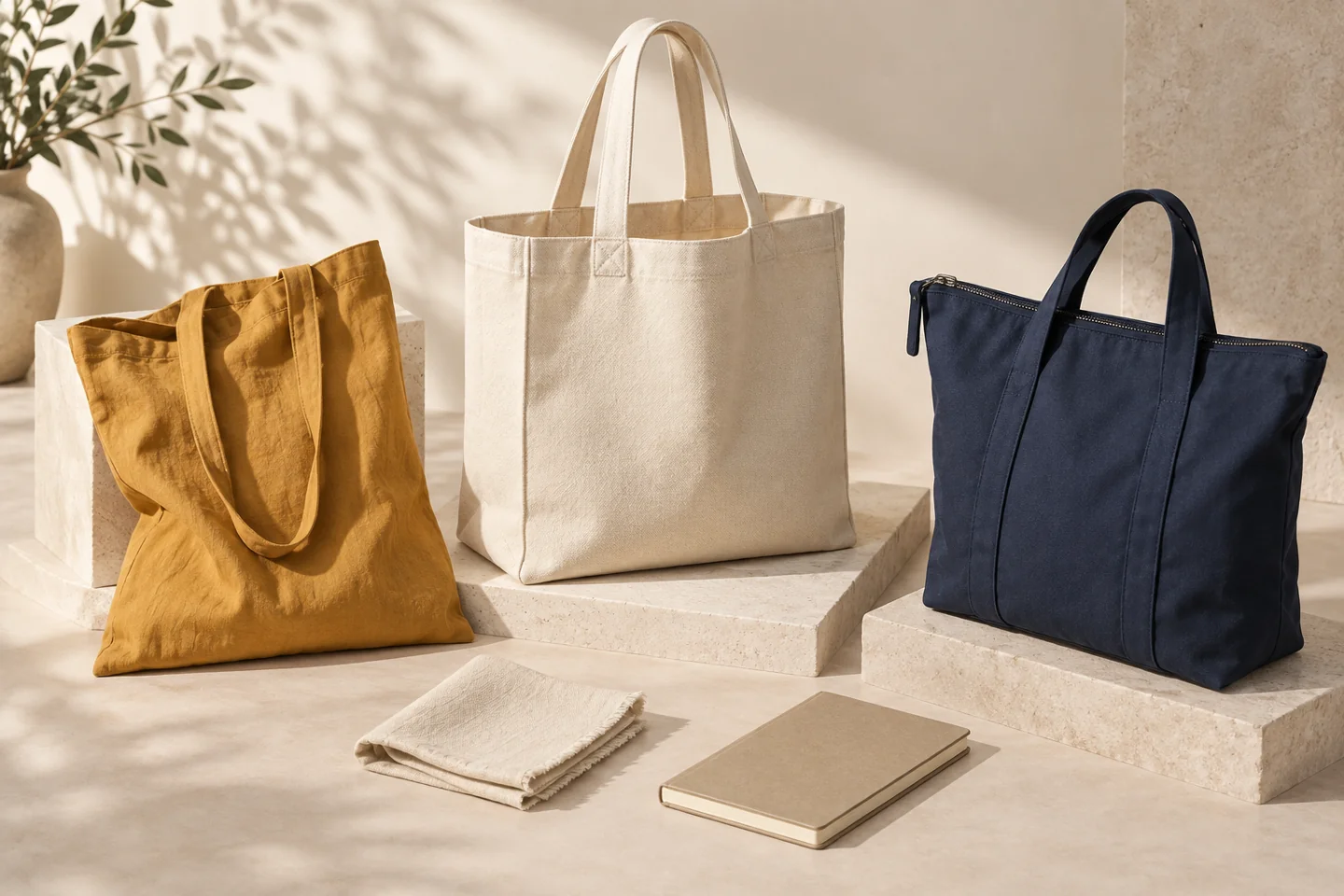
Choose a company tote by what it needs to carry, how people will carry it and how the finished bag is constructed—not by fabric weight alone. A lightweight flat tote may be right for a conference notebook. A gusseted shopper can make more sense for everyday errands. A commuting bag needs closer attention to closure, organization and device protection.
The best starting point is a realistic contents list and a physical sample. “Heavy canvas” does not tell you whether the handles fit over a coat, the opening accommodates a lunch container or the logo can be applied without stitching a pocket shut.
This is Brand Sauce’s editorial buying framework, not a laboratory comparison or a claim that every example is available through our stores. Manufacturer examples illustrate how to read specifications; confirm current stock, decoration options and destination eligibility before offering a particular bag.
Start with the job, not the tote category
Write one sentence describing the main use: “Carry a notebook and a few handouts around a conference,” or “Carry lunch, a water bottle and personal items between home and the office.” Those are different briefs even if both teams ask for a branded tote.
For an employee-choice collection, do not assume everyone needs another bag. Offer a tote because it fills an identifiable gap in the range. Our company-store product-curation guide explains how to build a collection around useful roles rather than near-duplicate products.
| Primary job | Starting specification | Check before approving |
|---|---|---|
| Light event handouts | Simple flat tote with comfortable handles | Actual folder fit, print clarity and carrying comfort |
| Lunch and everyday errands | Gusseted base with room for bulky contents | Base width, loaded shape and cleaning instructions |
| Office commuting | Closure, practical pockets and suitable shoulder carry | Opening clearance, device compartment and loaded comfort |
| Recognition gift | Refined construction and a restrained decoration treatment | Finishing, useful organization and recipient preference |
| Packable backup bag | Low bulk and an easy folding arrangement | Whether people can refold and store it conveniently |
These are starting points, not universal quality rankings. A substantial structured bag can be inconvenient for someone who needs an emergency bag that fits inside another bag. A simple flat tote can be an excellent answer to a deliberately modest job.
Read fabric weight without turning it into a strength rating
Fabric weight describes material, not the maximum load of the finished tote. When a specification uses grams per square meter (GSM) or ounces per square yard, it is describing mass per area. It is not the empty bag’s weight, and it is not permission to carry that number of pounds. If a listing says only “ounces,” ask the supplier to confirm the measurement basis before comparing products.
For a concrete example, SanMar’s Port Authority BG428 specification lists 12-ounce cotton canvas, cotton web handles, stitched side seams and dimensions of 12.5 inches high by 14.5 inches wide by 4 inches deep. Notice how much useful information sits outside the fabric-weight figure. The listed fabric alone does not answer how the bag will feel on a shoulder or how its opening will behave around a box.
Compare like with like. A heavier fabric can be a reason to request a sample, but it is not enough to award a winner. Handle attachment, seam construction, base design, finish and the intended load all deserve separate inspection. If a supplier provides a load claim, request the conditions and the exact model covered; do not transfer it to another tote that happens to use a similar cloth.
For your purchasing worksheet, keep separate fields for material composition, stated fabric weight and units, empty finished-bag weight, and any documented carrying limit. Leave unknown fields marked “not supplied.” Filling a missing specification with an assumption makes the shortlist look more certain than it is.
Measure the opening, the base and the handle drop
A gusset adds depth through the bag’s construction. That can help accommodate lunch boxes, groceries or other three-dimensional contents, but a gusseted bag does not automatically stand upright when empty. A photograph may show a filled or supported bag. Ask to see the sample empty and loaded.
Record height, width and depth in the supplier’s stated order. Then check where the width is measured: the top opening and the base may differ. A zipper can also reduce usable entry space. External dimensions should not be treated as guaranteed internal clearance.
Use a simple fit check. Place the actual notebook, lunch container and filled bottle you expect people to carry into the sample. Close the bag if it has a closure. Check whether the contents sit naturally, whether the opening needs to be stretched and whether the handles pull the mouth into an awkward shape. A cardboard stand-in is useful for preliminary sizing, but it cannot reveal loaded balance.
Handle length and handle drop are different measurements. The total strap length does not directly describe the clearance between the top of the bag and the top of the handle. Ask for the drop, then try the bag over the clothing people are likely to wear. Do not use one person’s shoulder fit as a universal answer.
If a laptop is part of the brief, verify the actual device and sleeve against the usable compartment and opening. A tote large enough to contain a laptop is not necessarily designed to protect it. For a more device-focused decision, see our guide to employee backpacks and laptop fit.
Inspect the construction before choosing the logo size
Turn the sample inside out where its construction allows. Look at the handle attachment points, seam finishing, lining and pocket edges. Check for loose threads, skipped stitches, rough surfaces and uneven assembly. These observations are screening criteria, not a certified durability test.
Next, map the decoration area onto the actual bag. Handles that run down the front, an exterior pocket, a zipper or a lining can limit access. A large uninterrupted-looking panel in a product photograph may not be an equally large usable print or embroidery area.
Send the decorator the exact style, color and artwork. Ask which methods are supported, what area is usable, and whether a decorated sample is needed. Confirm that decoration will not close a pocket, interfere with a zipper or place uncomfortable backing against the contents. Do not assume a method approved for one cotton tote will produce the same result on every other fabric or finish.
Approve both the logo’s appearance and the bag’s function. Open every pocket and work every closure on the decorated sample. View the mark when the bag is flat and when it is carrying the intended contents; folds can change how artwork reads. A restrained mark that stays legible in use can be more successful than a larger mark chosen only to fill the maximum print area.
Treat care and environmental language as product-specific
Do not turn “cotton” into “machine washable.” L.L.Bean for Business lists spot cleaning for its 1944 Boat and Tote, despite its substantial cotton-canvas construction. That is a useful reminder to read the exact product instructions rather than borrow care advice from a different cotton item.
Obtain care guidance for the finished, decorated bag. If the blank-product instructions and the decorator’s instructions differ, resolve that before launch. Publish an accurate care summary alongside the store listing so the recipient does not have to guess. A bag that is inconvenient to clean may still be right for a particular use, but that tradeoff should be visible.
Environmental claims need the same specificity. The FTC’s Green Guides summary cautions against broad, unqualified environmental-benefit claims and explains that partial recycled-content claims need qualification. A supplier’s stated recycled percentage should not become an unsupported claim that the whole finished bag is environmentally superior.
Ask what the percentage covers: the main fabric, the entire bag or the packaging. Retain the supporting documentation and use the supported scope in your copy. Reusability is a design intention, not proof that a recipient will repeatedly use a bag or that the program achieves a measured environmental reduction. For this guide, we make no lifecycle comparison between materials or fulfillment models.
Use a sample scorecard with pass-or-fail requirements
Shortlist two or three candidates, then evaluate them using the same contents and sequence. Define nonnegotiable requirements first. If a lunch container must fit flat, a beautiful bag that fails that check should not win because its color earns extra points.
| Check | Practical procedure | Record |
|---|---|---|
| Contents fit | Load the agreed items and operate the closure | Pass/fail; any awkward fit |
| Carry comfort | Try hand and shoulder carry as appropriate | Handle clearance, pressure and slipping |
| Access | Retrieve the notebook, keys and bottle | What requires unpacking other items |
| Construction | Inspect seams, attachments, lining and base | Visible issues and questions for the supplier |
| Decoration | Inspect the finished sample flat and loaded | Legibility, placement and pocket function |
| Care | Review the confirmed finished-item instructions | Whether they suit the intended use |
| Delivery readiness | Confirm SKU, color, method, quantity and destination | Quoted terms and unresolved exceptions |
Keep the assessment practical and within the manufacturer’s guidance. Do not improvise a destructive overload test and turn the result into a public capacity rating. For everyday comfort feedback, invite a small range of intended users and record their observations without presenting that group as a statistically representative study.
Photograph the approved sample, retain its identifier and write down the artwork revision. Keep one reference sample when feasible. If the supplier proposes a substitute later, recheck the failed-or-critical dimensions and construction details rather than approving it because the color and general silhouette look similar.
Choose bulk, on-demand or hybrid after the product is qualified
Bulk can be the sensible choice for a known event count, one design and one delivery point. Ask for a complete decorated quote, including setup, packaging, freight and any distribution work. A lower unit price is useful only if the purchased quantity serves the program.
On-demand is worth evaluating when recipients choose over time, demand is uncertain or the collection must avoid pre-buying a finished bag for every eligible employee. Confirm that the exact tote and decoration combination supports the required order quantity. On-demand does not automatically mean every construction, finish, color or destination is supported.
A hybrid program can separate predictable event demand from ongoing employee choice: batch the event bags, while keeping a qualified tote option in the employee store. That approach also permits different products for different jobs rather than forcing a single bag into both roles.
Here is an illustrative quantity calculation, not a forecast or customer result: a team expecting 180 attendees chooses to purchase 200 event bags, creating a 20-bag planned reserve. If only 150 bags are handed out, 50 remain. Record the reserve policy and a credible later use before ordering; do not describe all 200 as successfully distributed. Compare ordering models using actual quoted costs and realistic quantities, as outlined in our on-demand versus bulk swag guide.
Company tote buying FAQs
Is a heavier canvas tote always better?
No. Fabric weight does not settle fit, handle comfort, construction quality or suitability. A heavier bag may be appealing for structured everyday carry, while a lighter, more compact bag may better serve a packable-backup role. Evaluate the whole sample against its job.
Does a gusset tell me how much weight a bag can hold?
No. It describes depth in the construction, not a carrying-load rating. Confirm the intended contents, check manufacturer guidance and request documentation for any stated load claim.
Should every employee get the same tote?
Not necessarily. A uniform event handout can simplify distribution, but an employee gift collection can let people choose a bag only if they will use it. Keep the choice set manageable and explain each option’s practical differences.
Can we order the same design one bag at a time?
Possibly, but the answer depends on the specific product, decoration method and supplier workflow. Verify the minimum for the finished combination, not just the blank bag. Ask about repeat-order setup, available colors and individual-shipment costs.
What should be in the final approval record?
Include the SKU and color, dimensions and handle drop, material specifications, approved artwork and placement, sample reference, care instructions, supported product claims, quote scope and substitution rule. That record gives the next person a repeatable purchasing decision instead of a folder of attractive tote photos.
Primary product and guidance sources checked September 26, 2026. Hero image is a custom conceptual illustration, not a photograph of the cited products. Sample procedures are editorial recommendations; no hands-on product results are claimed.