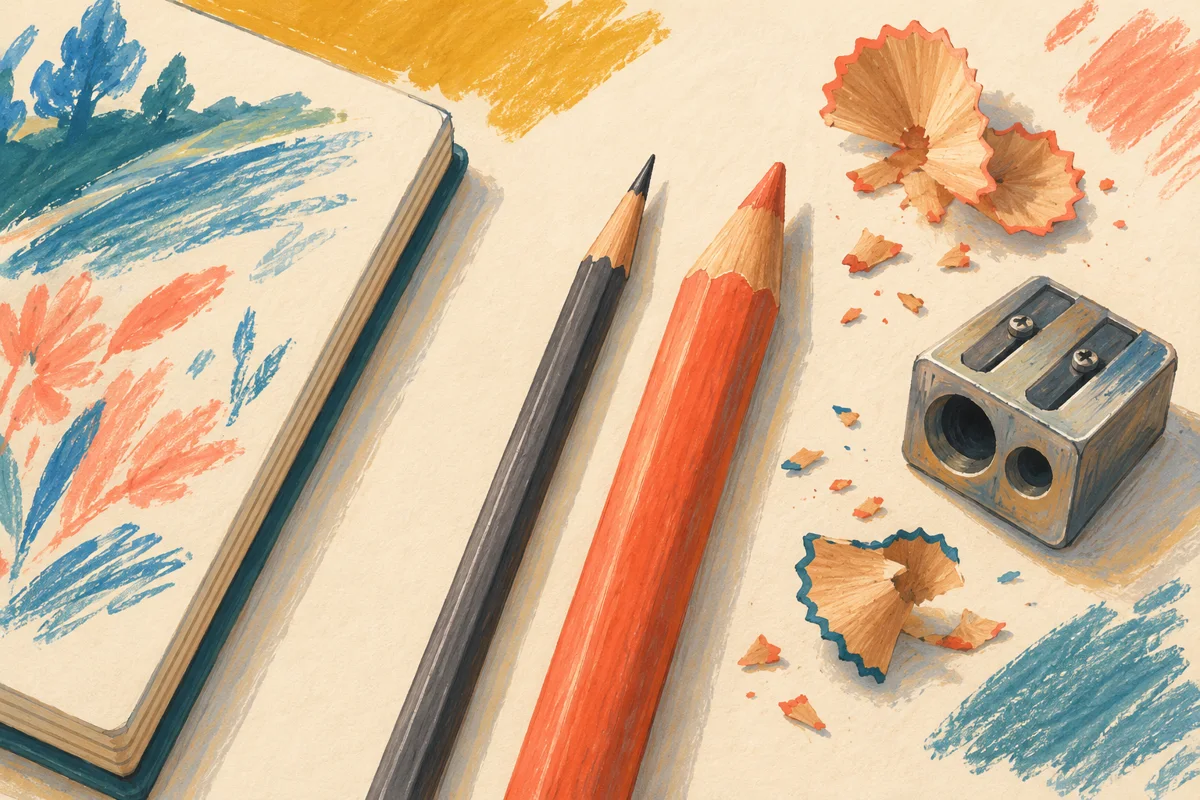
Choose the sharpener after choosing the pencils, and approve them as a pair. “Standard,” “jumbo” and “double-hole” are not enough to guarantee that a sharpener will handle every pencil in a workshop kit. Check the pencil’s outside barrel size, its shape and the kind of point the activity needs.
For an adult museum sketching session or a community arts welcome pack, this small check prevents an awkward handout: a handsome pencil that participants cannot sharpen with the accessory beside it. It also answers a useful purchasing question—whether every kit needs the same sharpener or different pencil sets need different accessories.
Read the barrel measurement, not the core measurement
The graphite or colored core is inside the wood. Its diameter does not tell you whether the complete pencil fits a sharpener. Ask for the outside barrel specification and the supported pencil shapes. For triangular or unusual profiles, get the supplier’s compatibility confirmation for the exact pencil model; do not treat a measurement across one flat face as proof of fit.
Two current manufacturer examples show why the specification matters:
- STAEDTLER’s 512 001 BK double-hole tub sharpener specifies one opening for standard graphite pencils up to 8.2 mm, with a 23-degree sharpening angle, and another for thick graphite and colored pencils up to 10.2 mm, with a 30-degree angle.
- Faber-Castell’s FC183400 standard/jumbo metal sharpener is described for graphite and colored pencils, with a maximum diameter of 10 mm. Its US page showed sold out when checked.
These are examples of published compatibility information, not a Brand Sauce product shortlist or a claim that either model is available for your order. A pencil described only as “jumbo” still needs checking against the chosen model. Neither page establishes universal compatibility with every oversized pencil.
Choose the point for the activity
A larger opening is not simply a more generous version of the smaller one. As the STAEDTLER example shows, the sharpening angle can differ too. Ask the workshop leader to make the actual marks the session requires: fine outlines, broad shading or colored-pencil fills. A pencil that enters the opening but produces an unsuitable point has not passed the buying check.
Keep this decision separate from graphite hardness. Our HB-versus-2B workshop pencil guide addresses the mark-making choice; the sharpener check makes sure that chosen pencil remains usable after its first point wears down.
A five-step paired-sample approval
- Freeze the pair. Record pencil model, barrel profile and outside size, plus the exact sharpener model and intended opening. If the pencils will be decorated, use a finished sample rather than assuming an undecorated sample covers every change.
- Check entry without forcing it. Following the manufacturer’s directions, confirm that the pencil can be inserted and turned normally. Stop if it binds or requires scraping off the finish. An almost-fitting pencil is not an approved match.
- Make a usable point. Sharpen a sample of each pencil type in the set, then draw on the intended workshop paper. Note repeated breakage, uneven wood removal or a point that does not suit the exercise. Investigate the pencil and sharpener together; do not automatically blame the blade.
- Rehearse the cleanup. If people will sharpen at their seats, check how shavings are contained and how the container opens and closes. An open metal sharpener may be fine at a shared sharpening station but inconvenient in a take-home pouch without a cleanup plan.
- Pack and reopen the kit. Confirm that the sharpener stays accessible, the container stays closed during ordinary handling, and participants can identify the correct opening. Keep an approved pair as the reference for incoming goods.
This is a proposed buyer acceptance check, not a report of Brand Sauce product testing. It does not establish blade life or certify a kit for children. If the audience includes children, confirm the exact products’ age guidance and your program’s supervision requirements separately.
Use this release-or-hold decision
- Fits and makes the required marks: approve that named pair, subject to the remaining packing and delivery checks.
- Does not fit: change the sharpener or pencil model, then repeat the paired check. Do not solve a diameter mismatch by asking participants to push harder.
- Fits but makes the wrong point: request a suitable sharpening geometry or a manufacturer-recommended alternative.
- Works but spills in the intended setting: choose a tested container version or move sharpening to a staffed/shared station with a waste receptacle.
- Supplier substitutes either item: reopen approval. Matching colors or the same “jumbo” label does not preserve compatibility.
Illustrative example: an arts center plans 30 take-home kits containing a standard graphite pencil and a thick colored pencil. The buyer approves both pencils against one two-hole sharpener and marks the intended opening on the kit’s instruction card. If the thick pencil changes before packing, the buyer holds that variant until the replacement pair passes—not all 30 kits after they have already been distributed.
Copy this into the supplier brief
Please confirm the exact pencil and sharpener model numbers, supported outside barrel sizes and shapes, and which opening is intended for each pencil. Supply paired samples for approval before the full order. Confirm any container/closure, decoration limits, destination-country availability, quantities and delivery timing. Do not substitute either model without renewed compatibility approval. Price: quote needed.
When the kit also includes a notebook, check the working surface separately using our notebook paper and binding guide. A well-matched pencil, sharpener and page make a complete workshop tool; a matching color scheme alone does not.
AI-created editorial illustration; not a product photograph or test result. Manufacturer specifications checked October 26, 2026.