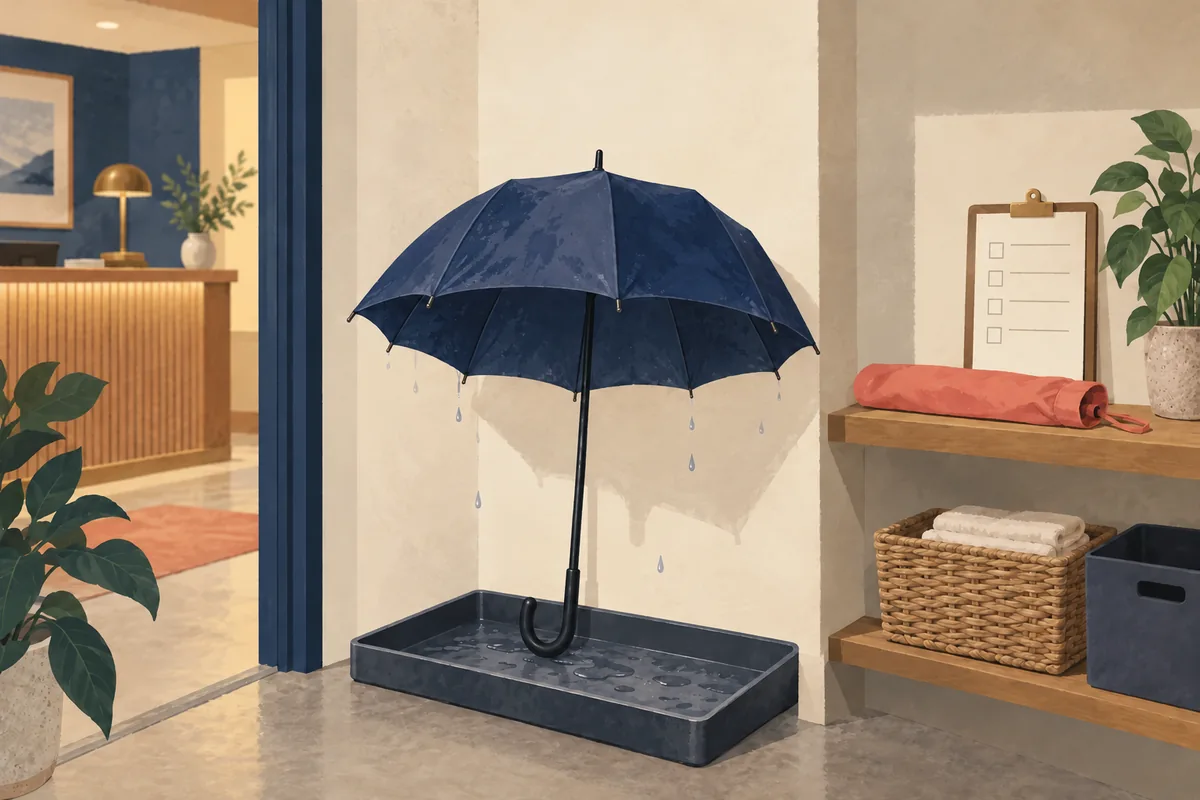
Let a wet branded umbrella dry before returning it to its normal storage sleeve. At a hotel guest desk or office reception, a neat row of tightly wrapped umbrellas can hide the fact that the last borrower brought them back wet. Make drying a separate step from putting stock away.
There is an important exception: a purpose-built wet-umbrella case may be designed for temporary transport. That is a different job from storing an umbrella between uses. Check the instructions for both the umbrella and the case; do not assume an ordinary fabric sleeve has a moisture barrier.
What the manufacturers actually say
BLUNT’s care guidance says to dry its umbrellas completely after rain to reduce the chance of mildew and staining. Its preferred method is a fully open canopy in a dry area. Where space is limited, it also permits standing the umbrella handle-up with the canopy tie released. Treat that second method as BLUNT’s advice for its products, not a universal instruction for every folding mechanism.
Knirps likewise instructs owners to leave an umbrella open until dry after use, then return it to its protective cover. Neither instruction gives a universal drying time. A shift change or a fixed number of minutes is not evidence that the fabric is ready to wrap.
For the transport exception, Knirps describes its X4U Dry Case as using absorbent microfiber to protect bag contents from a wet umbrella. That feature does not override the company’s drying guidance. It also does not establish that a different promotional sleeve does the same thing. These are care references, not a Brand Sauce catalog shortlist or confirmation of decorated stock.
A three-state return check for the front desk
Use this simple decision aid beside the return point. It is an editorial workflow suggestion, not a manufacturer test or a hygiene certification.
- Wet or uncertain → drying area. Keep the umbrella out of the ready-to-lend supply. Release the tie and arrange it according to that model’s care instructions. Use an area away from guest circulation and equipment, with drips contained. Do not spread open canopies across an exit or walkway.
- Dry and working → ready storage. Check the folds as well as the exposed outer panel, and make sure a damp sleeve is not going straight back on. Close and fasten the umbrella using its intended mechanism; never force a resistant frame. Store it in the dry cover or designated ready rack.
- Damaged, persistently stained or questionable → review. Separate it from lending stock. Follow the supplier’s cleaning or repair guidance instead of concealing the problem in a sleeve. Drying is not disinfection.
For a small desk, two clearly separated locations—“drying” and “ready”—are more useful than one attractive umbrella stand where the states are mixed. Add a separate review location only when needed. Assign the readiness check to a role on each shift so that the person receiving the return does not have to remember every umbrella later.
Copy this care-card brief into your order
Umbrella care-card approval
Exact umbrella model and supplier: ______
Manufacturer care instructions, link and date checked: ______
Approved drying position: ______
Included sleeve: ordinary dry-storage cover / specifically rated wet-carry case / unresolved
Case drying and cleaning instructions: ______
Decoration-compatible cleaning method confirmed by: ______
On-site drying location and drip control: ______
Role responsible for moving dry umbrellas to ready storage: ______
Damaged-item review contact: ______
For a recipient gift rather than a loan umbrella, shorten the insert to a useful reminder: “After rain, dry your umbrella following its care instructions before storing it in its sleeve.” Include the exact model’s care link. If a special case is supplied, add its instructions rather than presenting wet storage as a general feature.
Check the care plan before approving the logo
Ask the decorator whether the approved cleaning method applies to the finished printed canopy. BLUNT recommends warm water and a clean cloth for its canopies and advises against chemical detergents, bristle brushes and machine washing. Do not automatically transfer that advice to another manufacturer—or improvise a cleaning chemical for a logo.
If reception cannot provide a suitable drying area, resolve that practical limitation before ordering shared umbrellas. When comparing samples, use the umbrella dimension guide to establish actual open space, not just the advertised canopy number. Then confirm the decoration area using production-ready logo files. A good artwork proof answers neither the storage question nor the care question.
Illustration: AI-generated editorial artwork, not a supplied product, customer location or drying-test result.