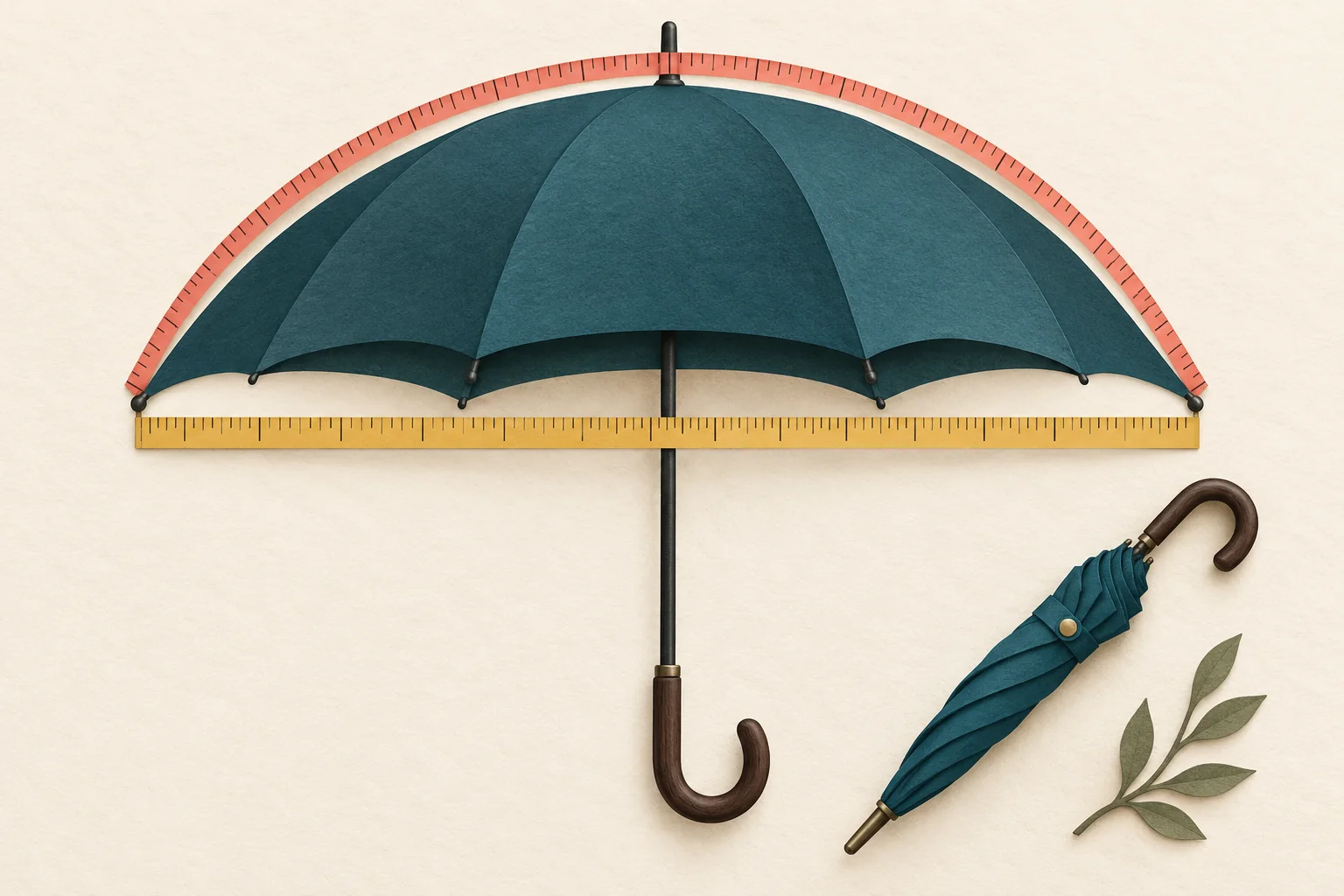
A “60-inch umbrella” is not necessarily 60 inches wide when open. That number may describe the arc over the curved canopy, rather than the straight distance underneath it. Before ordering branded umbrellas for a golf outing, hotel guest desk or employee gift, get the measurement name—not just the number.
Totes explains that its listed canopy sizes follow the arc, measured from one tip over the top to the opposite tip. That tells you how Totes labels its products; it is not permission to assume every supplier uses the same convention.
Separate the three dimensions that affect the purchase
- Canopy arc: the curved, tip-to-tip measurement over the open canopy. Useful for identifying a model, but not its straight open width.
- Open diameter: the straight span between opposite tips of the open umbrella. Ask for this when comparing the space beneath two canopies.
- Closed length: the end-to-end length when the umbrella is closed and any telescopic shaft is retracted. Use this to check carrying and storage fit.
The manufacturer’s HF Umbrella measurement guide distinguishes these from rib length and overall open length. Its key qualification is that frame and canopy shape affect the finished diameter. Do not turn an arc into a diameter by subtracting a fixed number of inches, or double a rib measurement and call that the open width.
A concrete manufacturer example: SHED RAIN lists its e-Motion golf umbrella with a 58-inch arc and a 41-inch closed length. Those figures describe different things. Neither states a 58-inch open diameter. This is a specification example, not a Brand Sauce product recommendation or confirmation of catalog availability.
Copy this quote-comparison worksheet
Make one copy for each proposed model. Keep missing information visible; a blank should not silently become an assumption.
Umbrella model and supplier item number: ______
Advertised size and units: ______
That size measures: arc / diameter / rib / other / not specified
Confirmed open diameter: ______
Confirmed closed length, including handle: ______
Packed length and widest packed section, including sleeve: ______
Weight: ______
Intended use: individual carry / shared guest use / event handout
Storage or bag opening and usable internal space: ______
Sample fit observations and reviewer: ______
Logo panel, printable area and proof reference: ______
Destination country, availability and decorated delivery date confirmed by: ______
Decorated price and shipping: quote needed / quote reference ______
Comparison rule: compare diameter with diameter for open span, and packed dimensions with usable storage space for carry fit. Keep arc in its own field. If one quote supplies only arc and another supplies diameter, request the missing measurement before ranking them by size.
A worked example: the bigger number loses the comparison
Invented dimensions for demonstration—not actual products or test results. A hotel is comparing two umbrellas for guests:
- Option A: advertised as 60 inches; supplier confirms that is arc, with a 50-inch open diameter and 38-inch closed length.
- Option B: advertised as 54 inches; supplier confirms that is open diameter, with a 36-inch closed length.
Option B has the greater confirmed open span: 54 inches versus 50. Sorting the two headline numbers would have produced the opposite conclusion. If the hotel’s storage compartment has only 37 inches of usable length, Option A also fails that length check. Option B remains a candidate, subject to its packed width, handle shape and a physical fit check.
The example does not prove that B keeps two people dry. It shows which measurements can support a purchasing decision and which claims still need a sample.
Check the use, not a universal “two-person” label
For a shared guest umbrella, have two people stand beneath the sample with the bags or outerwear they normally carry. Check whether the shaft position and grip are comfortable and whether the canopy is awkward around entrances. Treat this as a fit observation, not a rain-performance test: wind direction, how people hold the umbrella and movement change the experience.
For an employee commuter gift, check the actual bag opening and packed umbrella, not just whether one length is smaller than another. An umbrella can pass the length check and still have a handle or sleeve too bulky for the intended compartment. Our backpack fit guide uses the same practical principle: match dimensions to the real item and the real carrying arrangement.
For an event handout, decide how attendees will take it home before choosing a long stick model. Keep product-fit decisions separate from the plan for getting merchandise to the venue; a carton arriving successfully does not make its contents convenient to carry away.
Confirm the logo space separately
A larger canopy number does not specify a larger printable rectangle. Ask for the decoration template for the exact model, the permitted panel position and a proof at the intended artwork size. Use your production-ready logo files, but do not treat a logo proof as evidence of coverage, wind resistance or storage fit.
The useful order description is not “large branded umbrella.” It is an identified model with named measurements, an approved decoration area and a confirmed use. If a supplier cannot identify what its size number measures, leave that comparison unresolved until it can.
The hero is an AI-generated editorial illustration, not a measured product diagram, catalog item or test result. Specific models, decoration options, country availability and prices require confirmation.