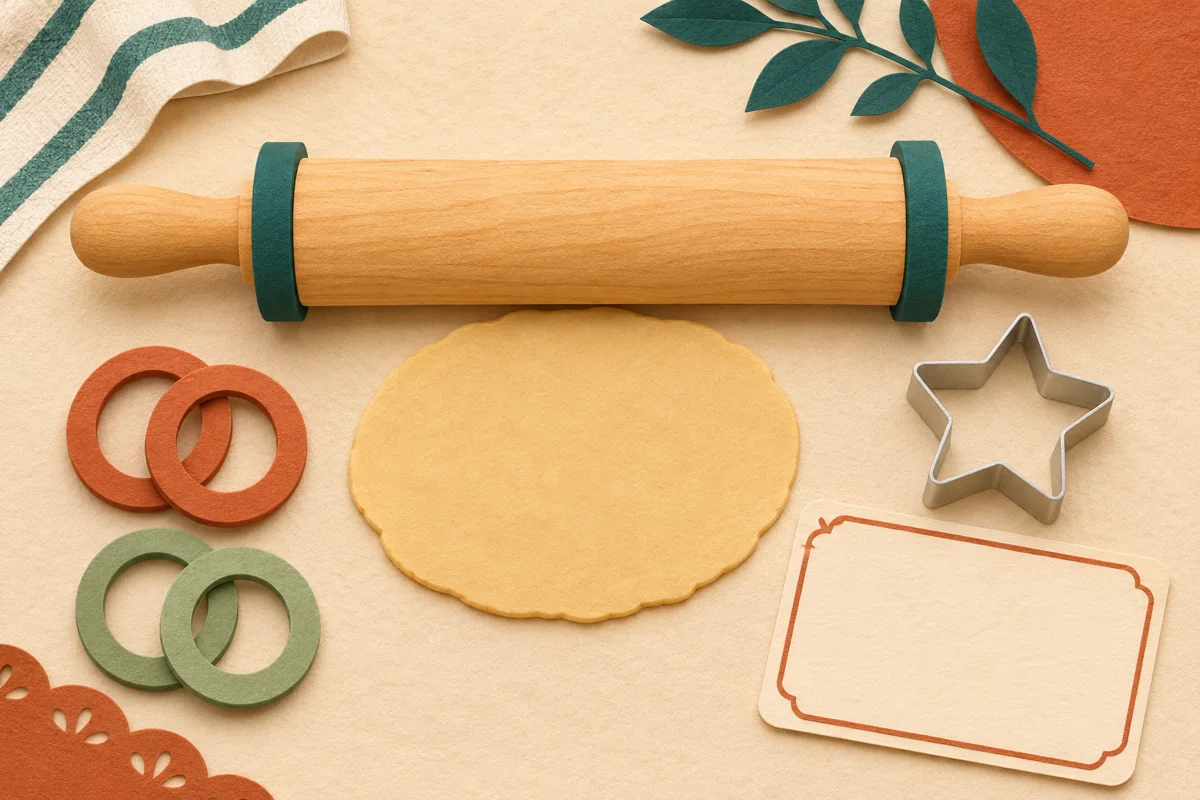
For a cookie-making workshop, buy the rolling pin around the recipe’s required dough thickness—not the number of colored rings in the box. Adjustable rings can make a useful take-home gift, but a set that skips the instructor’s target thickness may add an avoidable workaround to the class.
The question to settle before ordering is simple: can this exact pin, on the planned work surface, produce the sheet of dough the lesson needs?
Match the recipe before choosing the rings
Start with the instructor’s approved recipe and its stated rolling thickness. Keep the original units in the purchasing brief. One quarter inch is 6.35 mm; a ring labeled 6 mm is not an exact conversion. That small difference may be acceptable for the recipe, but the instructor—not a rounded product description—should make that decision.
For a concrete specification example, Joseph Joseph’s current PrecisionPin listing gives five approximate thickness settings: 2, 4, 6, 8 and 10 mm. It also allows use without rings. A recipe calling for 3 mm therefore has no directly matching setting in that listed set. Do not assume every “adjustable” pin includes every useful interval.
That example is a manufacturer specification, not a verified Brand Sauce catalog offer. Confirm the exact model, included ring pairs, destination-country supply, decoration options and delivery commitment with your supplier. Unconfirmed pricing stays quote-needed.
A thickness stop is not a dough-size guarantee
Rings limit how close the rolling barrel comes to the supporting surface. They do not promise that a given portion of dough will reach the diameter printed in a recipe.
King Arthur Baking’s rolling-pin comparison illustrates the distinction: its baker found a fixed quarter-inch pastry pin useful for evenly rolled cookie dough, but the same pin stopped a pie-dough round short of the desired diameter. That is King Arthur’s reported experience, not a Brand Sauce test, and it does not establish that all guided pins are unsuitable for pie.
For a single cookie lesson, a matching thickness stop can be a helpful teaching aid. For a workshop covering several pastry thicknesses, choose a verified range or a conventional pin the instructor is comfortable teaching with. For broad, free-form sheets, check the working barrel width as well as the thickness settings.
Run this one-recipe acceptance check
Before approving the gift batch, ask the instructor to run one sample through the actual lesson. This is a proposed purchasing check, not a product test we have performed.
- Identify the setting. Compare the ring markings and supplied parts with the approved recipe. Fit the matching pair according to the manufacturer’s instructions; do not rely on ring color across different brands.
- Recreate the station. Use the intended board or mat and the lesson’s parchment arrangement. Ensure both rings have a clear, level supporting path; one ring riding over a mat edge changes the setup.
- Roll the lesson portion. Check that the dough fits within the usable barrel span without the guide rings running onto it. If it does not, trial smaller portions or a wider pin before approving.
- Check the result. Have the instructor compare thickness at the middle and edges, cut the planned shapes and bake the sample using the lesson recipe. Record whether the finished result is acceptable; a ring label alone is not approval.
- Pack and reset. Confirm that participants can remove, identify and store the spare pairs, and that the cleanup instructions fit the venue.
For the PrecisionPin example, the manufacturer specifies hand washing for both rings and wooden pin, with no soaking and immediate drying. Do not turn a general “kitchen-tool gift” assumption into a dishwasher instruction. If the kit includes a mat, also check the mat’s fit inside the intended tray.
Use a recipe-to-tool release brief
- Lesson: recipe version, target thickness in original units and instructor-approved tolerance or alternative setting.
- Tool: exact model, included thickness pairs and usable barrel width.
- Station: board or mat, parchment setup and portion size.
- Sample decision: approved, approved with a specific adjustment, or rejected; instructor and date.
- Take-home contents: pin, complete ring pairs, storage provision and model-specific care card.
If the sample needs a workaround, put that adjustment on the lesson card before packing—not in an instructor’s memory. For a larger baking bundle, the same recipe-first approach applies to choosing dry and liquid measuring cups. A smaller kit that matches the class is more useful than a larger set whose settings never get used.
Image: AI-generated editorial illustration, not a product photograph or a demonstration of measured dough thickness.