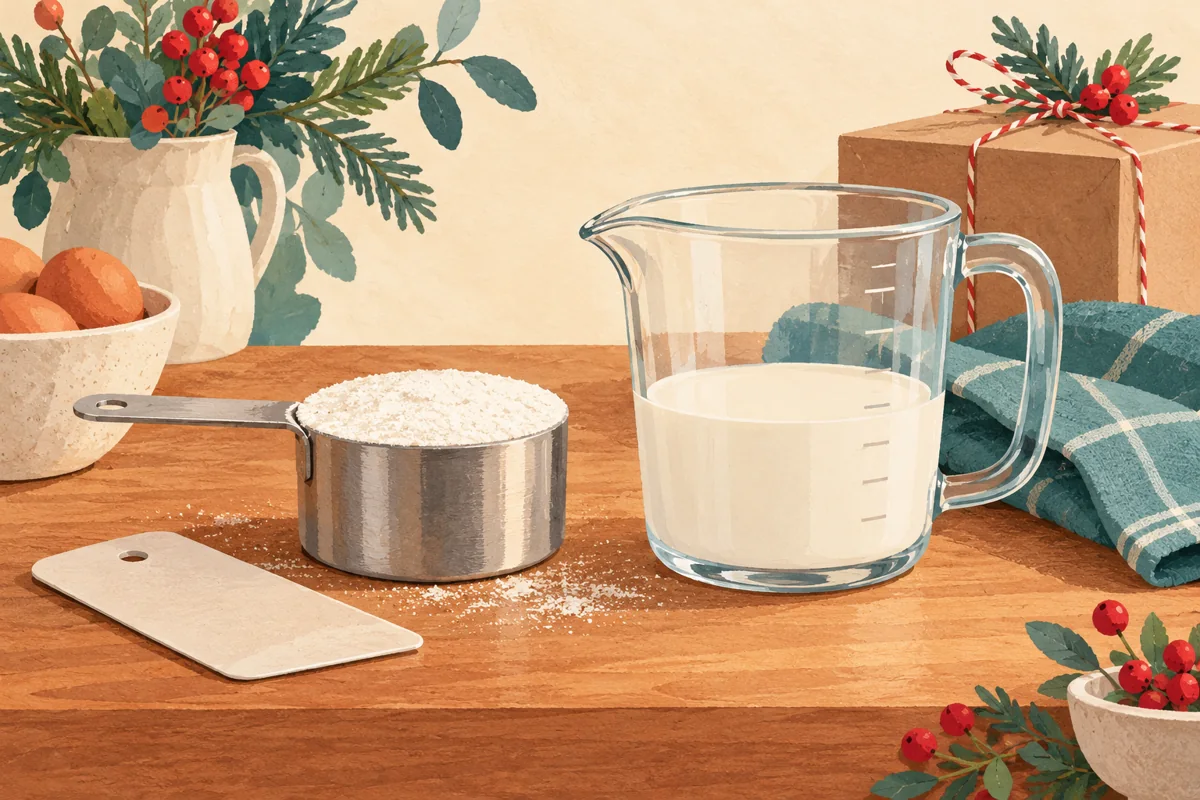
For a baking gift built around cup-based recipes, a nested dry-cup set and a liquid measuring jug do different jobs. Do not approve a “complete measuring set” from the number of pieces alone: six nested cups can still leave the recipient without a convenient way to measure milk.
For a community-center baking workshop or an employee holiday bake-along, start with the actual recipe. Buy the tools needed to measure its ingredients, rather than adding a decorative utensil bundle and hoping it covers the lesson.
One task needs a flat rim; the other needs a visible fill line
Dry measuring cups let the user fill to the rim and sweep away the excess. A liquid jug leaves space above its measurement line and has a pouring spout. OXO explains that the extra height makes a liquid cup unsuitable for leveling dry ingredients at the intended mark; a brim-full dry cup also makes transferring liquid awkward. Its measuring-cup guide recommends matching the tool to the ingredient, particularly for baking.
The useful distinction is not simply “wet food versus dry food.” King Arthur Baking’s dry and liquid cup guidance recommends a liquid measure for ingredients that settle to a level surface, such as milk or oil. It puts thick ingredients such as sour cream and peanut butter in the dry-cup category. For a conventional transparent liquid cup, read the bottom of the curved liquid surface at eye level on a level counter; for flour, use the recipe’s filling method and level the top rather than tamping it down.
Some designs have a different reading position: OXO describes angled cups that can be read from above. That is a model feature, not a reason to teach every jug the same way. Follow the supplied tool’s instructions.
Decide what belongs in the gift
- A hands-on class: list the recipe’s cup-based quantities and assign each one to a supplied tool. Check the smallest quantity as well as the largest; a large jug is not automatically a good tool for a small addition.
- A take-home baking kit: if the recipe needs both types, include both or clearly state what the recipient must already own. A gift should not quietly become a shopping list halfway through the recipe.
- An optional kitchen gift without a recipe: describe the contents precisely: dry cups, liquid jug, measuring spoons, or a combination. Avoid “everything you need” unless the intended task is defined.
- A recipe written in weights: consider whether a scale is the more useful gift. King Arthur prefers weighing for baking; our scale-capacity checklist covers the bowl and total load. Do not invent gram equivalents for a volume recipe.
Worked packing example: a workshop kit
Illustrative planning example, not a tested recipe: a community-center instructor’s approved recipe calls for 1½ cups of flour and ½ cup of milk, plus small spoon-measured additions. The packing team proposes four nested dry cups and a whisk.
The dry set may cover the flour in multiple fills, but the kit has no dedicated liquid measure or measuring spoons. The decision is to add an appropriate jug and the required spoons, or explicitly make those participant-supplied equipment. Ask the instructor to rehearse the recipe using the final contents before printing the insert. Adding more sizes of dry cup would not resolve the missing-tool problem.
Copy this recipe-to-box checklist
- Recipe owner and version: record the approved recipe and who can resolve measurement questions.
- Ingredient-to-tool map: beside every measured ingredient, write the supplied tool, quantity and number of fills. Flag anything missing.
- Legibility: inspect the sample’s units and fill marks in normal working light. Keep the logo away from measurement markings and confirm an approved decoration location.
- Technique: include a short instruction for leveling or reading the liquid line, as appropriate to the actual model. Preserve recipe-specific instructions such as packed or sifted.
- Unit match: confirm the tool and recipe use the same convention. For the related regional issue, see our recipe-card and measuring-spoon unit check.
- Pack-out: photograph the approved contents beside the insert; count tools by function, not just total pieces. Recheck the map if a supplier substitutes a set.
This is a buying brief, not a verified Brand Sauce catalog shortlist. Confirm exact SKU, decoration, care instructions and recipient-country availability before ordering; branded-order prices remain quote-needed. The manufacturer references explain measurement methods and do not establish Brand Sauce stock.
Primary sources checked October 30, 2026. AI-generated editorial illustration, not a product photograph or a test result.