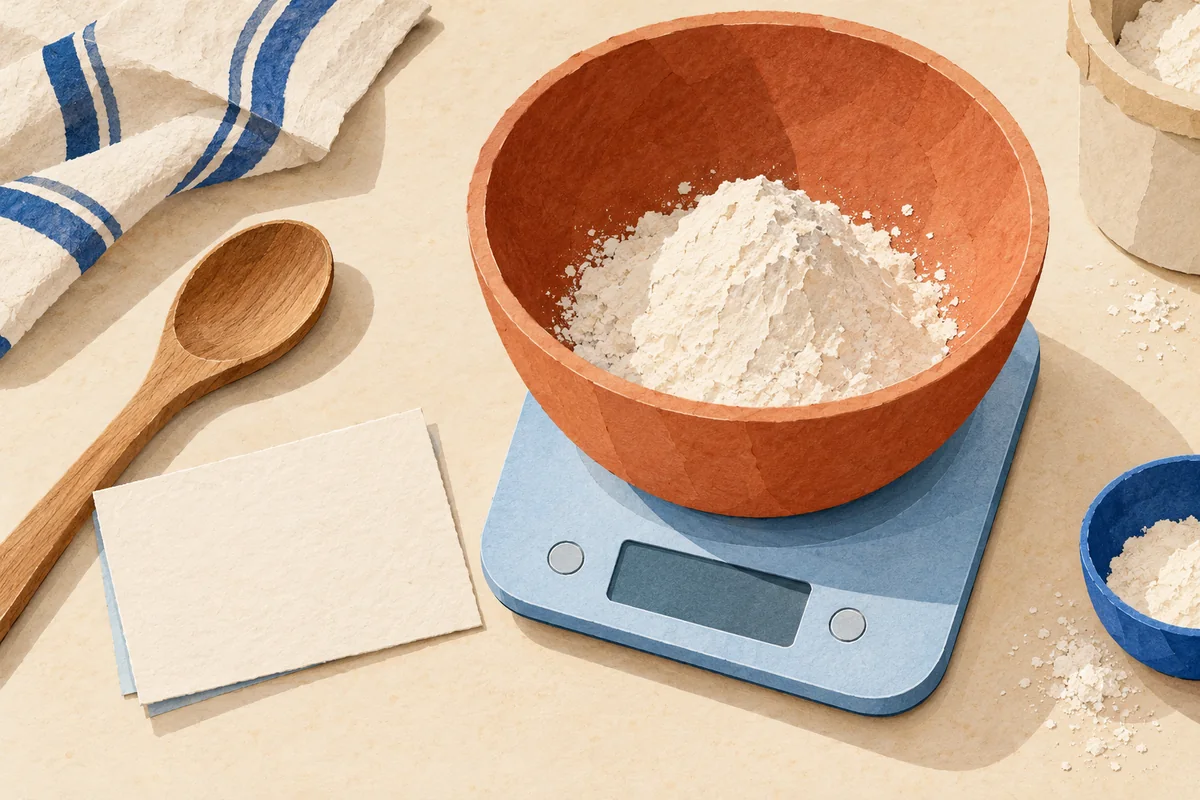
No: pressing tare hides weight from the reading; it does not remove the bowl from the scale. When choosing a kitchen scale for a cooking-class gift or employee baking kit, size the capacity for the container and everything that will remain in it, not just the next ingredient.
A heavy ceramic bowl can make an otherwise suitable gift awkward to use. Before comparing colors or deciding where the logo belongs, ask what recipients will actually put on the platform.
Zero on the display is not an empty platform
Tare lets the user add ingredients without doing subtraction each time. The bowl stays on the platform, and previously added ingredients stay there too. For a scale whose maximum is the total supported load, use this purchasing calculation:
Required load capacity = empty container + all ingredients on the scale at once.
Remaining load allowance = rated capacity − everything already on the platform.
OXO’s instructions for its 11 lb glass scale distinguish the zeroed ingredient reading from the used-capacity indicator. They allow successive additions only until maximum capacity is reached and direct users to remove excess weight immediately when the overload indication appears. Do not deliberately overload a sample to discover its limit.
Illustrative example—not a product test: suppose the selected model has a 5,000 g total-load limit. A 1,200 g bowl plus 2,500 g of ingredients uses 3,700 g, leaving 1,300 g before that limit. Pressing tare before adding another ingredient does not make 5,000 g available again. If the planned batch contains 4,000 g of ingredients, that same bowl would bring the total to 5,200 g: choose a suitable higher-capacity model, a lighter container or a smaller batch instead.
Confirm how the exact model specifies capacity and tare range. Do not assume every manufacturer’s advertised weighing capacity is expressed on the same basis, or treat the theoretical remaining allowance as a target to fill exactly.
Check the smallest measurement as well as the largest load
A scale can hold the whole bowl yet still be the wrong choice for tiny additions. Record both the maximum load and the displayed increment, then compare them with the recipe. The OXO 11 lb stainless-steel model, for example, lists 1 g metric increments and a pull-out display. Those are two different selection features: readable small changes and visibility around a large bowl.
A 1 g display increment is not itself a promise of accuracy within 1 g. If the workshop depends on small fractional-gram additions, request the model’s measurement specifications and choose equipment suited to that task; a general kitchen gift is not automatically the right measuring instrument.
These manufacturer references explain features, not a verified Brand Sauce product shortlist. Confirm the exact item’s customization, recipient-country availability and instructions before offering it. Branded-order pricing is quote-needed.
A five-minute bowl check before you approve the gift
Use this suggested acceptance checklist with the proposed sample and the actual class recipe. It is a buyer workflow, not a claim that Brand Sauce has tested a scale.
- Calculate the heaviest stage. Weigh the empty bowl and total the ingredients that will be present together. Include any accessory that remains supported by the scale. Compare that total with the documented load limit.
- Check the physical fit. Set the bowl down as instructed. It should sit stably without resting on the counter or another object. Confirm the display and controls remain accessible.
- Rehearse a normal addition. Select the recipe’s unit, tare the bowl and add a modest amount within the stated limit. Check that the intended user can read the display and operate tare without shifting the bowl.
- Check interruptions. Read the model’s standby and automatic-off instructions. Decide what the class should record before a long pause instead of assuming the current reading will remain available.
- Approve the handoff. Include model identification, power requirements, care instructions and the manufacturer’s manual. Keep decoration away from controls, labels and any surface the manufacturer does not approve for it.
If a recipe card also uses tablespoons or teaspoons, check its intended units with our measuring-spoon and recipe-card guide. Do not silently convert a volume-based recipe into grams without ingredient-specific information.
Put the purchasing decision on one card
Recipe or intended task: [name]
Exact scale model: [reference]
Capacity and whether it includes the container: [confirmed specification]
Empty bowl: [g]
Largest simultaneous ingredient load: [g]
Combined load: [g]
Smallest addition / required increment: [g / g]
Bowl fit and display access: [pass / change needed]
Decision: [approve / change bowl / reduce batch / choose another scale]
For an optional employee gift, use the gift-preference survey approach to establish whether recipients want kitchen equipment at all. For a cooking workshop, approve the bowl, recipe and scale together. A tare button makes measuring easier; it does not make an undersized scale bigger.
AI-generated editorial illustration, not a product photograph or test result. Manufacturer sources checked October 19, 2026.