Choose the wristband’s job before its material: a souvenir should be easy to wear again; a one-time admission credential should make removal or transfer evident. “Fabric wristband” does not settle that choice. The closure can turn a similar-looking band into either reusable merchandise or a cut-off event pass.
For a community fundraiser, conference social or company family day, write down what staff will actually do when they see the band. If the answer is “nothing—it is just a keepsake,” do not order an irreversible closure by default. If it grants entry, do not assume a freely removable bracelet proves that the wearer checked in.
Start with this three-way selection rule
- Souvenir only: specify a removable, reusable closure and confirm that recipients can adjust it themselves. Keep it visually distinct from admission credentials.
- Entry identification: specify a single-use, tamper-evident closure appropriate to the event’s duration. Pair it with a written issuing, inspection and replacement procedure.
- Both: decide whether guests are happy to keep a cut-off memento. If they expect to wear it again, separate the reusable gift from the admission check instead of asking one closure to do incompatible jobs.
This is a buying rule, not a security certification. Tamper evidence supports a staffed process; it does not establish identity, prevent every transfer attempt or replace ticket validation.
Ask about the closure—not just “cloth” or “paper”
ID&C’s US wristband guidance distinguishes fabric bands fitted with a sliding barrel lock, which must be cut off, from promotional versions with adjustable bead closures intended for reuse. The important specification is therefore the exact closure supplied with your order, not a photograph of a fabric band.
For an adhesive option, Wristband Resources’ Tab-Free Tyvek product page describes a tamper-resistant adhesive closure and recommends short-term use of up to two days. It also says numbering is sequential within a pack but is not guaranteed to continue sequentially across multiple packs. That distinction matters if you plan to record issued numbers: inspect each pack’s range rather than assuming one uninterrupted sequence.
These are manufacturer specification examples, not a verified Brand Sauce product shortlist. Confirm the chosen configuration, destination-country availability, customization and delivery date with the supplier. Branded pricing is quote-needed; a stock-band shipping claim is not a promise for a printed order.
A five-question approval checklist
- What does wearing the band authorize? Write one precise answer: general admission on Saturday, entry to a particular session, or no access rights. Put the date or access label in the proof where staff can read it.
- What happens when it comes off? Obtain a sample with the quoted closure. Follow its application and removal instructions. Confirm whether it is reusable, visibly damaged on removal or intended to be cut off. Do not ask guests to discover that at the entrance.
- Can staff recognize the right band? Check the finished sample under the actual entrance lighting. Use readable text or a distinct design alongside color; avoid making color the only distinction between admission types.
- What if someone cannot wear it? Agree on an alternative verification route with the event lead before ordering. Do not make an improvised, loosely fitted band the default exception. Our accessible gift-selection guide covers the broader principle of offering usable alternatives.
- Who can issue a replacement? Name the desk or person, the record they check and how they mark the replacement. Decide what happens to the original credential if your admission system tracks it. Keep spare admission bands with that team, not in the open giveaway pile.
Release the order only when the proof, closure sample and desk instructions agree. A beautiful proof cannot resolve an unspecified closure or an undefined replacement rule.
Worked example: a fundraiser with a souvenir table
Illustrative scenario, not a customer case study: a community fundraiser sells entry tickets and also offers a fabric bracelet that supporters can take home. People can buy the bracelet without attending.
Using that reusable bracelet as the entrance signal would create an obvious ambiguity: owning merchandise is not the same as holding a valid ticket. A cleaner setup is to validate tickets at check-in and issue the selected admission credential there. The souvenir stays at the merchandise table and carries a visibly different design. Staff instructions explicitly say that the souvenir does not grant entry.
If the organizer instead wants one fabric band to serve as both pass and keepsake, a single-use closure may fit—but the organizer should describe it as a memento guests remove after the event, not a bracelet designed for repeated wear.
Copy this into the order brief
Purpose: [souvenir / admission / both]. Valid event, day and access area: [details or none]. Closure: [exact supplier option]; removal and reuse expectation: [details]. Approved sample and artwork reference: [references]. Non-color identification cue: [text/design]. Alternative verification route: [process]. Replacement authority and record: [owner/process]. Quantities: [expected issues + separately stated replacement allowance]. Destination and in-hand date: [details]. Custom configuration and delivered price: [written confirmation required].
Keep souvenir demand separate from credential quantities. If attendance is uncertain, our guide to avoiding leftover event swag can help frame the merchandise decision without treating every spare entry band as a gift.
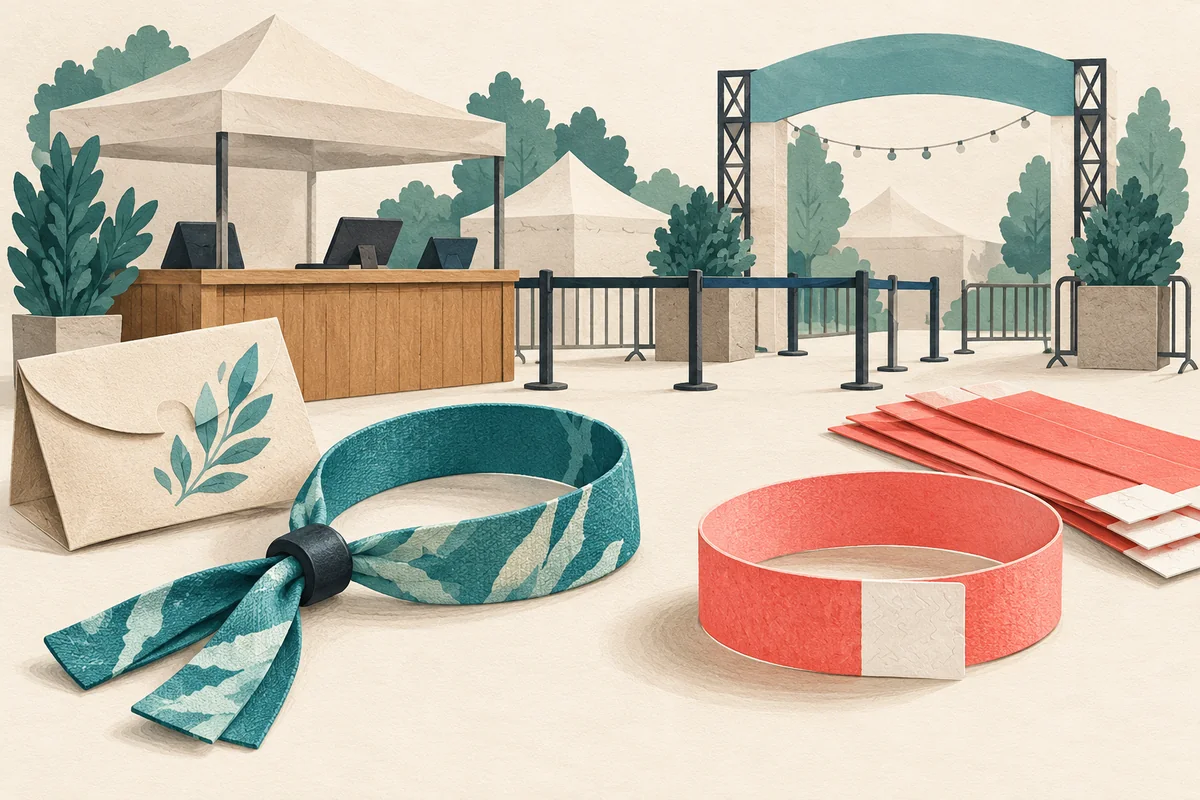
Header image: AI-generated editorial illustration, not a product photograph or evidence of testing.