No: “cabin-size” on a duffel’s product description is not a promise that every airline will accept it. For a travel-bag gift, compare the packed bag’s outside dimensions with the rules for the recipient’s actual flights. Check whether it is intended as an overhead carry-on or an under-seat personal item; those are different buying briefs.
This matters for a sales-team kickoff or incentive trip. A bag that looks compact in a catalog may grow noticeably once its end pockets hold shoes and its main compartment holds clothing. The useful approval question is not “How many liters is it?” but “What are its three outside measurements when packed for this trip?”
Two airlines, two size envelopes
At our October 21, 2026 review, American Airlines’ carry-on policy lists a maximum of 22 × 14 × 9 inches, including handles and wheels, and requires the bag to fit the airport sizer. Its personal-item limit is 18 × 14 × 8 inches, with under-seat fit required. American also notes that some airports and aircraft have additional restrictions.
Southwest’s carry-on policy lists 24 × 16 × 10 inches, including wheels, handles and attachments. It distinguishes the overhead carry-on from the personal item placed under the seat and warns that partner-airline rules may differ.
These are two current examples, not a worldwide standard or a permanent allowance chart. Recheck the operating airline’s official policy for each flight before ordering and again before departure. A size-compliant bag also does not establish what a particular ticket includes or guarantee overhead space.
Worked example: one oversized dimension is enough
Illustrative purchasing example, not a tested product: a proposed duffel measures 23 × 13 × 9 inches when packed, with all protrusions included. Its corresponding dimensions are within Southwest’s published carry-on envelope above, but its 23-inch side exceeds American’s 22-inch limit. The two smaller sides do not compensate for that extra inch.
Do not add the three dimensions together and treat the total as permission. These carry-on limits specify separate sides. Do not substitute the bag’s advertised liter capacity, either: capacity does not establish its external shape. If a soft bag can be packed smaller, approve and document that smaller packed configuration rather than promising that an overfilled bag will squeeze through.
A packed-sample checklist for the buyer
- Name the role. Is this the traveler’s main carry-on, their personal item alongside a roller, or simply a gym/weekend gift? If it is not being selected for a known flight, avoid an airline-approved claim.
- Record the flight requirements. Capture the operating carriers, relevant size limits, any published weight restrictions and the ticket’s baggage entitlement. For multiple flights, the bag must satisfy each applicable requirement, not just the outbound carrier’s.
- Ask what the supplier measured. Obtain the exact model and distinguish flat, empty or nominal dimensions from packed external dimensions. Confirm whether pockets, feet, handles and attachments are included.
- Pack a representative sample. Use the clothing and accessories the intended trip requires. Fill the end pockets as the recipient is likely to use them. Close the bag normally; do not measure an empty shell or rely on someone continuously compressing it.
- Measure the bounding shape. Record the maximum outside extent in all three directions, including protrusions in the configuration intended for travel. Check a suitable physical sizing frame where available. A tape measure is a purchasing check, not airline acceptance.
- Write the outcome precisely. Record which documented limits the measured configuration meets, the review date and any packing condition. If a side exceeds the limit, choose a smaller model or remove the flight-specific promise before release.
Leave room in the buying brief for ordinary packing variation rather than deliberately selecting a sample that only just fits. That is our procurement recommendation, not an airline tolerance: do not assume staff will overlook an extra inch.
Copyable travel-bag approval record
Gift purpose: ___. Carry-on / personal item / general travel bag: ___. Exact model: ___. Destination country and supplier-confirmed availability: ___. Operating airlines and flight dates: ___. Official policy links and date checked: ___. Size and weight requirements: ___. Ticket allowance confirmed by: ___. Representative contents: ___. Packed external dimensions, units and included protrusions: ___. Sample reviewer: ___. Result and conditions: ___. Approved description: ___. Decoration, delivery timing and total quote: ___.
Availability, decoration and delivery to the recipient’s country need separate supplier confirmation; airline size rules do not verify any of them. Keep unconfirmed pricing as quote-needed. This post is a selection method, not a verified catalog shortlist.
What should the gift description say?
Use measured facts and a limited claim. For example: “Travel duffel; packed sample measured ___ × ___ × ___ inches with the listed contents. Check your airline and ticket allowance before flying.” Avoid “approved for all airlines,” “guaranteed cabin bag” or an under-seat promise based only on an overhead-bag limit.
For a trip where employees already travel with a roller, ask whether a duffel would replace that carry-on or create an unwanted extra bag. A short gift preference survey can resolve that before the order. If weight is part of the flight requirements, our luggage-scale buying checklist covers a separate check; weighing a bag cannot establish dimensional fit. For identification without unnecessary exposure, see what to put on a luggage tag.
Bottom line: buy against a documented travel use and a packed measurement, not the phrase “cabin-size.” When the route is unknown, present the gift as a travel bag and leave flight acceptance to the recipient’s current airline rules.
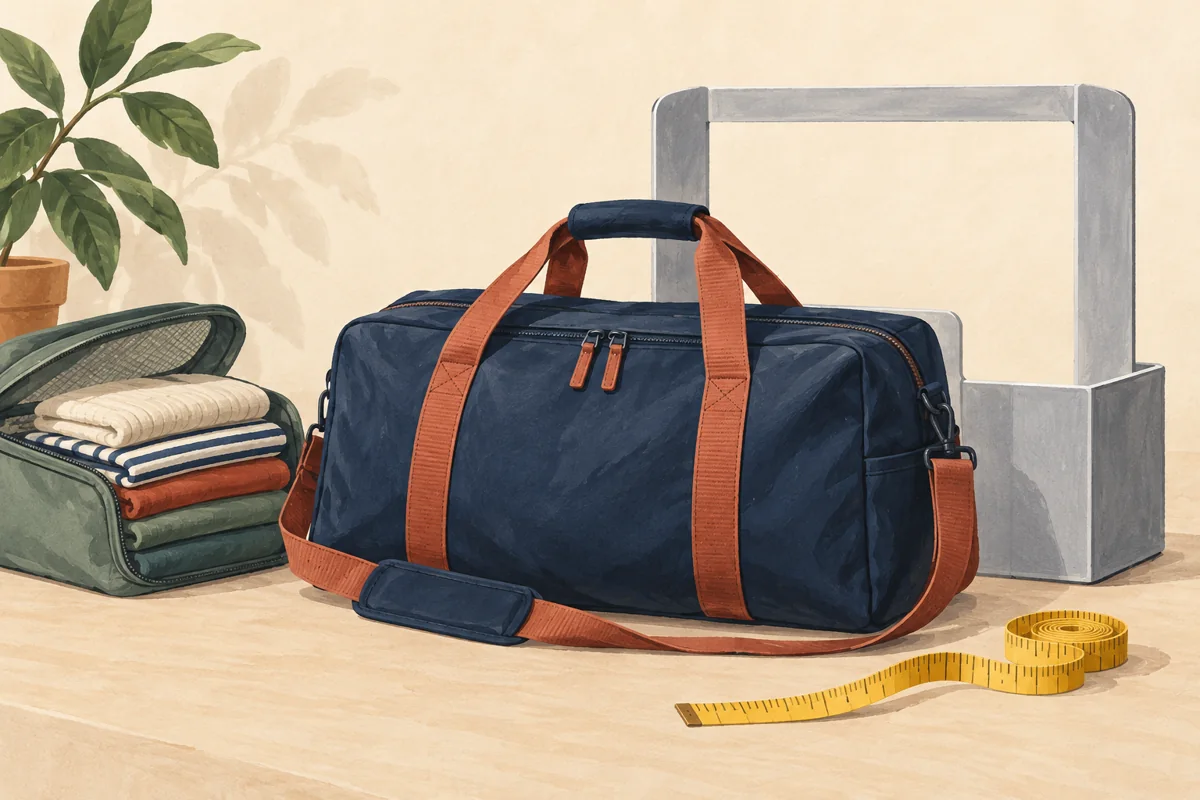
Editorial illustration: AI-generated conceptual artwork, not a product photograph or evidence of a luggage test.