Match a puzzle-storage accessory to the puzzle’s finished width and height, not just its piece count. Then choose between a roll-up mat and a flat case according to where the recipient can actually put it away. A “1,000-piece” label is a useful starting point, not a complete fit specification.
For a recreation center giving volunteers a winter puzzle gift, the accessory can make a shared dining table usable again between sessions. But a large flat case is not helpful if the recipient only has a narrow closet, and a roll-up system introduces a packing routine they may not want. Offer the accessory as a choice when storage preferences are unknown.
Measure three spaces, not one
Start with the finished puzzle rectangle. Ask the puzzle supplier for its dimensions, including the widest points of a shaped puzzle. Compare that with the accessory’s usable assembly area—not its shipping box or overall exterior. If the manufacturer requires a clear margin for rolling or closing, that margin must remain outside the puzzle.
Next, account for sorting. A surface that fits the finished picture may leave nowhere for hundreds of loose pieces. Separate trays can solve that problem, but those trays need their own storage plan.
Finally, measure the packed accessory and its intended home. For a flat case, check shelf depth, doorway clearance and permitted carrying orientation. For a rolled mat, check the assembled tube length and packed diameter. Do not assume that “portable” means it will fit a normal tote.
What the two formats actually offer
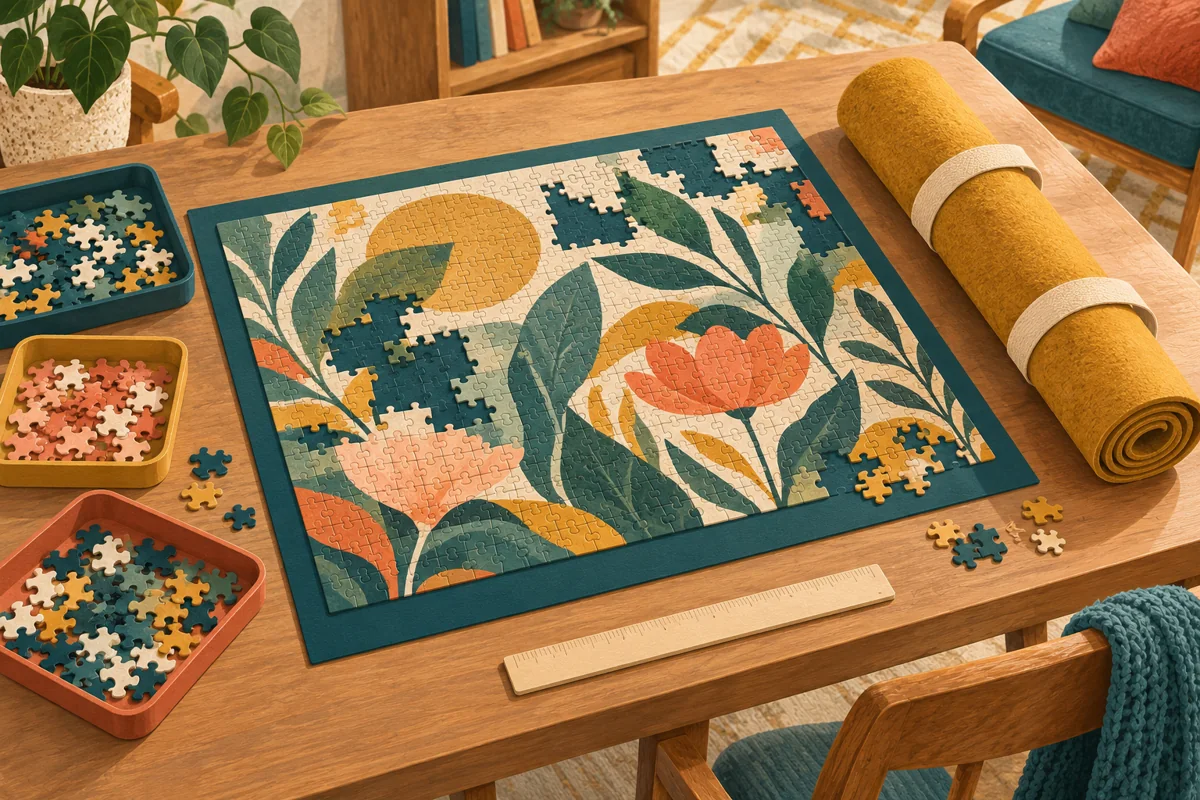
MasterPieces’ Jigsaw Puzzle Roll Up, SKU 50501, describes a 36-by-30-inch felt mat with tubes and hook-and-loop straps, intended for puzzles up to 1,000 pieces. This illustrates the roll-up approach: the working surface becomes the storage wrap. Ask for the packing instructions before deciding how much of that surface can be occupied.
Ravensburger’s Puzzle Store & Go, article 17962, uses a puzzle base, five sorting trays and a closing lid. Its description says the unfinished puzzle remains in place even upright. That is a claim about this specific closed system; an uncovered board does not inherit it. The listing describes suitability for 500- and 1,000-piece puzzles and separately provides size and box-size fields, another reason to confirm usable dimensions rather than selecting the largest number on the page.
These are current manufacturer examples checked November 1, 2026, not a Brand Sauce catalog shortlist or products we have physically tested. Ravensburger’s U.S. listing specifies U.S.-only shipping. Neither page establishes a decorated corporate order’s availability across recipient countries. Brand Sauce supply, branding options and delivered prices remain quote-needed.
A fit calculation that catches the wrong bundle
Illustrative example—not a specification for either product above: a gift puzzle measures 28 by 20 inches. A proposed board has a usable rectangle of 27 by 19 inches. It fails in both orientations, even if both boxes say “1,000 pieces.” Rotating the puzzle makes its 28-inch side face the 19-inch space; it does not solve the problem.
A second surface measures 30 by 22 inches, leaving one inch on each side if the puzzle is centered. That establishes geometric room for the picture only. It does not establish space for loose pieces, compliance with a required rolling margin, or successful transport. Confirm those separately before calling the bundle compatible.
Use this accessory-selection record
- Puzzle: exact edition, finished width × height, thickness/material and shape.
- Accessory: exact model, usable width × height, required clear margins and any excluded puzzle types.
- Loose pieces: where they go during play and while packed; whether trays are included.
- Storage: packed dimensions, intended shelf or closet space, permitted carry orientation.
- Recipient routine: willing to roll/unroll, prefers a flat closing case, or does not need an accessory.
- Sample decision: follow the manufacturer’s instructions with the actual puzzle, reopen after ordinary storage, and record displaced sections or damaged pieces. Approve the pair, change the accessory, or offer the puzzle alone.
That last check is a proposed buyer exercise, not a claim of testing or a durability certification. Do not roll a wooden, unusually thick or specialty puzzle unless the accessory maker confirms compatibility.
If the gift itself is custom, settle the finished puzzle format and artwork approval before buying a matching storage accessory. If you add a large case to a mailed gift, reassess the protective shipping package; the attractive case is not automatically the shipping carton.
AI-generated editorial illustration; not a catalog photograph or evidence of a completed product test.