No: a one-size apron is not a guarantee of suitable coverage or comfortable fit for every café employee. Adjustable ties help position the garment, but they do not make its fabric panel wider or longer. Before ordering a logo run, check the panel dimensions and let the intended wearers try the sample over their actual uniform.
For a coffee shop, the useful question is not “Does the knot close?” It is “Can this person work comfortably, reach the pockets and keep the intended area of their clothes covered?” Here is a short fitting process a manager can use before approving the order.
Read the dimensions behind “one size”
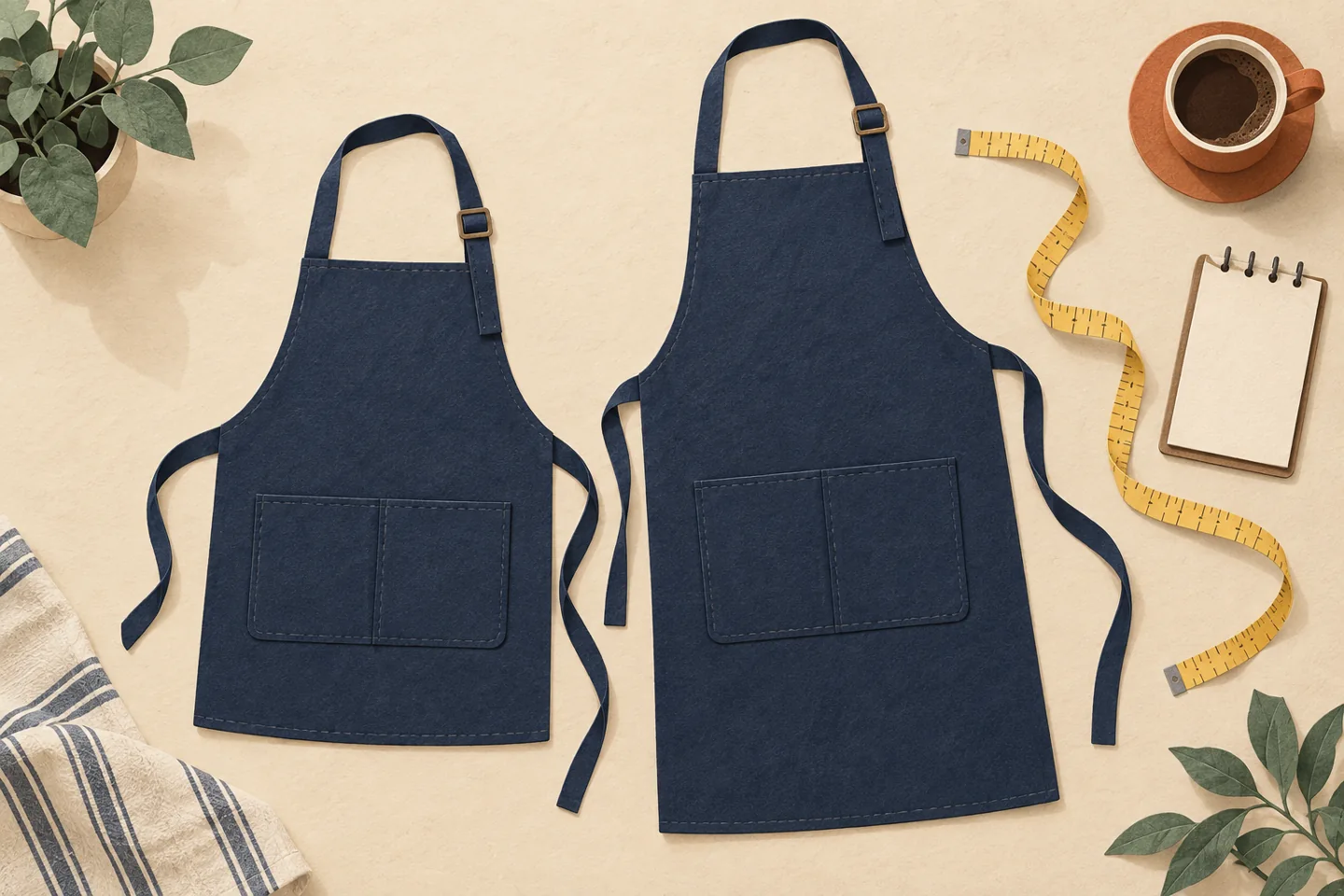
Two real supplier specifications show why the size label alone is insufficient. SanMar’s Port Authority A510 specification lists OSFA, an adjustable neck strap and a panel measuring 22 inches wide by 24 inches long. Its measurement notes define waist width as the fabric measured edge to edge beneath the waist straps—not the length of those straps or a maximum wearer waist measurement.
The Port Authority A520 specification also lists OSFA, but its panel is 22 inches wide by 30 inches long. SanMar describes a single-strap length-adjustment system. In this pair, the full-length version adds six inches of listed length, not additional listed waist-panel width.
These are current manufacturer specification examples, not a verified Brand Sauce product shortlist or stock promise. Exact decorated availability, color, delivery country, lead time and price are quote-needed. Sources checked October 1, 2026.
Copy this apron fitting card
Use one card per wearer and candidate style. Record a staff identifier rather than circulating body measurements. Ask people to try the apron over the layers they normally wear at work, and keep the fitting away from hot equipment.
- Sample identity: manufacturer, style, color, panel width and length, strap arrangement.
- Coverage: with the top edge positioned appropriately, does the panel cover the front area needed for the role? Record where coverage is missing rather than simply marking “too small.”
- Ties: can the wearer secure and release them comfortably without an improvised extension? Can loose ends be managed appropriately for the task?
- Movement: reach forward, bend, turn and sit if the role requires it. Note pulling, slipping or a hem that interferes with movement.
- Pockets: use the ordinary lightweight contents for the role, such as a pen and order pad. Can the wearer reach them without pulling the apron out of position?
- Adjustment: can the wearer put it on again and recover the same fit without assistance? Record any preferred alternative fastening or strap arrangement.
- Decision: approve this style, try another configuration, or hold the wearer’s allocation pending a suitable option.
This is a usability check, not a protective-equipment test. An ordinary branded apron’s coverage or stain-release description should not be turned into a heat, cut or chemical-protection claim.
Change the dimension that actually failed
If the ties are the problem but panel coverage is good, investigate a different fastening or documented tie length. Do not automatically move to a longer panel.
If front coverage is too narrow, request a wider cut. Longer waist ties can help fastening, but they do not add fabric to the front panel.
If the hem is too high or too low, try another panel length after setting the top edge correctly. Lowering the whole apron to gain leg coverage may leave the upper area less covered and move the pockets out of reach.
If one style works for most but not all staff, approve a second fit option with a coordinated color and logo. A consistent uniform does not require an identical garment cut. Keep the exception available for future hires instead of resolving it as an undocumented one-off.
Check laundry and logo placement on the chosen fit
Care instructions differ even between the two examples above. The A510 specifies cold washing, low-heat drying and no ironing; the A520 allows a warm iron if necessary. Compare the exact care label with your actual laundry arrangement, and ask the decorator for care directions applicable to the finished item. Do not assume a home-wash specification establishes suitability for your commercial laundry process.
Before approval, wash the sample according to the agreed instructions and repeat the fitting observations. This is a proposed trial, not a claim that we have tested either apron or measured its shrinkage.
Then inspect the proposed logo on the apron as worn. A flat artwork proof cannot show whether a bib folds, a strap adjustment changes placement, or embroidery interferes with a pocket. Follow the broader decorated-apparel sample approval checklist, using production-ready logo files rather than a screenshot.
Send an order brief that preserves the fit decision
Copy and complete: “Quote [approved style and color] for [quantity] staff in [delivery country], plus [alternative style] for [quantity]. Confirm panel dimensions, tie or fastening details, decorated sample, finished-item care, logo location and arrival date. Do not substitute another ‘one-size’ apron without approval.”
For multiple locations, put both approved options and the fitting card into the uniform rollout plan. That gives the next manager a repeatable choice—not just a product name that happened to fit the first person who tried it.
Illustration: AI-generated editorial artwork; not a photograph of either manufacturer example.