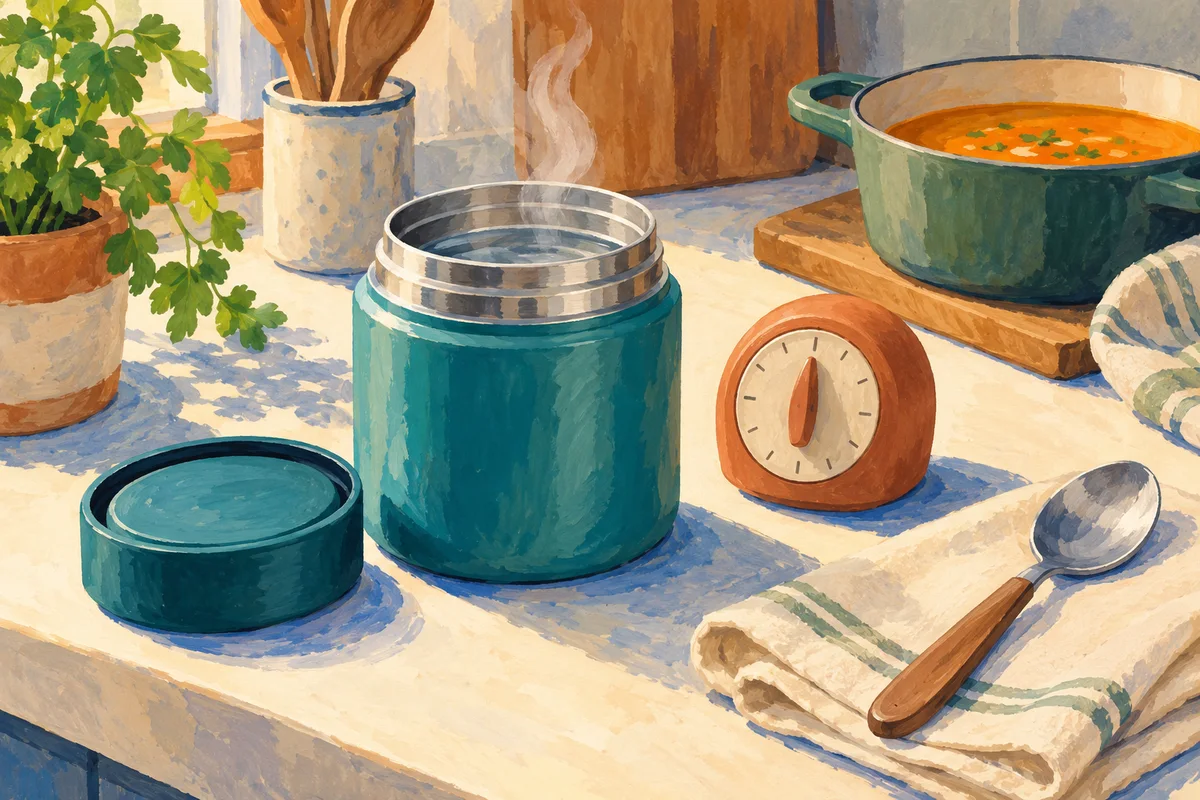
Yes—prepare the inside of an insulated food jar before adding hot lunch, following that model’s instructions. Preheating is a separate step from heating the meal. A passive vacuum jar is meant to retain heat, not bring refrigerated soup up to temperature.
For a workplace gift, the useful extra is not another promise about “hours hot.” It is a short, accurate packing card that travels with the jar. That matters for field teams and staff taking lunch before a shift: the relevant interval begins when they pack, not when they clock in.
Use the actual jar’s directions, not a universal five-minute rule
Manufacturer instructions differ. The US Thermos Stainless King 16oz product page recommends boiling water for five minutes before filling with hot food. Stanley’s US FAQ instead describes warm tap water for five minutes, followed by emptying and immediate filling. Those are examples of documented preparation methods, not interchangeable instructions for every insulated container.
Get the care-and-use sheet supplied with the exact regional SKU. Record its water instruction, waiting period, fill limit and closure method. If that sheet conflicts with a general FAQ or reseller description, ask the supplier to resolve the discrepancy before printing your insert. Do not invent a blended method.
These manufacturer pages were checked October 19, 2026. The examples explain preparation; they are not a verified Brand Sauce product shortlist. Decoration options, stock and delivery-country availability require confirmation for an order, and branded pricing remains quote-needed.
Keep “hot retention” separate from safe food handling
USDA’s packed-lunch guidance recommends an insulated container for hot meals, warming it before filling, and keeping it closed until lunch. Its hot-holding target is 140°F (60°C) or above; leftovers should be reheated to at least 165°F (73.9°C), checked with a food thermometer.
Those are different temperatures for different jobs. Reheating prepares the meal; hot holding maintains it afterward. A catalog’s “hot for X hours” claim alone does not establish that a particular portion will remain at a safe temperature through a particular shift. Do not print that claim as a food-safety guarantee or tell recipients to judge safety by whether lunch feels warm.
A packing card you can complete before gifting
Use the following as a content checklist for your insert. Replace every blank from the supplied instructions; retain the manufacturer’s warnings and link to the complete document.
- Identify: This card is for model ____ in market ____. Full instructions: ____.
- Prepare the container: Clean and assemble it as directed. Preheat using ____ water for ____, with the lid positioned ____.
- Prepare the meal separately: Follow appropriate cooking or reheating guidance. Do not use the jar itself as a cooker or assume it can go in a microwave.
- Pack: Carefully discard the preheat water, add the prepared hot meal promptly, and respect the specified fill limit ____. Close using ____.
- Carry and open: Keep closed until mealtime. Follow the model’s carrying, venting and hot-content precautions: ____.
- After use: Follow the supplied disassembly, washing and drying instructions: ____.
Release rule: no unresolved blanks about heat, filling or closure. Do not replace detailed instructions with an illustrated card that omits a pressure-release step or changes how the lid is used.
Check whether the gift suits the lunch routine
Before ordering, ask three practical questions:
- Where is lunch packed? Someone who prepares food at home has a different routine from someone expecting to fill the jar with cold leftovers at work. A gift cannot fix missing heating facilities.
- How long until the meal is eaten? Record packing time, travel and likely delays—not only the nominal lunch break. If the intended routine cannot meet the food-handling requirements, offer another gift or lunch-storage approach.
- What portion is actually wanted? Choose a capacity that works with the maker’s filling instructions and the recipient’s meal, rather than assuming the biggest jar is best.
For example, a hypothetical team member packing at 6 a.m. and eating at 1 p.m. has a seven-hour interval even if the workday starts at 8 a.m. That arithmetic defines the question to investigate; it is not evidence that any jar will safely hold that person’s lunch for seven hours.
Add those questions to your employee gift preference survey. For recipients who prefer a cold packed lunch, use the separate lunch-bag and cold-source checklist instead. The right gift supports an achievable routine—and the right insert explains that routine without overstating what insulation can do.
Illustration: AI-generated editorial still life, not a product photograph or test result.