Not by itself. A branded insulated lunch bag can be useful for carrying a cold meal, but the bag is only one part of the setup. Before choosing one for employees, check that it can hold the meal and the cold sources, and find out where lunch will be stored after the commute.
That is a more useful buying question than “How many cans does it hold?” A compact bag that looks good in a welcome kit may be the wrong shape once a rigid lunch container and freezer packs go inside.
What actually needs to fit?
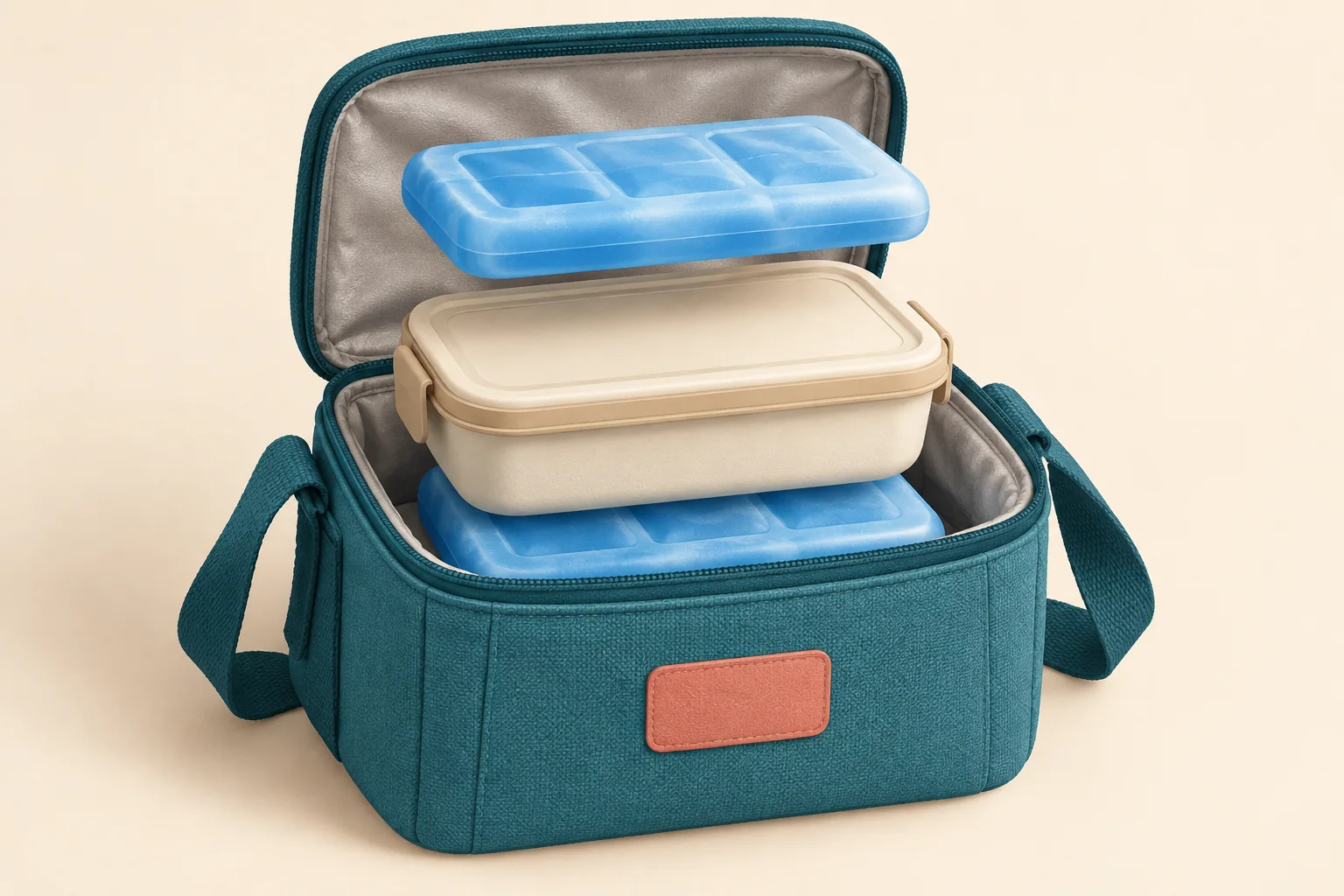
For perishable lunches, USDA recommends an insulated soft-sided bag with at least two cold sources. Its bag-lunch guidance describes two frozen gel packs, each at least 5 by 3 inches, or a frozen gel pack paired with a frozen water bottle or juice box. Position cold sources above and below the perishable food.
Those pack dimensions are a starting point for your fit check, not a bag-performance certification. A listed capacity in liters or cans does not establish whether the employee’s meal container and chosen packs will fit together with the zipper closed.
For a company purchase, ask for usable internal dimensions and a sample. Specify the containers and cold packs you intend to use; do not approve the bag from its exterior dimensions alone.
Choose for the storage situation, not the logo area
- Employees have a refrigerator on arrival: prioritize a manageable footprint and easy access to the contents. USDA says to refrigerate perishable items when you arrive; if the insulated bag goes in the refrigerator, leave it open so cold air can circulate.
- Employees have no reliable refrigerator: do not turn the word “insulated” into an all-shift cooling promise. Ask the supplier for any performance evidence, including the starting temperature, cold-pack setup, surrounding temperature, duration and measurement method. A claim measured under different conditions is not an answer for your workplace.
- The bag is for shelf-stable snacks: insulation may be less important than convenient size and cleanability. Follow each food’s storage label; not every packaged snack is shelf-stable.
USDA’s Keeping “Bag” Lunches Safe says cold perishable food should be kept at 40°F (4.4°C) or below. It also limits time left at room temperature to two hours, or one hour above 90°F (32.2°C). Those limits are not advertised cooling times for a lunch bag.
If storage access varies across locations or shifts, ask about it in your employee gift preference survey. A gift should fit the recipient’s workday, not assume everyone has the same break room.
A six-point purchase checklist
Use this original approval checklist with the actual sample and proposed order. It is a purchasing aid, not a food-safety test.
- Pack the intended load. Put the selected meal container and both cold sources inside. Record their dimensions and check whether the bag closes without forcing the zipper or distorting the container.
- Check access. Can someone remove the container without emptying unrelated items onto a shared counter? Will the open lid fit in the intended refrigerator space?
- Confirm cleaning instructions. Obtain the manufacturer’s directions for the liner, exterior and decorated area. Do not assume a wipe-clean liner makes the whole bag machine-washable.
- Separate the claims. Ask whether “leak-resistant” refers to the liner, seams or a separate food container. Do not treat it as a promise that loose liquid can safely travel in the bag.
- Check the decorated version. Request approval of the logo method and placement on this exact construction, including whether decoration affects the lining or insulation. Keep the approved specification with the order.
- Confirm what arrives. List the bag, containers, cold packs and instructions separately. Confirm destination-country availability, quantities and lead time; mark unconfirmed costs as quote-needed.
Decision: approve the purchase only when the sample fits the intended load, the care instructions are clear and the supplied contents are documented. Revise the selection if the meal fits but the packs do not. Hold any recipient-facing cooling-duration claim until evidence supports the exact statement and its conditions.
Copy this into your supplier brief
We are evaluating a branded lunch bag for [recipient group] in [destination countries]. Recipients will have [refrigerator access / no reliable refrigerator access]. Please provide usable internal dimensions, a sample, cleaning instructions and the approved decoration method. The intended load is [container dimensions] plus [two cold-source specifications]. Confirm which accessories are included and quote the complete setup. If you make a cooling-duration claim, provide the test conditions and results supporting it. Do not substitute bag size, liner or included accessories without approval.
If you include a lunch bag in an employee onboarding kit, make the contents explicit: “bag only” is different from “bag with two freezer packs.” For an ongoing store, use the same distinction in your product-selection rules so employees can choose knowingly.
The hero image is an AI-generated editorial illustration of a packing concept, not a catalog product, customer photograph or demonstrated cooling result. No specific product availability or price is represented here.