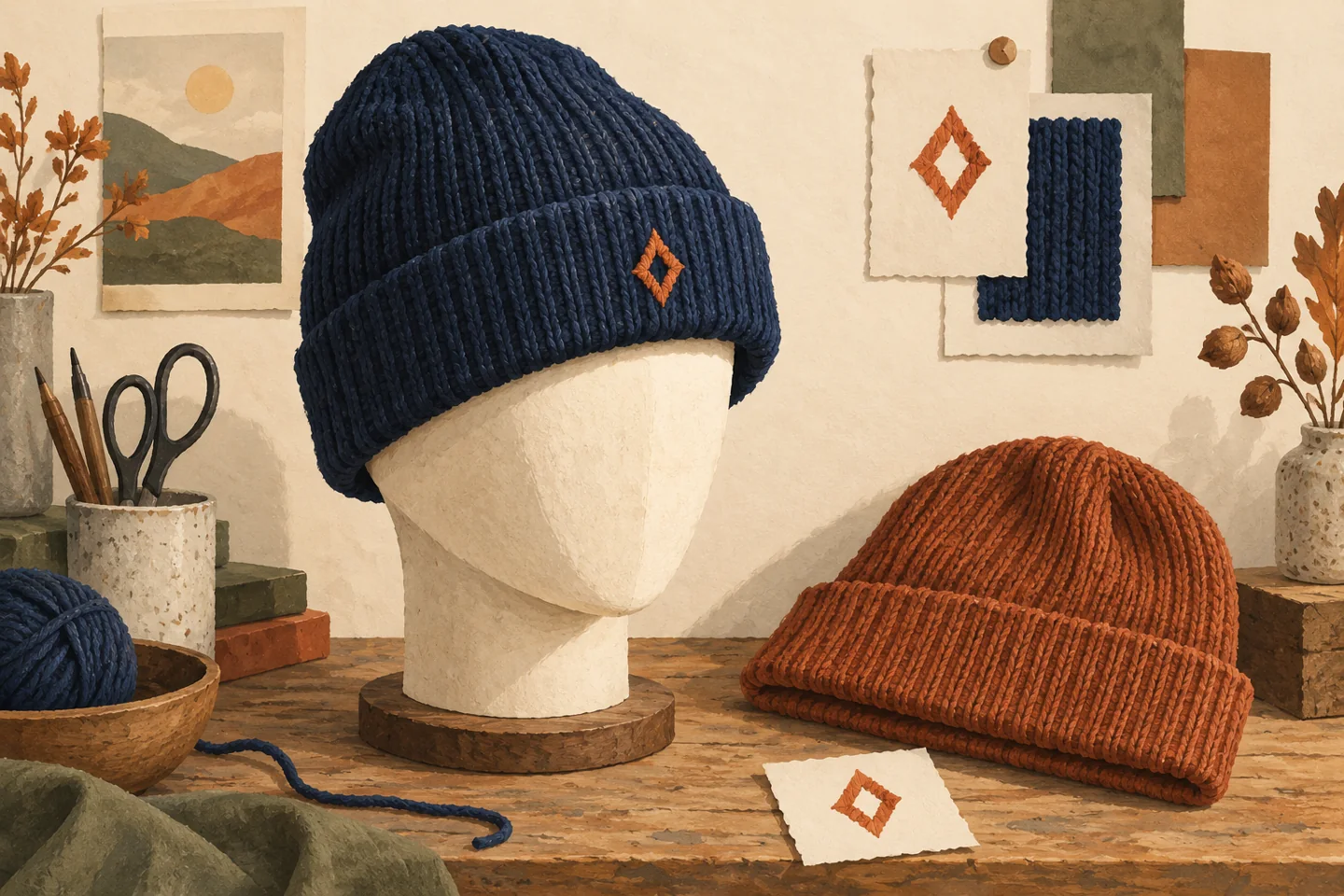
Approve a beanie logo with the cuff folded as people will wear it—not just on a flat artwork preview. The visible cuff, the decorator’s embroidery area and the full height of the hat are different measurements. Treating them as interchangeable can leave an otherwise readable logo crowded against a fold or partly hidden when someone adjusts the hat.
For a winter volunteer crew or seasonal employee gift, the buying decision is simple: can this exact hat carry the approved mark comfortably and visibly in its intended wearing position? Use the approval card below before releasing the decorated order.
Separate hat height, cuff depth and embroidery area
A product’s overall length is not a logo allowance. For example, Printful’s Yupoong 1501KC listing gives a 12-inch hat length and identifies front embroidery as a customization option. That does not make the entire 12 inches a usable embroidery field. The product-specific file guidelines and the decorator’s confirmed placement govern the design.
Ask for three separate pieces of information: the hat’s measurement convention, the visible cuff depth at the agreed fold, and the permitted embroidery width and height. Ask the decorator to show the logo’s location relative to the cuff edges on that exact style. Do not choose a universal distance from the bottom edge and assume it works across all beanies.
The manufacturer example explains how to read a listing; it is not a verified Brand Sauce catalog recommendation. Exact style, color, decorated availability in the delivery country, price and arrival date remain quote-needed. Sources checked October 1, 2026.
A smaller logo is not always the same logo
If the full wordmark only fits by making its lettering tiny, request an approved compact brand mark instead of shrinking everything indiscriminately. Printful’s embroidery preparation guide, for example, specifies a 0.25-inch minimum text height and 0.05-inch minimum line thickness for flat embroidery. It also directs users to each product’s embroidery template. Those are Printful’s requirements, not a universal promise that another decorator or every knit will produce the same result.
Keep the full logo file available, then have the brand owner approve any removed tagline, thicker lettering or simplified symbol. Our logo-file checklist helps separate source artwork from a screenshot that merely looks sharp on a phone.
A logo already sewn successfully on a polo still needs review for a beanie. Printful’s explanation of digitization notes that embroidery type, product type or placement can require separate stitch-file preparation. It also distinguishes its visual mockup from the actual digitized result. Ask your supplier whether the existing file is suitable; do not assume a previous setup approval transfers unchanged.
Copy this folded-cuff approval card
Complete the card for the exact decorated sample. This is a proposed buyer check, not a report of Brand Sauce testing.
- Identify: record style, color, sample reference, logo version, thread colors and intended delivery country.
- Set the fold: photograph the agreed wearing position and record the visible cuff depth. State whether the program expects one fold or another configuration; do not rely on an unlabeled flat photograph.
- Locate the mark: record finished logo width and height, plus the decorator’s placement reference. View the sample from the front and side to check whether the mark sits where the proof indicates.
- Try it on: ask several intended wearers to put the sample on normally. Check logo visibility, cuff rolling and pressure or irritation around the decorated area. Do not force everyone to keep an uncomfortable fold merely to expose the logo.
- Inspect the stitching: check lettering, open spaces inside the mark, puckering and the inside finish. Refer questionable areas back to the decorator; a screen preview cannot settle them.
- Check care: obtain instructions for the finished decorated item. If you run a wash trial, follow those instructions and repeat the fold and wearing checks afterward.
- Release or hold: name the approver and retain the reference photos. Record any change that needs another sample rather than approving an unspecified “equivalent.”
For the broader production handoff, use the decorated-apparel sample approval guide. This cuff check adds a specific wearing-position decision to that process.
Choose the fix that matches the failure
- The mark is partly concealed at the comfortable fold: ask for a revised placement or a different cuff construction. A larger logo is not the fix.
- The text is unreadable at the permitted size: try the approved compact logo or remove nonessential text with brand approval. Do not enlarge the design beyond the confirmed field.
- The decorated area feels uncomfortable: have the supplier review the design, stitching and inside finish, then resample. Do not accept a neat exterior as proof of wearable comfort.
- Different wearers need substantially different folds: test another hat shape or offer an alternative. One-size labeling does not establish one preferred wearing position.
Illustrative decision: a volunteer coordinator prefers a wordmark with a tagline. The decorator’s proof fits the cuff, but the sample’s tagline is difficult to read. The coordinator can submit a brand-approved symbol-only version and request a new proof and sample. That is a design change requiring approval—not evidence that the original logo would become readable in a larger production run.
Send a brief that preserves the approved fold
Copy and complete: “Quote [style/color] for [quantity] recipients in [country]. Use [approved logo version] at [finished dimensions] in [thread colors], positioned as shown in [sample reference/photos] with [agreed cuff configuration]. Confirm decorated sample, finished-item care and arrival date. Obtain approval before changing hat style, logo size or placement.”
If this is part of a seasonal crew program, connect the approved sample to the volunteer apparel distribution plan so replacements follow the same decision. The goal is a repeatable, wearable result—not simply a logo that fits inside a rectangle.
Illustration: AI-generated editorial artwork, not a product photograph or embroidery test result.