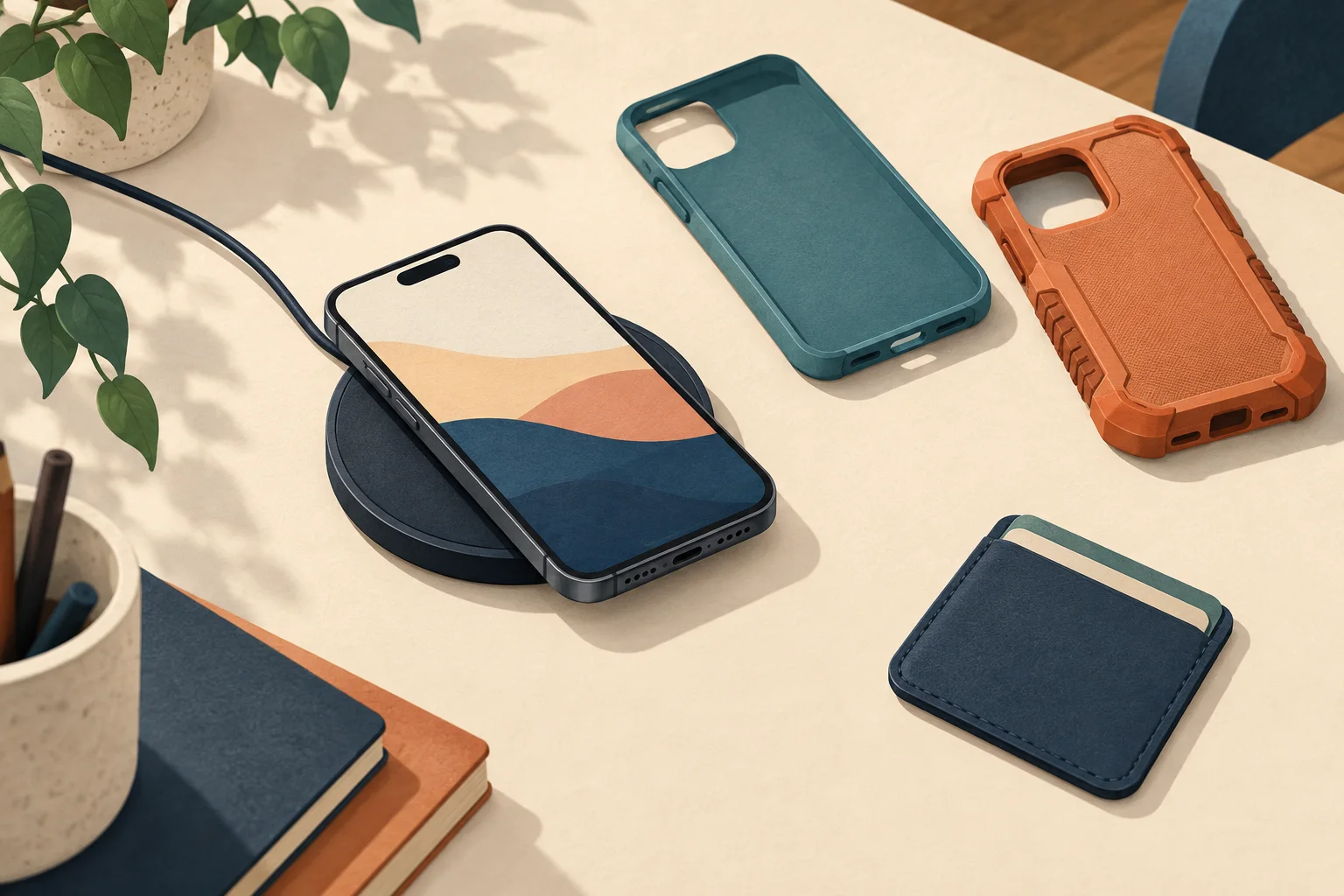
A branded wireless charger may work through a phone case, but “case-friendly” is not a promise that covers every employee’s setup. Approve the phone, case, charger and power adapter as a combination. A logo on the charging pad does not settle compatibility.
For an IT or people team choosing a desk gift, the useful buying question is not just “Does it charge?” It is “Can recipients use it with the phone and case they already carry, without an unexpected accessory purchase?”
Separate three questions before choosing a charger
Does the exact phone support the charger? Check the phone manufacturer’s specification and the charger’s current compatibility list. Do not approve by operating system or connector alone. A USB-C port is not evidence of wireless-charging support.
Will the case work in that combination? Apple’s wireless-charging guidance says to try removing a thick, metal or battery case when charging fails or slows. It also advises using the supplied or manufacturer-recommended power adapter and positioning the phone as directed. Treat these as troubleshooting and setup instructions—not a universal case-thickness allowance.
Does magnetic attachment have separate requirements? For its Qi2 accessories, Belkin recommends a MagSafe/Qi2-compatible case and removing an attached wallet or other magnetic accessory before charging. A purpose-designed compatible magnetic case is not the same thing as an arbitrary metal plate or stick-on accessory. Follow the instructions for the exact charger and phone.
These manufacturer references explain compatibility checks; they are not a Brand Sauce catalog shortlist or a claim that these brands are available for decoration in every country.
Use this compatibility record for each sample
Copy the following fields into your purchasing sheet. One row should describe one actual combination, not “iPhone” or “Android” in general.
- Phone: exact model, manufacturer-confirmed wireless-charging support and any required software conditions.
- Case: manufacturer and model, stated charging compatibility, and any wallet, grip, kickstand or mounting accessory normally attached.
- Charger: supplier SKU and underlying manufacturer model, supported phones, placement instructions and stated case limitations.
- Certification evidence: if Qi certification is claimed, the matching WPC ID and database entry—not just a logo in a sales image.
- Power supply: the required adapter and cable, what is included, and the correct plug version for the destination.
- Sample outcome: date, person checking, whether charging starts and remains connected during the planned desk-use check, and any required case or accessory removal.
- Recipient conditions: the exact limitation to show before selection, plus an alternative gift if the combination is unsuitable.
The Wireless Power Consortium’s certified-products page links to its database and explains that certified products receive a WPC ID. Ask the supplier to connect the quoted decorated SKU to the underlying certified model. A database entry verifies that listed model’s certification; it does not prove that every case fits or that your recipient will receive the highest advertised charging rate.
Try normal desk use, not just a charging icon
Request a sample of the proposed finished item and use the specified power supply. Follow its instructions, keep the charging area clear, and check representative employee phone-and-case combinations. Record whether placement is straightforward and whether ordinary repositioning requires careful realignment. For a stand, include the intended viewing orientation if the manufacturer supports it.
Keep cards and credentials out of the space between phone and charger. Apple warns that items with magnetic strips or RFID chips can be damaged there; Belkin gives the same caution for its Qi2 magnetic holders. Do not use an employee’s access badge as a spacer or leave a card wallet sandwiched in the setup.
This is a proposed usability check, not a laboratory test or a claim that Brand Sauce has tested a particular charger. It cannot certify electrical safety, prove a charging-speed claim or establish compatibility with untested phones. Follow manufacturer troubleshooting instructions if a combination behaves unexpectedly.
Make the gift decision from the result
- Works with the intended phone and everyday case: consider it for that verified audience, with setup instructions and the complete required power supply clearly identified.
- Works only after removing a wallet: disclose that step before selection. Let the recipient decide whether the inconvenience is acceptable.
- Works only with a replacement case or separately purchased adapter: include the needed component in the quote, or make the extra requirement explicit. Do not call it ready to use as delivered.
- Phone support or case compatibility remains unknown: offer a non-charging alternative rather than assign the charger to everyone.
For example, a hypothetical team could offer a charger to employees who confirm a supported setup, alongside a notebook for those who do not. That is selection logic, not a tested success rate. A short gift-preference survey can ask for the phone model and whether recipients want a charger; it does not need device serial numbers or account details.
Keep the choice set manageable using your company-store curation rules. If the gift is part of a welcome kit, make the compatible alternative available at the same decision point rather than after a new hire discovers a mismatch.
Send this brief with the quote request
We are considering a decorated wireless desk charger for [phone models] used with [case models/accessories], shipping to [countries]. Confirm the exact charger model, supported combinations, case restrictions, certification evidence where claimed, included cable and adapter, destination plug versions and decoration limitations. Quote the complete usable set and a sample. Identify any recipient setup steps and obtain approval before substituting the charger, adapter or cable.
Availability and pricing remain quote-needed for the actual decorated SKU and destinations. The best choice is the one whose limitations you can explain before someone selects it—not the one with the biggest wattage printed on the box.
Illustration: AI-generated editorial artwork, not a stocked-product photograph or product test. Primary-source guidance checked September 30, 2026.