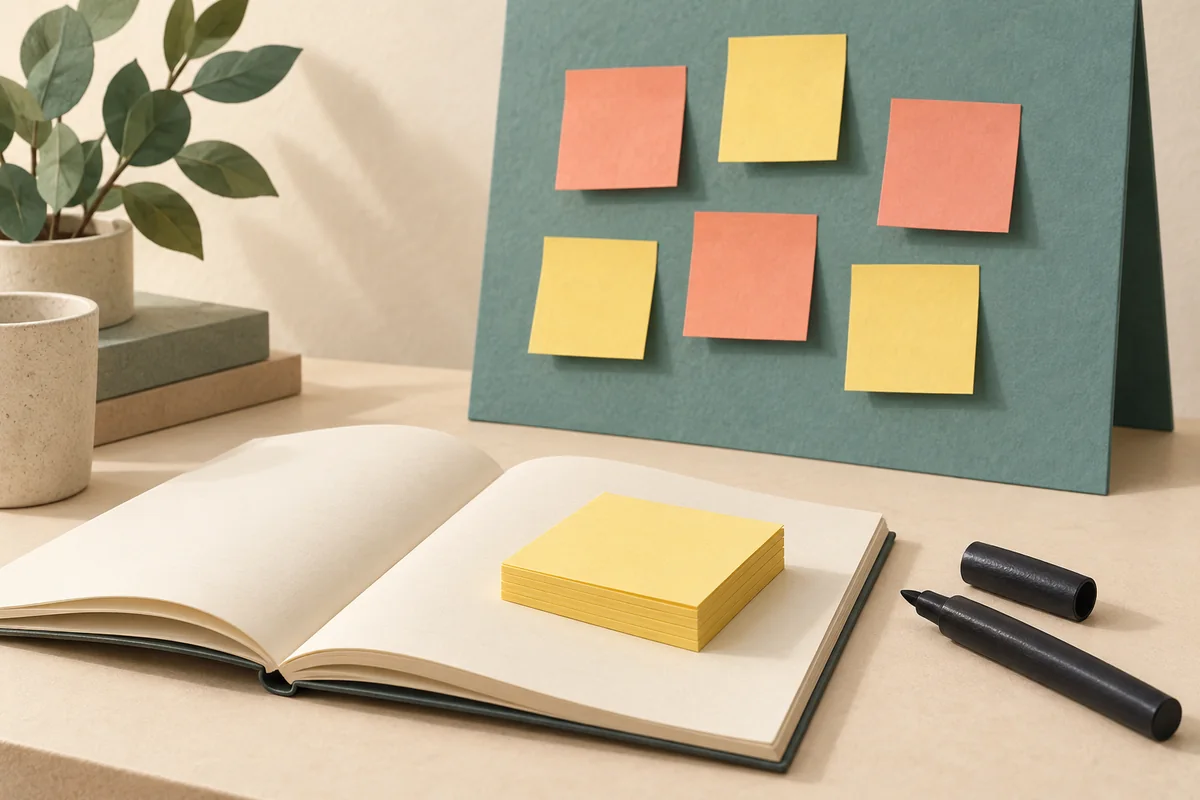
Do not assume branded sticky notes ordered for a desk will also work on a workshop wall. Specify the surface first, then ask for an adhesive intended for that use. For a facilitated session, approve the actual printed note on the permitted display surface before committing the full order.
A creative agency running a client workshop has two different jobs to solve: participants need somewhere to capture ideas, and the facilitator needs those ideas to stay visible while the group moves them around. A logo proof answers neither question.
Paper notes and wall notes are not the same brief
Manufacturer descriptions show why the distinction matters. 3M’s original Post-it Notes value-pack page describes an adhesive designed for paper. Its Super Sticky Notes product page specifically identifies walls, windows, doors and other vertical surfaces, including moving and re-sticking notes.
Those are statements about the listed products, not evidence that every promotional sticky pad has the same adhesive. They also do not establish Brand Sauce catalog availability, custom-print eligibility or delivery to your country. For a custom order, get the exact item, destination availability and decorated price confirmed; anything unconfirmed remains quote-needed.
Use this selection logic before comparing colors or quantities:
- Notes stay in a workbook or on paper handouts: start with a product specified for paper. Check that it removes acceptably from the actual printed handout, not just a sheet of ordinary office paper.
- Notes form a vertical workshop display: request a product specified for the intended vertical surface. Include how long the session lasts and whether participants will reposition notes.
- The venue prohibits adhesive or cannot approve the surface: choose an approved freestanding display or another capture method. A stronger adhesive is not a workaround for the room’s rules.
- The pad is only a take-home gift: avoid describing it as a workshop-wall product unless that use has been verified. If the exercise does not need removable notes, a notebook chosen for the writing task may be a simpler brief.
Put the logo outside the working space
Ask for an actual-size proof showing the trim, adhesive edge and printed artwork. Mark the area participants can write in. A large centered logo might look attractive in a product thumbnail but compete with the sentence the group needs to read.
For workshop pads, our recommendation is a modest mark near an edge, with a clear central writing field. This is a layout preference, not a universal production specification: ask the printer to confirm its template and restrictions. Use the logo-file handoff checklist for the separate artwork-production step.
Write an example workshop contribution at the proposed size, then view it from the farthest expected participant position. If the exercise requires an idea plus a name or vote tally, include those too. Choose note dimensions from that task; do not shrink the writing just to preserve an oversized logo. If colors represent categories, add written category labels to the display so color is not the only cue.
Copy this workshop sample card
This is a proposed buyer acceptance check, not a laboratory method or a test Brand Sauce has performed. Agree the pass conditions before comparing samples, and follow the product’s application instructions.
- Identify the sample. Record manufacturer, item code, dimensions, adhesive specification and artwork version. State whether it is the finished printed item or an undecorated sample; the latter leaves print usability unresolved.
- Name the permitted surface. Record the actual board, glass or wall finish and obtain the venue’s permission. Use an approved inconspicuous area for the check. Do not assume permission for glass also covers painted walls.
- Rehearse the writing. Use the marker supplied at the session. Check that the idea is legible over any printing, that normal handling does not smear it, and whether marks transfer to the sheet underneath.
- Rehearse the display period. Apply fresh notes as instructed and leave them for the planned session duration. Record curling, lifted edges or fallen sheets. Use comparable positions and conditions for each candidate.
- Rehearse the moves. Move notes between the actual exercise zones as many times as the agenda requires. Record whether each note remains usable after those moves; a successful first application does not answer this.
- Check removal and close the decision. Inspect the approved surface for residue or visible changes after removal. Record pass, reject or restricted use, with the reviewer and date. A pass applies to the conditions checked, not every wall or finish.
Copyable release record: Item/artwork: ___; destination: ___; permitted surface: ___; marker: ___; display duration: ___; required moves: ___; writing/display/removal observations: ___; approved use: ___; outstanding questions: ___; approver/date: ___.
When to separate the giveaway from the workshop supply
Hypothetical example, not a customer result: an agency wants branded pads in welcome packs and a three-hour idea-mapping session with two rounds of regrouping. Its quoted custom pad is specified only for paper. Rather than infer wall performance, the buyer keeps that pad for workbook notes and requests a separately verified workshop supply for the display. Alternatively, the buyer asks for a custom option that meets both briefs and approves its sample before ordering.
The split is a purchasing option, not a claim that two orders are cheaper. Compare the complete quotes, minimums and delivery requirements. Keep the workshop-critical supply on the event checklist even if the take-home gift changes.
The final buying question is: “Will this exact printed note support this exercise on this approved surface?” A familiar brand name, an attractive mockup or the word “sticky” cannot answer that on its own.
Manufacturer guidance checked October 8, 2026. The hero is an AI-generated editorial illustration, not a catalog item or a product-test result.