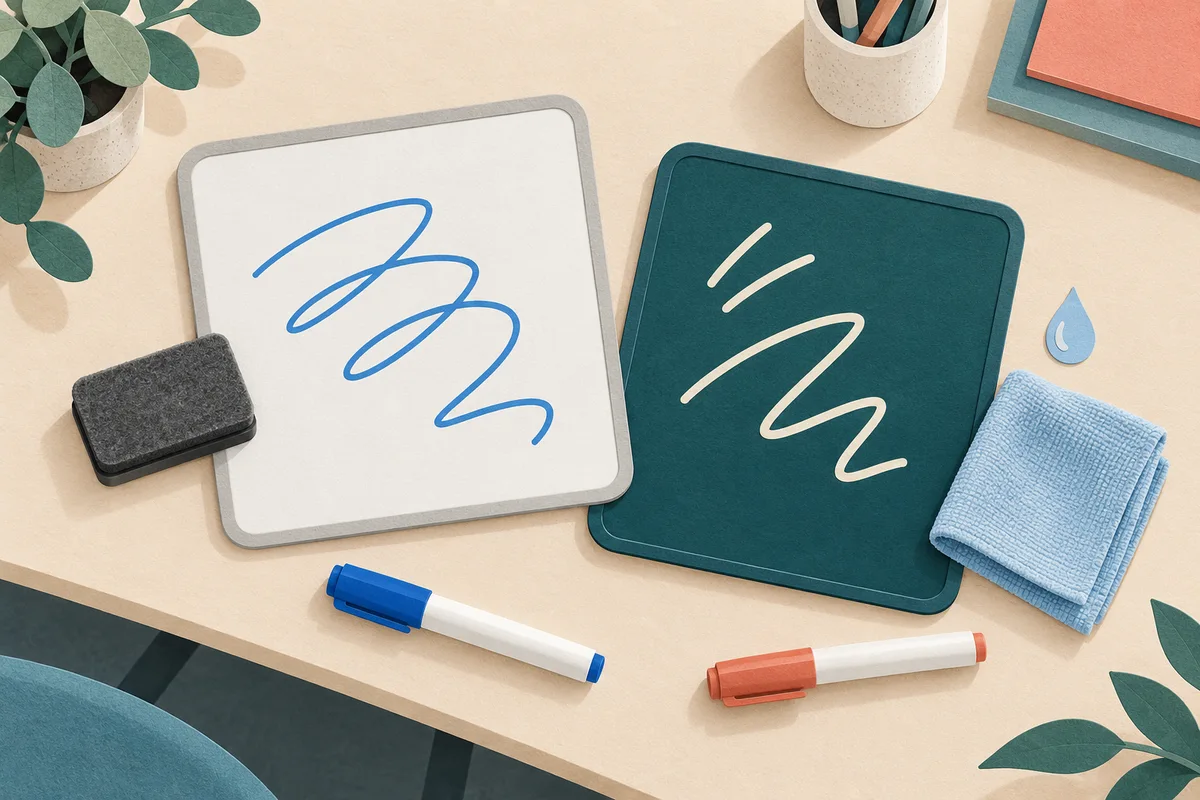
Choose the erasing method before you order a branded reusable board. For a training exercise that resets every few minutes, start with a supplier-approved dry-erase board and marker pair. For a display that people may brush against, investigate a compatible wet-erase system. Neither “reusable” nor “non-permanent” tells you enough on its own.
The buying unit is the finished board, its marker and its cleaning instructions—not a glossy blank plus whichever pen happens to be in the cupboard. This matters for small workshop boards, desk planners and reusable activity cards as much as for a wall-mounted board.
Dry-erase and wet-erase solve different problems
In its guidance on erasable writing on glass, edding distinguishes its dry-wipe 90 glassboard marker from its 4090 and 4095 chalk markers, which it recommends for smudge-resistant applications and removes with a damp cloth. That is a manufacturer-specific distinction, not permission to use any chalk marker on any board.
Surface compatibility still comes first. For example, the edding 365 whiteboard marker is described as dry-wipeable from virtually all non-porous surfaces, including enamel and melamine. “Virtually all” is not a guarantee for an unknown laminate, printed logo or decorative coating. These manufacturer examples explain the categories; they are not a Brand Sauce stock or decoration offer.
- Fast, repeated workshop answers: shortlist dry-erase pairs. Include an eraser with each board or make one readily available at each table.
- A board handled while the writing should remain: investigate a wet-erase pair, then check normal handling on a sample. Plan where the damp cloth comes from and who resets the board.
- A permanent record of the exercise: use paper or agree a capture method before erasing. An erasable board alone does not preserve participants’ work.
- A printed reusable card with an unspecified coating: pause the marker choice until the printer identifies the finished writing surface and compatible ink.
If participants need to keep and rearrange individual ideas, workshop sticky notes have a different job. Choose the activity format before deciding which object gets the logo.
Approve the decorated sample, not just the blank
Ask whether the permanent graphics sit beneath the writing layer, on its exposed surface or outside the writing area. Have the supplier identify where participants may write and which cleaner is permitted. A proof of logo placement cannot establish erasability.
Use this proposed acceptance exercise with a production-representative sample. It is a purchasing check, not a test Brand Sauce has performed:
- Write the actual task. Use the exact supplied marker, including the colors you will distribute. Check whether the tip can form readable answers within the intended boxes.
- Allow the intended dwell time. If answers stay up for an hour, check after an hour. For a weekly planner, ask the supplier to demonstrate the longer interval under its care instructions; do not extrapolate from an immediate wipe.
- Reproduce normal handling. Have someone hold or pass the board as planned. Check whether important marks rub off before the activity ends.
- Erase as instructed. Use only the approved dry eraser, damp cloth or cleaner. Check for residual writing, smeared ink and changes to the permanent print. If writing across a logo is intended, include that area only after the supplier confirms it is writable.
- Reset and write again. Check readability after cleaning and drying. Record the exact combination that passed; do not silently substitute a different marker in the final kit.
Dry-erase does not mean maintenance-free. Quartet’s board-care guidance includes erasing, cleaning and thorough drying, and warns that remaining cleaning solution can mix with new ink and make later erasing harder. Follow the instructions for the specific board, especially a custom printed one, rather than borrowing a cleaning recipe from an unrelated surface.
A short brief you can send with the artwork
We need reusable boards for ______. Answers remain for ______ before reset. Participants will hold/pass/display them as follows: ______. Please quote the finished board with its named compatible marker and erasing accessory. Identify the writing surface, permitted writing zones, cleaning method and any limits on ink dwell time. Supply a decorated sample for a write–handle–erase–rewrite check. Confirm the replacement marker reference and availability in each destination country. Board, decoration, accessories and replacements remain quote-needed until confirmed.
Send the appropriate logo artwork files with that brief, but keep technical approval separate from visual approval. Both need to be resolved before ordering.
Illustrative decision: a facilitator wants every table to show an answer, erase it and move to the next question. A confirmed dry-erase set fits that reset routine. A reception team wants a small reusable sign whose writing survives incidental contact; a compatible wet-erase system may fit better, provided the team can clean it as directed. These are proposed choices, not measured performance results or promises about every surface.
The final handout should name the marker and say how to erase it. “Use an erasable pen” leaves the most important part of the purchase to chance.
Illustration: AI-generated editorial concept, not an actual catalog product or test result.