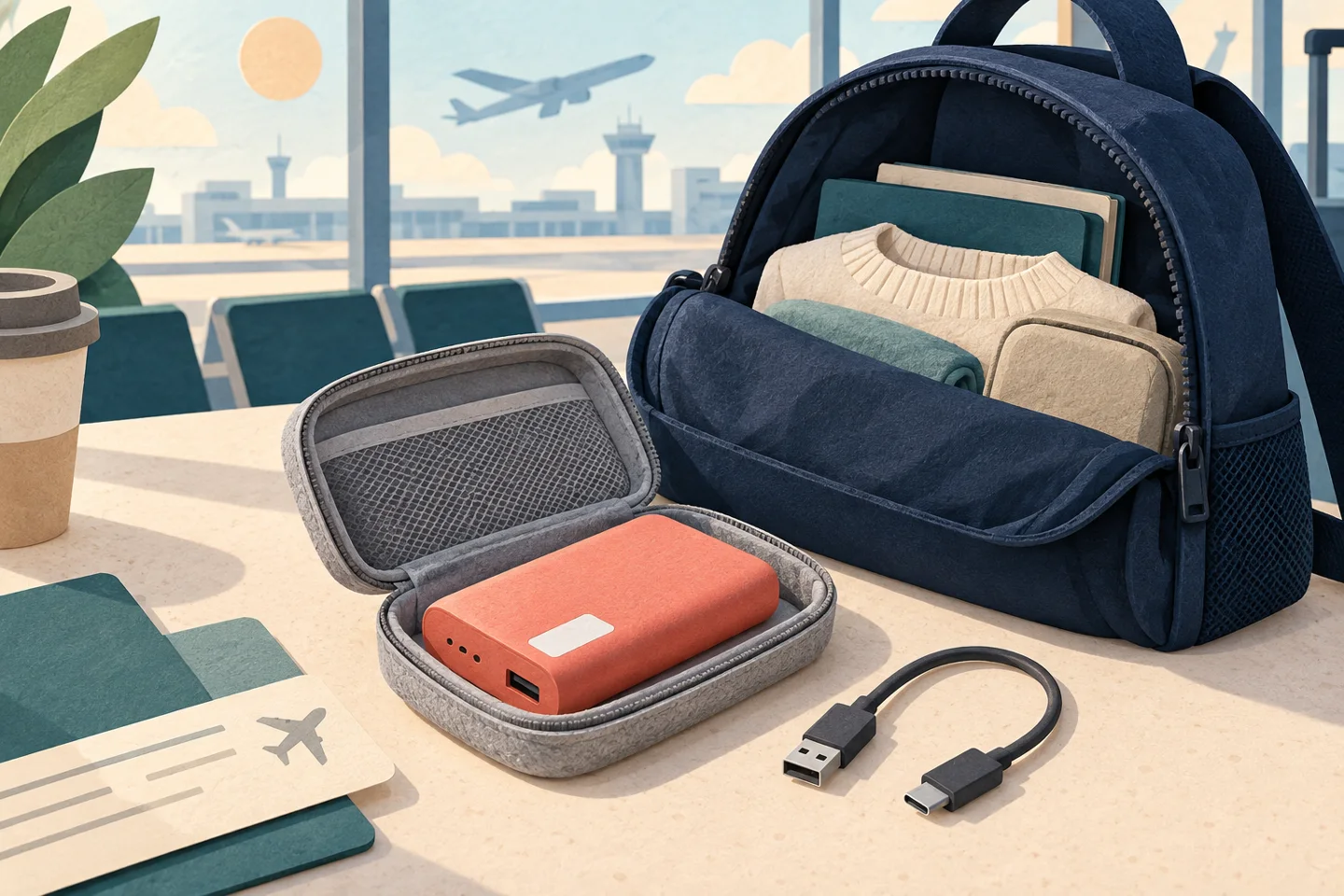
Employees can often fly with a branded power bank for personal use, but a logo does not make it airline-approved. The exact battery, its readable capacity label, the operating airline and the way it is packed all matter. For a sales kickoff or conference gift, check the return journey before ordering.
There is also a separate question for the event organizer: bringing one gift home is not the same as taking a suitcase of chargers to distribute at a booth.
Start with the battery rating, not the marketing name
The FAA’s passenger battery guidance gives a general lithium-ion limit of 100 watt-hours (Wh); its larger-battery allowance requires airline approval and is not a promise that a particular airline accepts a larger power bank. Ask for the exact model’s Wh rating before choosing artwork.
Milliamp-hours alone are not enough to calculate energy. The FAA explains the calculation as battery volts multiplied by amp-hours, with mAh divided by 1,000 first.
Worked example—not a catalog specification: if a manufacturer specifies a 10,000 mAh battery at 3.7 V, the calculation is 10,000 ÷ 1,000 × 3.7 = 37 Wh. Use the manufacturer’s battery rating and documentation, not an assumed voltage or a USB output setting. That calculation does not certify a product or override an airline’s policy.
Check the airline, not just the airport
The UK Civil Aviation Authority’s summary of the March 2026 changes specifies a maximum of two power banks per person, individual protection and cabin-only carriage. It says power banks must not be recharged aboard the aircraft and should not be used to charge other devices aboard. Do not turn that distinction into permission to use one on every flight.
For example, Emirates’ current dangerous-goods policy allows one power bank with a maximum capacity of 100 Wh and clearly visible capacity information. It prohibits both using and recharging it onboard, and requires storage in the seat pocket or under the seat rather than overhead. Those are Emirates conditions, not a universal allowance.
Sources checked September 29, 2026. Check each operating carrier and applicable departure or transit requirements again before travel. A recipient who already carries a personal charger may have no room within the relevant quantity limit for your gift.
Do not fly your booth inventory as personal batteries
The FAA’s lithium-battery packing guidance says the passenger allowance is for the passenger’s use, not batteries carried for further sale or distribution, including vendor samples. Splitting a box of giveaways among colleagues does not turn it into personal-use stock.
Arrange an appropriate shipment with a supplier or carrier that can confirm the battery shipping requirements, or choose a different giveaway. Our conference delivery guide can help with the receiving location and deadline; it is not a battery-transport clearance.
The same FAA guidance requires power banks to stay in the cabin, including removal from a carry-on that gets gate-checked, and protection against damage and short circuits. Damaged or recalled batteries that may spark or generate dangerous heat must not travel unless removed or made safe as specified in the guidance. Do not include a questionable unit in an employee gift kit.
A six-point buyer release checklist
Use this original decision aid before approving a travel-oriented power-bank gift. An unanswered item means hold the order, resolve the gap or offer another gift—not assume approval.
- Identify it: record the manufacturer, exact model, battery Wh, technical documentation and recall-check date. Ask the supplier for the documentation supporting that model’s transport eligibility.
- Protect the label: request a decorated proof that leaves the capacity rating, model identification and safety information readable. The logo should not cover the information a traveler needs.
- Map the journey: record the operating airlines’ policy links, capacity and quantity limits, storage rules, and onboard use restrictions. Include connections and return flights.
- Separate freight from personal travel: name the party responsible for compliant delivery of the giveaway stock to the event. Do not assign this to an employee’s suitcase.
- Check the recipient experience: provide suitable protective packaging, a packing note and a non-battery alternative for anyone whose itinerary or existing charger makes the gift inconvenient.
- Confirm the order: obtain written availability for the exact model, decoration and destination, plus a complete quote. This post does not verify a Brand Sauce catalog SKU or country availability; pricing remains quote-needed.
If recipients travel on many different itineraries, let the uncertainty influence your gift assortment. A non-battery choice may be easier than asking every employee to resolve a charger exception. Confirm that alternative’s availability too.
A short note to include with the gift
Before your flight, check your operating airline’s current power-bank rules, including your other batteries. Keep this item’s capacity label readable. Carry it in the cabin with protection against damage and short circuits; remove it if your bag is gate-checked. Follow the airline’s storage and charging restrictions. If this gift does not suit your trip, contact [program contact] for [confirmed alternative].
Replace the bracketed fields and confirm the alternative before using the note. A printed link can point to your program’s travel information, but it should not replace the manufacturer’s label; use our QR-code scan checklist if you add a code.
The hero is an AI-generated editorial illustration, not a catalog product, safety certification or product test.