Choose a branded pen by how it writes for your recipients, not by whether the listing says “gel” or “ballpoint.” For left-handed note-takers, put fast-drying ink on the brief, then ask someone who writes left-handed to try the exact pen on the paper you will supply. A polished barrel and a good logo proof cannot answer the smudging question.
This matters for training days: the pen should keep up with someone taking notes, turning pages and filling in exercises—not require them to pause after every line.
Do you need a special left-handed pen?
Not necessarily. Start with an ordinary pen that suits the writing task, and evaluate it with left-handed users rather than assigning them a different product automatically. Comfort and writing habits vary; let the person hold the pen and position the page naturally.
Manufacturer information can help narrow the samples. Zebra describes its SARASA dry X1 as a fast-drying gel pen suitable for left-handed writers, but its testing note says drying time depends on variables including writing pressure and surface. That qualification matters more to your order than treating a headline drying time as a guarantee on every workbook.
Uni-ball’s UK page for the Jetstream RT SXN-210 also emphasizes fast drying and suitability for left-handed users. Together, these examples are a reason to compare the exact ink-and-pen combination, not reject every gel pen or approve every ballpoint.
These are manufacturer examples, not a Brand Sauce product shortlist. They do not establish that either model is currently available with your logo, in your quantity or in each destination country. Request that confirmation and a current quote before building either into a gift promise.
Run a short writing check before approving the batch
The following is a proposed buyer acceptance check, not a laboratory method or a claim that Brand Sauce has tested these pens. Use it to compare samples under the same practical conditions.
- Identify each sample. Record supplier SKU, model, ink color, tip size and refill specification if provided. Keep barrel color separate from ink color.
- Use the real paper. Try the training workbook or notebook edition you plan to distribute. Include any different worksheet stock used during the session. A pass on office copy paper is not a pass on every surface.
- Write at a normal pace. Invite left-handed reviewers to take a paragraph of notes, complete a few short answers and turn the page as they normally would. Do not coach them to hover their hand or slow down to make a sample pass.
- Look at three separate outcomes. Record ink transfer to the hand, smearing of the written line and transfer onto the facing page. Keep them separate: clean hands do not prove that closing the workbook immediately is trouble-free.
- Check usability too. Ask about grip comfort, skipping and ease of starting the next line. Look at the reverse of the paper for marks that make the next exercise hard to read.
- Save the result with the specification. Keep the marked sheets and identify who reviewed them. Recheck if the supplier changes the pen, refill, tip size, ink or workbook stock.
If the paper itself needs reconsideration, use the broader company notebook selection guide. Here, the decision is whether a particular pen works for the person and the writing surface—not which notebook construction to buy.
A sample-review card you can copy
Pen and workbook check
Sample ID / exact pen specification: ______
Paper or workbook edition: ______
Reviewer / date: ______
Normal writing task completed: ______
Hand transfer: none observed / observed
Line smearing: none observed / observed
Facing-page transfer: none observed / observed
Grip and writing feedback: ______
Decision: approve this combination / try another pen / try another paper
Approved replacement or substitution rule: ______
“None observed” describes that review, not a universal smudge-proof claim. If reviewers disagree, record the difference and offer an alternative where practical. Do not average away a recurring problem simply because most people liked the barrel.
What if your favorite pen fails?
Hypothetical training-day decision: a professional-services team likes a metal pen’s appearance. On its sample workbook, a left-handed facilitator repeatedly smears notes while writing normally. A second pen works comfortably on the same pages. The team can quote the second pen with its branding, or try a different paper with the first. It should not approve the first combination and ask attendees to adapt their writing.
If refillability is part of the brief, keep the approved ink specification when arranging replacements; our branded pen refill checklist covers that separate purchasing question. An unspecified replacement can leave you with a different writing experience inside the same barrel.
Order when the sample works, the exact specification is written down and the decorated supply route is confirmed. Leave prices and country availability as quote-needed until then. A useful pen is one recipients can write with comfortably—not one that only passes the photograph test.
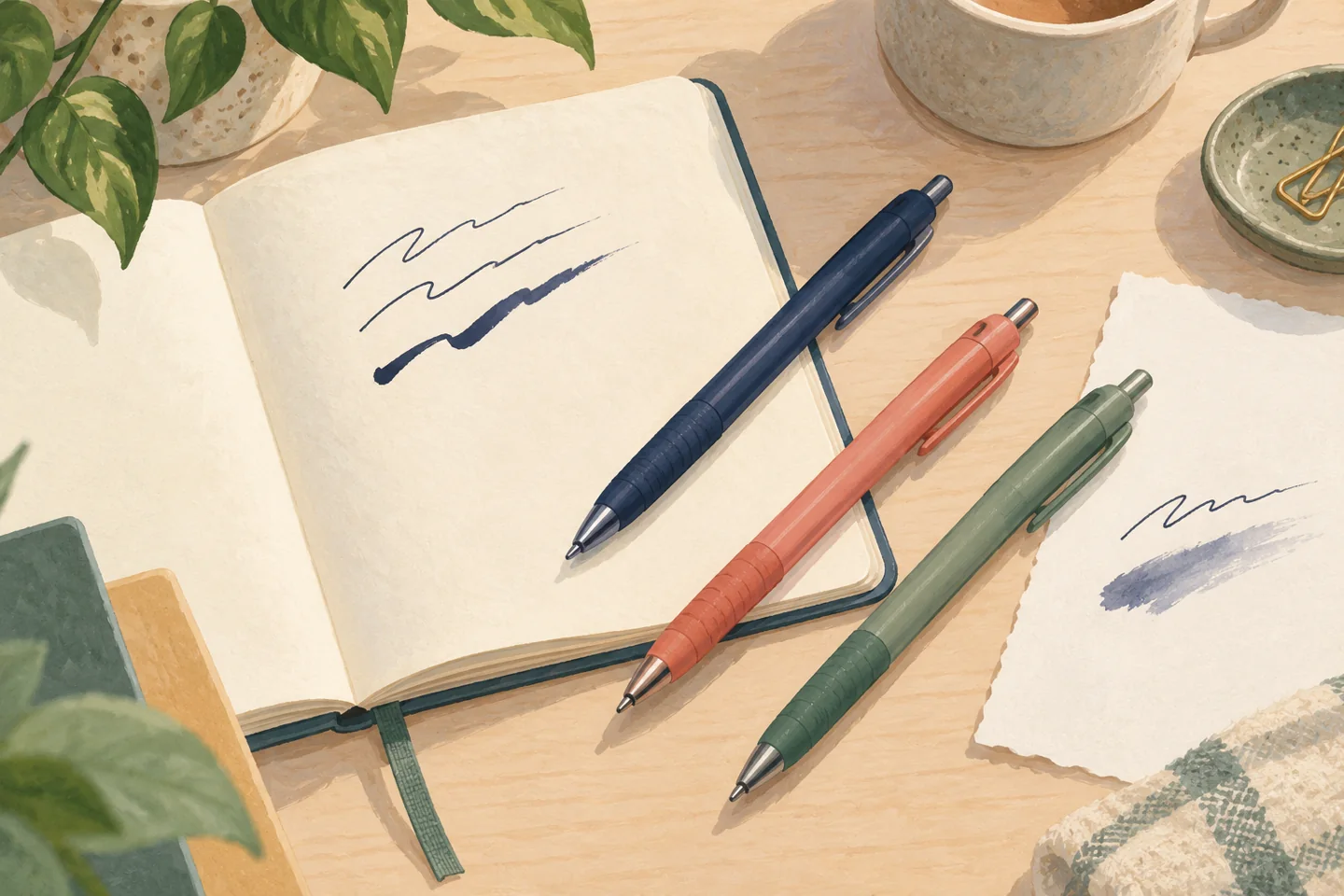
Illustration: AI-generated editorial artwork, not a product photograph or a recorded writing test. Manufacturer pages checked October 5, 2026.