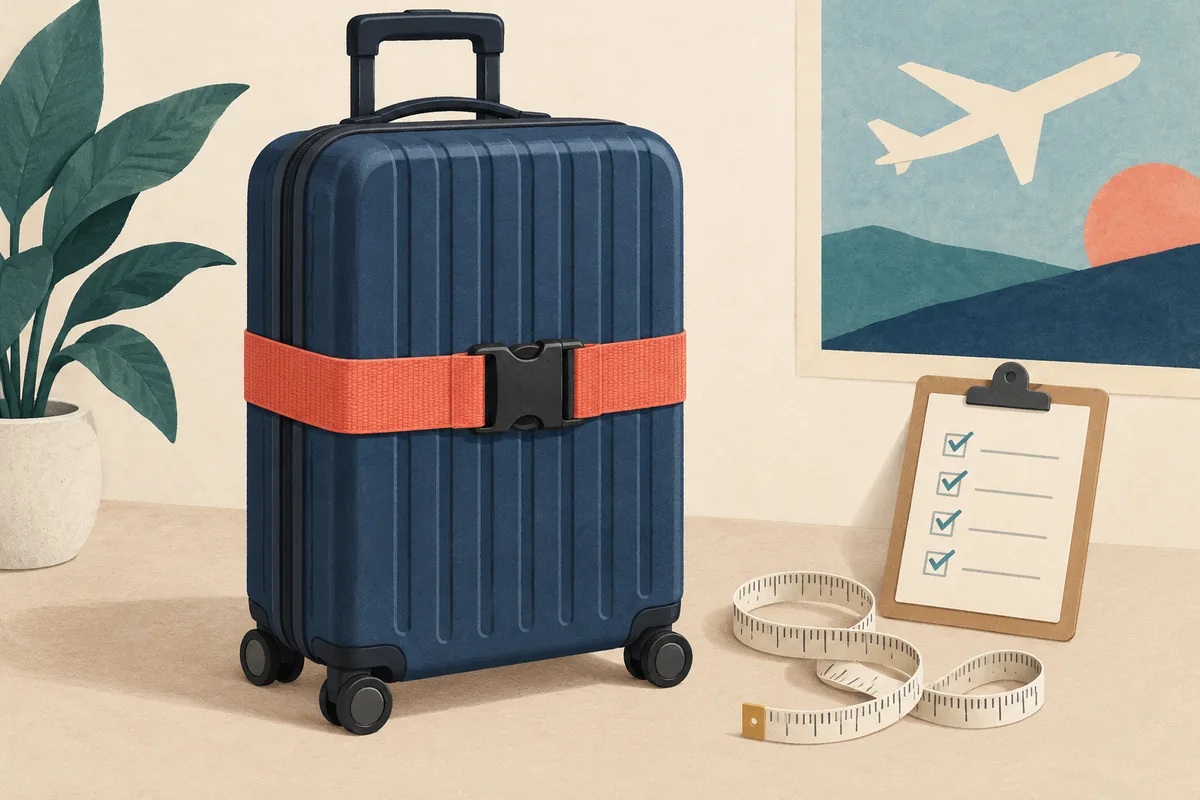
Size a branded luggage strap against the distance all the way around a packed suitcase, along the route the strap will follow. A suitcase’s advertised height is not that measurement. For a sales-team travel gift or an incentive-trip kit, request the strap’s minimum and maximum usable closed-loop circumference before approving an order.
That wording matters. A long strip of webbing, a buckled loop laid flat and the circumference of that loop are different measurements. “Adjustable” does not tell you how small the loop can become—or whether it will reach around an expanded case.
Read the dimension label before comparing numbers
Travelon’s luggage strap listing separates a 75-inch product length from a stated 39–73-inch circumference range. Its description also includes smaller “closed” and “completely open” figures. Those labels are a good reason to ask which measurement describes the working loop, rather than selecting the biggest number on the page.
Go Travel’s luggage strap listing gives a 1,700 mm height dimension but does not supply a minimum-to-maximum closed-loop range in that specifications block. A dimension alone is not enough to establish fit at both ends of the adjustment.
These are manufacturer specification examples, not a tested product shortlist or confirmation that either item is available with Brand Sauce decoration. For a branded order, confirm the exact item, artwork method, destination-country availability and delivered quote with the supplier.
Measure the packed route, including expansion
- Pack and close the case. Include any expansion setting the traveler expects to use. An empty soft-sided bag is not a reliable proxy for a full one.
- Choose the intended route. A horizontal wrap around the body and a vertical wrap over the top and underneath the case require different lengths. Follow the strap maker’s installation guidance; keep wheels and working handles clear.
- Measure one complete loop. Run a flexible tape around that route without compressing the suitcase. Record the circumference and units. If using non-stretch cord instead, mark where its ends meet and measure the cord afterward.
- Check the smallest case too. A strap that reaches the largest suitcase can still be too loose on a compact bag. Confirm that excess webbing can be retained as intended, without a dangling tail.
For early screening only, a rectangular horizontal route is approximately 2 × (width + depth); a vertical route is approximately 2 × (height + depth). Use the dimensions along the actual strap path, not an airline’s height-plus-width-plus-depth allowance. Curves, protrusions and packing make a direct loop measurement the better approval check.
A worked example: the same suitcase, two different answers
Illustrative arithmetic, not a product test: imagine a rectangular packed case with a body 28 inches high, 19 inches wide and 12 inches deep. A horizontal loop would be about 2 × (19 + 12) = 62 inches. A vertical loop would be about 2 × (28 + 12) = 80 inches.
A hypothetical strap with a supplier-confirmed usable range of 40–72 inches would pass the initial horizontal-length screen and fail the vertical one. If expansion adds 2 inches to the case depth, the horizontal estimate becomes 66 inches. Neither estimate proves that the buckle, adjustment or strap placement works: that comes from fitting the sample.
The decision rule is simple: every intended measured loop must fall within the confirmed working range, and the sample must fit without forcing the closure. If a measurement sits right at a limit, have the supplier resolve the fit on the actual packed case; do not invent a universal extra-length allowance.
Copy this luggage-strap approval card
Use one card for each proposed item and keep a photo of the fitted sample beside it. This is a suggested buyer acceptance check, not a baggage-handling certification.
- Item and adjustment: exact model; minimum and maximum usable closed-loop circumference; units; manufacturer’s fitting instructions.
- Cases checked: smallest and largest intended cases; packed and expanded settings; route and measured circumference for each.
- Closure: buckle fully engages without forcing; adjustment holds during ordinary rolling and repositioning; strap does not simply slide off the case.
- Clearance: wheels roll, handles operate and excess webbing is retained according to the instructions. Lift by the suitcase’s handle, not by the promotional strap.
- Artwork: approve logo placement with the strap adjusted on both cases. A buckle, slider or folded tail must not hide the only logo.
- Decision: approve the checked range, request a different size or choose another travel gift. Record any excluded case or wrap orientation in the recipient instructions.
Do not turn this check into a promise that a strap prevents theft, zipper failure or transit damage. It establishes suitability for the cases and everyday handling you checked, not every journey.
If the audience’s luggage sizes are unknown, offer a choice instead of calling one strap universal. A luggage tag with sensible contact details may suit a broader travel kit; a locking accessory raises a separate suitcase-lock compatibility question. Get the useful fit right before making the logo bigger.
Illustration: AI-generated editorial artwork, not a photograph of a supplied product or a fit-test result.