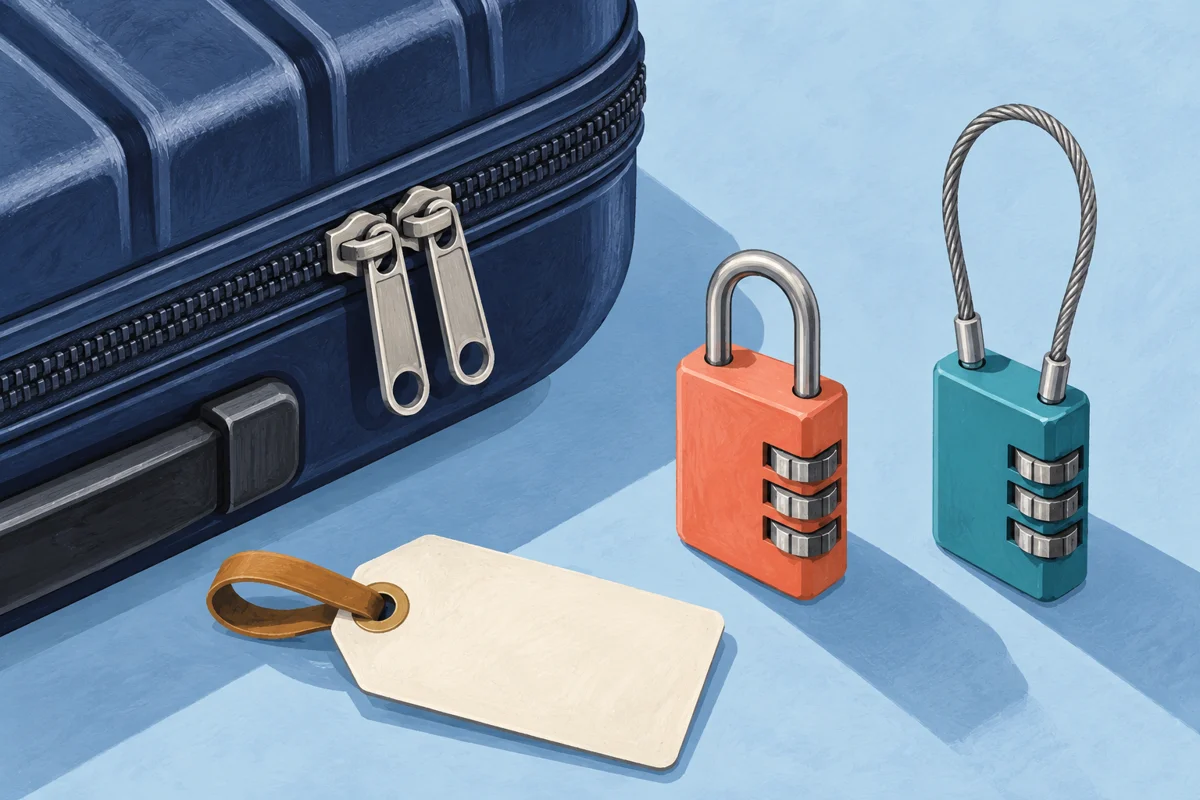
No. A branded luggage lock must fit the bag’s locking points, leave room for the user to operate it and suit the intended inspection system. “TSA-approved” does not mean universal suitcase fit. Before adding locks to a conference speaker gift or travel kit, approve the lock-and-bag pairing—not just the logo proof.
This is a purchasing checklist, not a lock-security test. Manufacturer information was checked October 8, 2026. The product example below explains dimensions; it is not a verified Brand Sauce catalog offer. Decoration, destination availability and delivered pricing remain quote-needed.
Three gates before the artwork proof
A small lock can still have a shackle too thick for a zipper pull. A thin cable can pass through both pulls yet leave the body awkwardly wedged against the case. Work through these gates in order:
| Gate | What to establish | If it fails |
|---|---|---|
| Attachment | The bag has two suitable locking points that the shackle or cable can join without forcing or modifying them. | Do not drill, bend or cut the bag hardware. Choose another accessory or a different compatible lock. |
| Reach and clearance | The closed lock reaches both points, rests clear of the zipper track and leaves its release mechanism accessible. | Try a different shackle shape or cable configuration on a sample; extra length alone is not proof of fit. |
| Operation | The intended user can read the dials, open and close the lock, and follow the model’s setup instructions while it is attached. | Change the mechanism or offer a different gift. A lock someone cannot operate is not an upgrade. |
For a suitcase with a built-in lock or a frame closure, first check its own instructions. A second padlock may be redundant or have no intended attachment point. For recipients bringing their own assorted bags, offer the lock as an option rather than promising that it fits everyone.
Read shackle dimensions, not just body size
For example, the Master Lock 4688D specification lists a flexible shackle with a 3 mm diameter, 38 mm length and 16 mm width, separately from its 30 mm body width. Those are four different measurements. The manufacturer also describes a user-set three-digit combination.
Use that distinction when requesting any promotional lock: ask for the diameter of the part that actually passes through the bag hardware, its usable reach and the body dimensions. If a cable has a thicker end fitting, ask for that measurement too. A nominal cable diameter does not answer whether its end will pass through a narrow opening.
Illustrative rejection rule: if a sample bag’s usable pull opening measures 2.5 mm and the part that must pass through it is 3 mm thick, reject that pairing. Do not approve it because the lock’s body looks compact. Conversely, an opening larger than 3 mm only clears the first gate; reach, shape and operation still need checking. These numbers illustrate selection logic, not a physical test we performed.
Inspection compatibility is a separate question
Travel Sentry explains its inspection system: authorized officers can open and relock compatible locks using inspection tools, and its Red Diamond identifies the system. That does not prevent baggage inspection. The company also notes that locks can be cut when officers cannot open them, and can break or go missing during handling.
Ask the supplier to identify the exact lock model and documented inspection-system compatibility. Keep recognition marks and the inspection keyway unobstructed by your decoration. Do not turn a supplier’s “TSA” label into a promise of theft-proof luggage, damage-free travel or compatibility at every airport.
Copy this lock-and-bag approval card
- Pairing: lock model/version; bag model; main compartment or other specific closure.
- Fit record: locking-point opening, shackle or cable dimensions, end-fitting clearance; photo of the closed pairing.
- Handling check: attach and remove without tools or force; confirm both intended locking points are captured and the body does not obstruct the zipper.
- User check: read dials and operate the release in the attached position. Follow the manufacturer’s setup procedure and verify the chosen combination before relying on the lock.
- Branding check: approved decoration area leaves controls, instructions, inspection markings and keyway visible and usable.
- Release: approved only for the recorded pairing, or held for a different sample; reviewer and date.
Include the model-specific instructions in the gift, not a generic reset diagram. Let each recipient choose their own combination; do not collect combinations in the event registration sheet.
If the bag itself is part of the package, complete the backpack fit check before approving its accessories. For a travel gift that does not depend on zipper geometry, consider a luggage tag and use our contact-details checklist. The useful gift is the one the recipient can actually use—not the one that merely fits inside the welcome box.
Image: AI-generated editorial illustration, not a photograph of supplied products or a fit-test result.