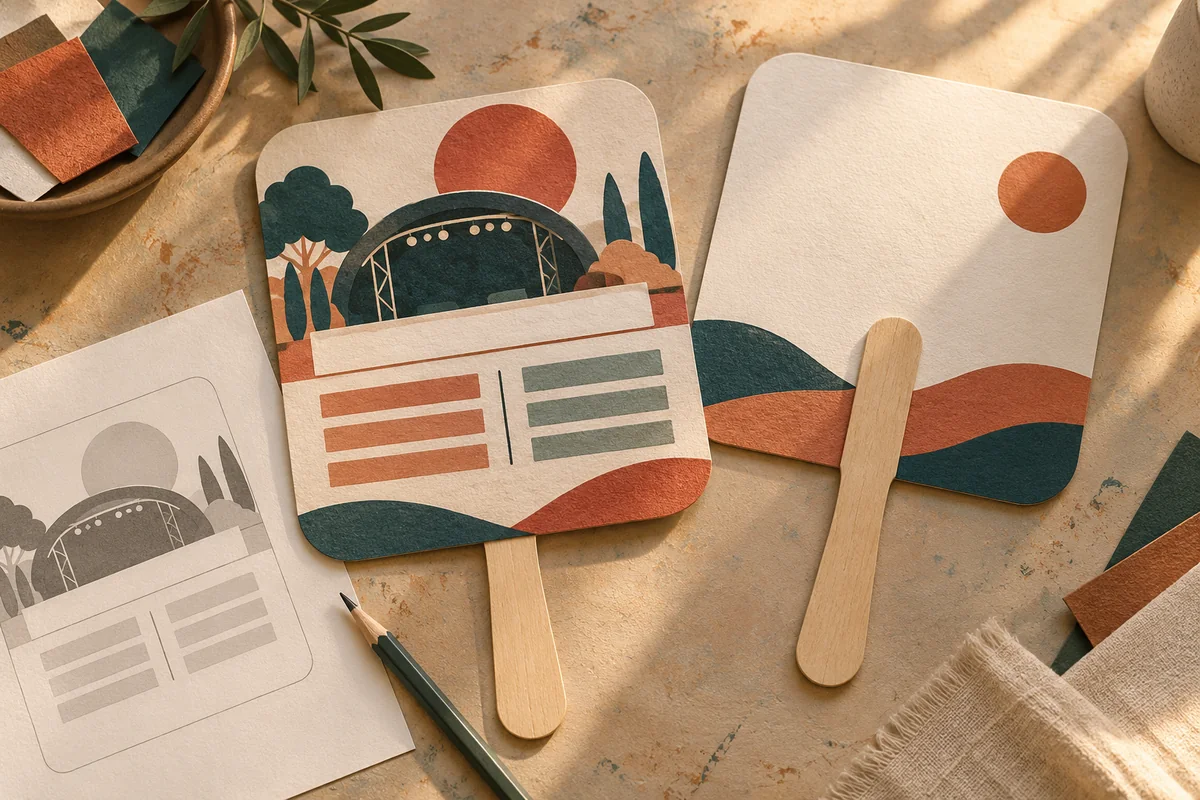
Yes—a branded paddle fan can carry a short event program, provided the layout is designed around the assembled fan, not just the flat artwork. The most important question is whether the back has an exposed handle. “Printed on both sides” does not automatically mean two uninterrupted reading surfaces.
For an outdoor theatre performance, community concert or arts fundraiser, give the fan one clear job: help a guest identify the event and find the next important detail. A full cast biography, venue map, sponsor directory and running order may deserve a separate program.
Check the handle before laying out the back
The fan section of Venturaline’s 2025 catalog (PDF, page 31), still available when checked, specifies a four-inch-high by 1¼-inch-wide allowance for the handle when printing the back of its single fans. That is a supplier-specific example, not a universal safe area; request the current template for the exact item you order.
Ask the printer for the exact shape template with trim, safe area and handle coverage marked. An exposed handle might split a schedule into awkward columns or cover the final line of a sponsor credit. Moving everything upward is not always enough: the curved top of a fan also limits the width available for long lines.
If the brief needs an uninterrupted back, ask about a construction that conceals the handle between layers, or a suitable stickless design. For example, Venturaline’s BL-7915-FSAND specification sheet describes a handle attached between the cardstock layers and full-color printing on both sides. Approve the actual construction in the quote and proof; the phrase “double-sided” alone is insufficient.
Use a three-level content brief
This is an original editorial planning aid, not a printer’s technical specification. Fill it in before the designer starts:
- Must be readable without a phone: event name, date, the short running order or main performance time, and the essential venue information guests need while seated.
- Include only if the actual-size proof remains comfortable to read: a concise sponsor acknowledgment, a short welcome or a small number of performer names.
- Move elsewhere: long biographies, extensive credits, detailed maps, complete accessibility information and any schedule that is still changing. Provide a separate printed option where needed, not only a web link.
Put the most prominent brand or event artwork on the front and the useful reading content on the back. This is a starting layout, not a rule: if the back is interrupted by the handle, place the running order on the clear front instead and simplify the branding.
Do not solve an overcrowded design solely by shrinking type. Print the proof at final size and ask someone who did not design it to find the start time and next item under lighting similar to the event. If they have to hunt or bring it unusually close, remove content or choose a separate program.
Worked example: a small outdoor arts performance
Illustrative scenario—not a customer project: an organizer wants a fan for a performance with three program items and six sponsors. The first brief also includes performer biographies and a paragraph about each sponsor.
A workable revision is:
- Front: event artwork, event name, date and venue.
- Back: the three-item running order in the clear area, followed by the six approved sponsor names only if they remain readable.
- Separate program or maintained event page: biographies and longer sponsor descriptions, with a readable web address on the fan.
If the chosen fan’s handle crosses the running order, the organizer must relocate the text, change the fan construction or use a separate program. A screen proof that hides the handle is not an acceptable resolution. If sponsor contracts require larger marks or more copy, resolve that requirement before ordering—not by squeezing logos into the remaining corners.
Match the material to the event conditions
Do not treat “laminated” as a promise of waterproof performance. Stouse’s rally-fan specifications distinguish coated poster board for short-term outdoor use, laminated tag stock explicitly described as not waterproof, and corrugated plastic options. These are useful examples of why the exact material matters.
Tell the supplier whether the handout will be distributed under cover, carried outdoors or used where rain is plausible. Request written suitability guidance for the selected material and print finish. A coated fan intended for brief outdoor use is not automatically appropriate for a wet, all-day festival.
These supplier pages were checked October 9, 2026. They are construction examples, not a verified Brand Sauce catalog shortlist. Exact sourcing, delivery-country coverage, quantities and delivered pricing remain quote-needed.
Copy this fan-program release checklist
- Construction: supplier/model ___; material ___; finished dimensions ___; exposed, concealed or absent handle ___.
- Artwork: front and back shown at actual size ___; trim and safe area confirmed ___; handle coverage visible on proof ___; all required text outside obstructed areas ___.
- Editorial: event/date/time checked ___; performer and sponsor names approved ___; schedule frozen for print ___; longer or changing content moved to its agreed destination ___.
- Reading: unfamiliar reviewer finds the key details ___; contrast and type size accepted on the physical proof ___; alternative program format arranged if needed ___.
- Use: assembled sample or representative construction reviewed ___; supplier’s material guidance matches the planned conditions ___; grip does not cover essential reading content ___.
- Release: final proof version ___; approver ___; approval date ___; confirmed delivery date and destination ___.
This is a proposed purchasing check, not a product test Brand Sauce has conducted. A home-printed layout can expose readability problems, but it cannot establish the finished fan’s color, durability or assembly quality.
If the design includes a QR code, use our finished-surface scan checklist before release and keep a typed alternative. For production artwork, the logo-file handoff guide explains what to send the printer. The final decision is simple: if the fan cannot carry the essential information comfortably, let it be a fan and give the program its own space.
Image: AI-generated editorial illustration, not a customer photograph, supplier product image or tested sample.