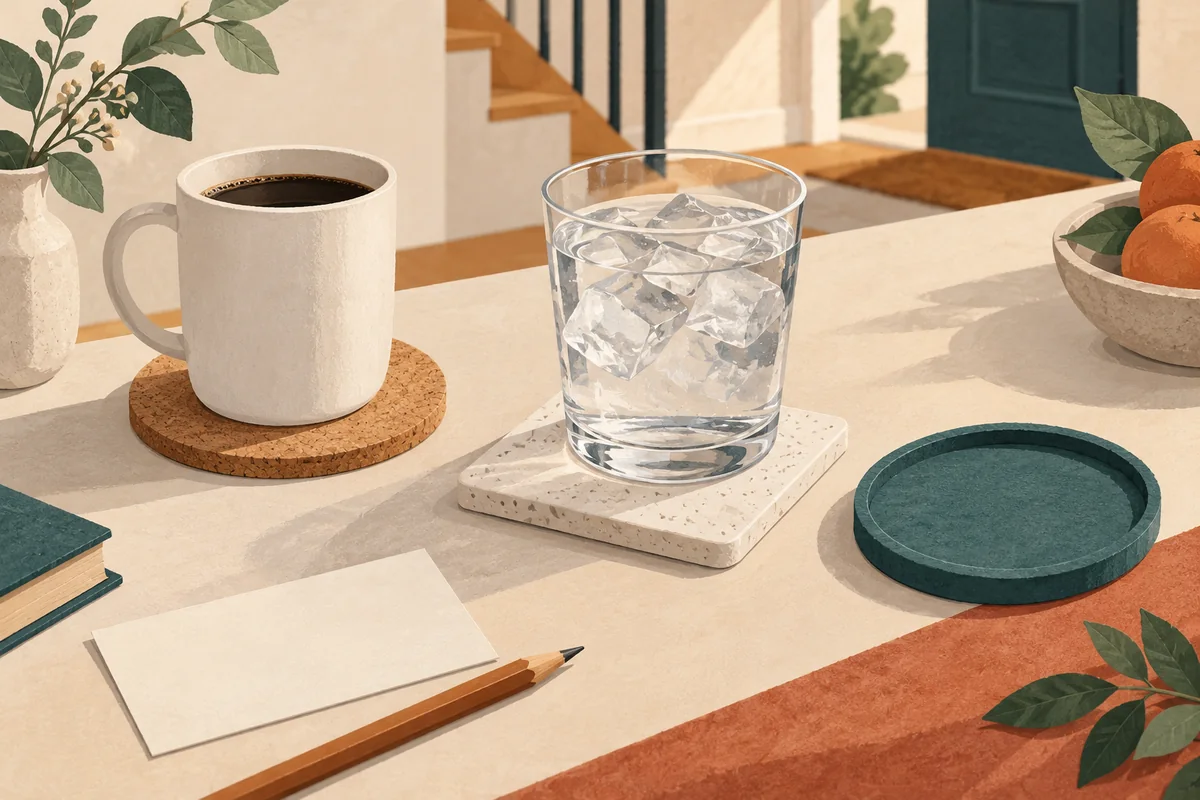
A branded coaster is not necessarily an absorbent coaster. If your real-estate open house serves cold drinks, ask what happens to condensation on the finished, decorated item: does it soak in, collect on the surface, or reach the table? Choose from that answer—not from the word “stone,” a cork underside or a convincing mockup.
For a take-home gift, appearance matters. For the refreshment table, the coaster also needs to work with your glassware and cleanup routine. One item can do both jobs, but that should be a checked decision.
Read the construction, not just the material name
CoasterStone describes its promotional range as absorbent stone coasters with full-color, edge-to-edge printing. That is useful evidence that decoration and an absorbency claim can coexist in a manufacturer's range. It is not proof that every printed stone or ceramic coaster performs identically, or that a particular design has passed your use check.
Likewise, IKEA’s 365+ cork coaster listing specifies cork and damp-cloth cleaning. That instruction applies to that item; it is not permission to put any cork-backed promotional coaster in a dishwasher. The top surface, backing, adhesive and decoration all belong in the care specification.
These are construction and care references, not a Brand Sauce product shortlist. No current Brand Sauce stock, customization eligibility or destination availability is asserted here. Ask for the exact item code, country availability and decorated quote before ordering; unconfirmed pricing remains quote-needed.
Choose the job before requesting samples
- You want condensation taken up by the coaster: request an explicitly absorbent finished item. Ask whether the claim covers the proposed printing or coating, and how the coaster should dry between uses.
- You want a wipe-clean barrier: ask how the design contains moisture and how staff should remove it. A surface that does not absorb water can still suit the job, provided the actual setup keeps moisture off the furniture.
- You want a giveaway rather than table service: prioritize a clear care instruction, usable drink footprint and decoration that remains legible. Do not describe it as absorbent unless the supplier supports that claim for the delivered item.
A cork underside tells you about the underside. Ask separately what the drink touches. A raised rim may also make the usable flat area smaller than the advertised outside diameter; place the actual glass or mug on the sample. If you are selecting the vessel too, our drinkware selection guide addresses its separate everyday-use requirements.
Run a refreshment-table sample check
This is a proposed purchasing check, not a laboratory standard or a test Brand Sauce has conducted. Use a protected test area, not valuable staged furniture, and follow the supplier’s care instructions.
- Identify what you received. Record item code, top material, backing and decoration method. An undecorated sample cannot settle how the final print will look or behave.
- Check the fit dry. Set each planned glass and mug on the usable surface. Reject a combination that rocks, catches on the rim or cannot sit securely.
- Rehearse the cold-drink service. Use the planned vessel, drink temperature and refill pattern for the expected dwell time. Record those conditions so candidates can be compared fairly.
- Observe the water route. Check the top, edge and underside periodically. Record pooling, runoff or moisture underneath. Darkening alone is not a complete pass: the table-facing side matters too.
- Lift and reset the glass. Note whether the coaster comes up with it, shifts or leaves moisture behind. Inspect for visible print transfer or surface changes during ordinary handling.
- Rehearse cleanup. Follow the approved cleaning and drying method, then inspect the print and backing. Confirm who will dry and store reusable stock before the next event.
Copyable acceptance record: Item/artwork version: ___; destination: ___; glass or mug: ___; cold-drink conditions and duration: ___; top/edge/underside observations: ___; lift-and-reset result: ___; approved cleaning method: ___; drying/storage owner: ___; pass, reject or restricted use: ___; reviewer/date: ___.
Put the message where guests can actually see it
Lay the artwork proof beneath the actual vessel. A centered logo may disappear while the drink is in place; that can be fine for a keepsake, but less useful if the coaster carries event information. Keep essential information visible or repeat it elsewhere. If it carries a QR code, use the finished-item scan checklist, including a check with the glass in position.
The release decision should name both the product and its approved role: refreshment-table supply, take-home gift, or both. That is more useful than approving a material name and discovering its limitations at the event.
Primary supplier guidance checked October 8, 2026. The hero is an AI-generated editorial illustration, not a catalog photograph or an absorption-test result.