Do not assume a branded candle’s lid is a snuffer. A lid can protect a stored candle without being intended to extinguish it. Before choosing candles for a client thank-you or employee holiday gift, ask for the exact candle’s instructions—not an answer based only on whether its lid is metal, wood or glass.
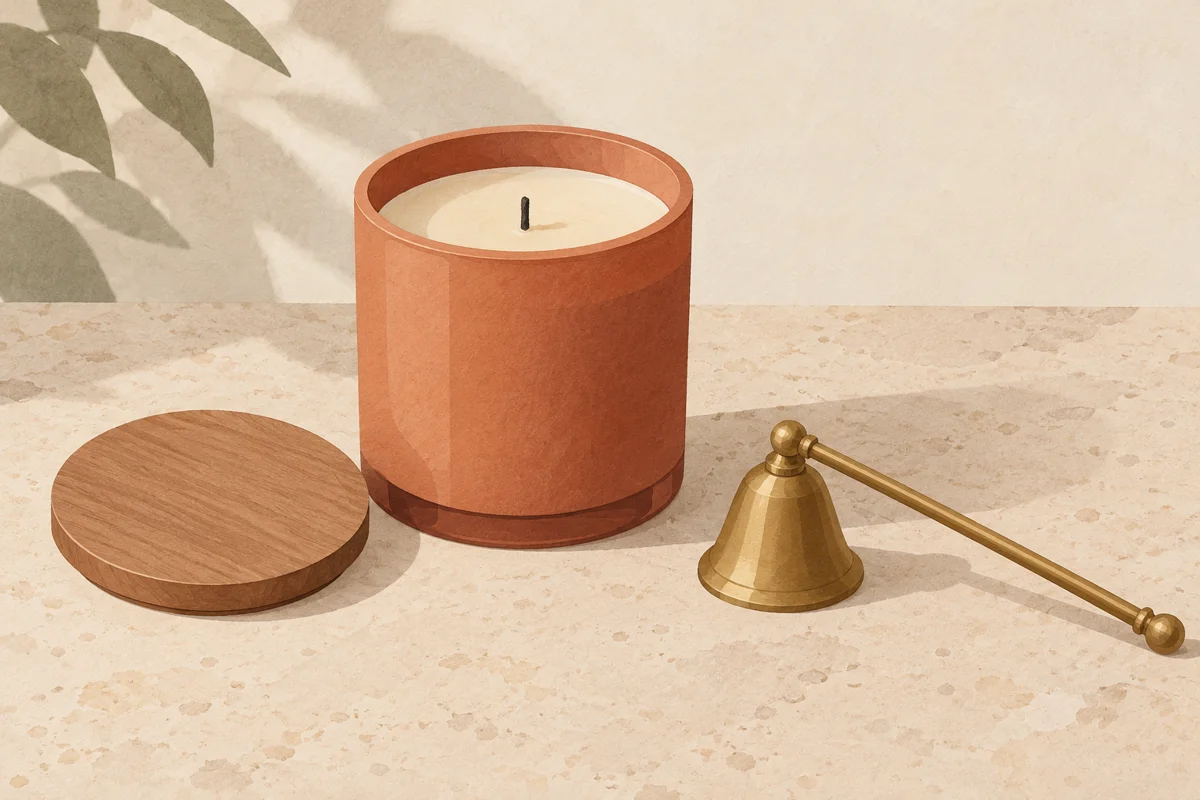
The hero image is an AI-generated conceptual illustration, not a product photograph or a burn test.
Separate storage from extinguishing
Yankee Candle’s glass-vessel care instructions explicitly say to extinguish the candle completely before replacing its lid and recommend a candle snuffer. Its basic candle-care guide separately describes lids as protection against dust and debris during storage. Those are two different jobs.
That manufacturer example is not a specification for every candle. A supplier may offer a purpose-designed extinguishing accessory, but ask for written instructions identifying the compatible candle and accessory. A matching diameter, attractive lid or salesperson’s informal assurance is not enough to describe a lid as a snuffer in your gift listing.
Use this selection logic:
- Instructions say to extinguish before replacing the lid: describe it as a storage lid. Do not add “snuffer lid” to your product copy.
- Manufacturer explicitly approves the supplied accessory for extinguishing this model: retain that instruction and identify the accessory accurately. Do not generalize it to other lids or candle sizes.
- The purpose is unclear: hold the extinguishing claim, request clarification, and choose a different candle if usable care instructions cannot be supplied.
A five-field candle-gift approval card
Complete this record before approving the decorated sample. It is a purchasing checklist, not a substitute for manufacturer safety testing.
- Exact configuration: candle manufacturer/model, vessel, wick type, fragrance option and supplied lid. Attach the instructions for that configuration rather than a generic care article.
- Lid function: storage only, manufacturer-approved extinguishing accessory, or unresolved. Record the supporting document and date. If unresolved, do not publish a functional claim.
- Decoration and labels: obtain the supplier’s approval of the intended decoration placement. Check that your logo, gift sticker or sleeve does not cover the original warnings or care instructions. Retain the readable label on the finished sample.
- Recipient handoff: confirm that the actual gift includes the product-specific instructions. If the box carries the only copy, ask for a durable insert or another manufacturer-approved way to keep those instructions with the candle after unboxing.
- Ordering decision: record the destination country, confirmed availability of the decorated configuration, lead time and quote. Approve, revise or hold; name the person responsible for closing any missing information.
Photograph the finished label and lid arrangement for the approval record. Do not improvise a lid-on-flame experiment to resolve missing documentation. If a different vessel or lid is substituted, reopen this check instead of assuming the original answer transfers.
What should the recipient see?
Keep the manufacturer’s instructions intact. The National Candle Association’s safety guidance emphasizes supervision, keeping candles away from combustible items and children or pets, never using water to extinguish them, checking that the wick is fully out, and allowing the wax to cool before touching or moving the candle. A branded thank-you card should not displace those practical instructions.
For a workplace gift program, distinguish “a gift to take home” from “approved for use at your desk.” Check the receiving organization’s open-flame and fragrance rules before planning an office candle moment. Offer a non-candle option rather than assuming every recipient wants fragrance or can use an open flame; a brief gift-preference survey can capture that choice without promising an unavailable item.
Worked example: an attractive lid, an unsupported claim
Illustrative scenario: an agency chooses a candle with an engraved wooden lid. The draft gift description calls it a “two-in-one lid and snuffer,” but the supplier has supplied only a storage photo and dimensions. The correct decision is to remove the snuffer claim and request the model’s care instructions—not infer function from the lid’s fit. If the instructions require extinguishing first, the lid remains a presentation and storage feature.
Finally, protect the vessel in transit as well as presenting it nicely. Our gift-box versus shipping-box guide addresses that separate decision. This post is a buying checklist, not a verified Brand Sauce candle shortlist; availability, decoration and prices remain quote-needed for the exact destination and configuration.