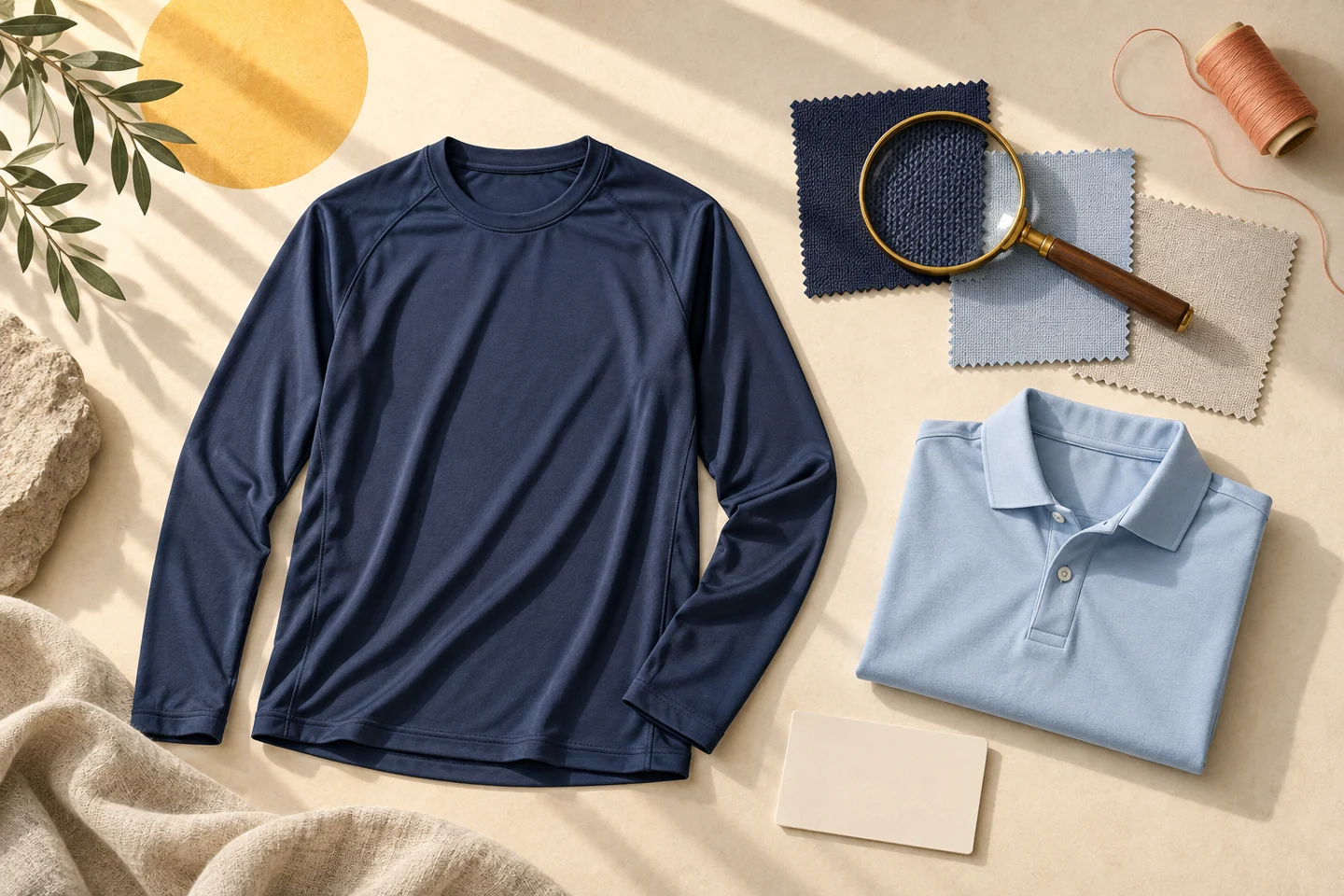
Choose UPF-rated company apparel when the intended use calls for documented ultraviolet protection—but approve the exact garment, its coverage and the proposed decoration before putting that claim in your store. A fabric rating is useful evidence. It is not a promise that every shirt from that brand, every logo treatment or every way of wearing it provides the same protection.
For an outdoor employee event, a sun shirt may be a thoughtful choice. For a required work uniform, the decision belongs with the person responsible for the workwear specification, not just the person choosing the logo. For an office gift collection, it can remain an optional alternative rather than the default for everybody.
Brand Sauce publishes this guide and provides company-store services. This is a purchasing and assortment framework, not a claim that any particular UPF product is available through Brand Sauce. Manufacturer examples illustrate how to read a specification; decorated availability, destination coverage and pricing require confirmation. Sources were checked October 1, 2026.
Separate the fabric rating from the coverage decision
UPF stands for ultraviolet protection factor. The Skin Cancer Foundation explains that it describes how much UVA and UVB radiation passes through fabric: UPF 50 corresponds to one-fiftieth passing through. That is a fabric-performance description, not a whole-body protection claim or a time allowance for staying outside.
The same guidance emphasizes coverage and fit, and notes that stretching or wetness can affect protection. A long sleeve and a short sleeve with the same stated rating do not cover the same skin. Evaluate the clothing as part of a broader sun-protection approach, not a replacement for one.
For buyers, this creates two separate approval questions: “What supports the stated rating?” and “Does this garment cover the areas the program expects?” Answering only the first can produce a technically documented but poorly chosen uniform. Answering only the second can produce an ordinary long-sleeve shirt advertised with an unsupported number.
Start with the use case, not a premium-product label
Write a one-sentence brief that describes the task, wearer and setting. “Optional apparel for employees attending an outdoor customer event” is more useful than “premium performance merch.” It tells the buyer what to sample and prevents marketing language from becoming the specification.
| Program | Buying priority | Release question |
|---|---|---|
| Outdoor event team | Appropriate coverage, comfortable fit and a dependable arrival date | Can every assigned wearer get an approved option before the event? |
| Ongoing outdoor workwear | Employer-approved requirements, replenishment and replacement rules | Has the workwear owner approved this exact style and decoration? |
| Optional employee gifts | Recipient preference and a useful alternative to standard polos | Can employees choose another equally funded option? |
| Customer-facing mixed indoor/outdoor team | Appearance, movement and practical coverage | Does the sample work in both settings without changing the approved use? |
Keep separate requirements separate. A UPF statement does not establish high-visibility, flame-resistant or other specialized workwear performance. Where those requirements exist, have the relevant owner review the complete specification. Our office, project and jobsite merchandise guide explains why those purchasing lanes should not be combined casually.
Request evidence that identifies what you are buying
Build a small approval record for each candidate. Include the manufacturer, style identifier, selected color, intended size range, fabric description, published UPF claim, care directions and the dated source that supports it. Save the underlying document, not just a screenshot of a distributor's category heading.
If the evidence covers a fabric family rather than the ordered garment, ask the supplier to explain the mapping. If a product page lists several colors, confirm which variations the claim covers. This is a traceability question—not an assertion that every color necessarily has a different rating.
AATCC's public summary of Test Method 183 describes measurement of UV transmission or blocking through textile fabrics, with procedures for dry or wet specimens. It points separately to ASTM D6603 for product labeling. That distinction is useful: naming a test method does not identify the particular item tested or show that your proposed marketing language is supported.
Ask what sample was evaluated, under what conditions, and whether the supplier's documentation supports the intended wording. You do not need to interpret a laboratory report yourself to notice that a report for a different fabric does not identify your selected item. Escalate unclear evidence to the manufacturer or a qualified textile-testing resource.
- Specific: the supporting record names or clearly maps to the selected style and variant.
- Scoped: wet-state, laundering or durability statements appear only when the documentation supports them.
- Current: the supplier confirms the document still applies to the goods being supplied.
- Usable: the approved claim can be reproduced accurately in the company store.
Read a real product page without turning it into a catalog promise
Columbia's official page for the Men's PFG Slack Tide Camp Shirt, style 1577051, describes a short-sleeve shirt with Omni-Shade UPF 50, sweat-wicking fabric and back venting. It is a useful example because the UV, moisture-management and construction details are listed separately.
Those are different attributes. Do not translate “sweat-wicking” into a UV rating, or a UV rating into a promise of cooling. A procurement brief should retain the separate fields and evaluate whichever ones matter to the wearer.
This manufacturer example is not a recommendation that the shirt meets a particular employer's requirements. Nor does its retail page establish decorated wholesale availability, all-country fulfillment, final pricing or compatibility with your logo. Ask for a quote on the exact configuration. A retail listing is a starting point for a specification, not a completed company-store offer.
Treat decoration as a separate approval step
Once the blank garment is selected, send the decorator the exact style, fabric, color, proposed method, logo dimensions and location. Ask for written confirmation that the proposed process is suitable for that garment and whether the original performance claim can still be used for the supplied configuration.
Do not assume that embroidery automatically invalidates a UPF claim, or that printing automatically preserves it. The answer needs to come from documentation appropriate to the actual garment and process. An attractive sample by itself cannot prove ultraviolet performance.
Separate two sign-offs. The brand owner approves appearance and placement. The supplier or relevant technical owner resolves the performance-claim question. If nobody can substantiate the claim after the proposed customization, pause the UPF-labeled listing or change the configuration; do not quietly turn an unresolved question into an assurance.
Keep labels and care information readable. If private labeling, relabeling or packaging changes are proposed, identify who will retain the original care and performance information for recipients. The buyer should not have to reconstruct it after an employee asks how to wash the shirt.
Use the broader branded-apparel sample approval process for appearance, dimensions and production reference. Add the UPF evidence record to that approval rather than treating the logo proof as the entire decision.
Run a wear trial for the questions a document cannot answer
A sample trial should evaluate fit and usability, not claim to measure UV protection. Ask representative wearers to try the sizes and cuts under consideration, using ordinary movements relevant to the intended activity. Record observations consistently so that “comfortable” is not the only result.
| Observation | What to record | Possible response |
|---|---|---|
| Reaching and bending | Whether sleeves or hem move out of the intended position | Try another size or cut |
| Layering and accessories | Whether the garment works with the actual layers or equipment | Review with the workwear owner |
| Logo location | Whether the approved placement conflicts with seams, pockets or movement | Revise placement and resample |
| Care practicality | Whether the manufacturer's instructions fit the program's laundering arrangements | Choose a better-matched garment or change the care plan |
Include people whose fit needs differ from the first sample wearer. If one cut cannot serve the intended group, approve a second cut or an alternative style with its own evidence. Do not label a substitution “equivalent” solely because its price and color are similar.
Choose bulk, on-demand or hybrid after the product is approved
UPF-rated apparel does not determine the right fulfillment model. A fixed event date with confirmed wearers may favor a coordinated bulk order. It gives the team a defined production run and a chance to inspect goods before distribution, while leaving the buyer responsible for size collection and any leftovers.
An ongoing optional store may favor on-demand ordering if the exact garment, decoration and destination are supported. The benefit is ordering against individual demand; the tradeoff is that future stock availability and production timing still need a plan. Do not promise a particular style indefinitely without a replenishment agreement.
A hybrid can make sense for required apparel: a planned initial issue plus a controlled reserve or replenishment route. Set the replacement trigger and approved fallback before the first item goes missing or wears out. Required issuance should not depend on employees remembering to browse a gift store.
Illustrative planning example: imagine 60 event staff, with 48 confirmed sizes and 12 still outstanding. Producing 60 guessed sizes does not solve the information gap. The practical options are a firm size-collection deadline, a separately approved contingency assortment, or an agreed route for the remaining 12. These are invented planning numbers, not Brand Sauce order data or a claim about savings.
Release the listing only when these five fields are settled
Give the store owner a concise release record. It should be possible to understand the offer without chasing the original email chain.
- Exact item: approved style, colors, cuts and available size range.
- Claim: the supported UPF wording and the document behind it.
- Customization: the approved method, location and configuration-specific confirmation.
- Delivery model: quoted destination scope, timing, minimums if any and replenishment route.
- Exception owner: who approves substitutions, resolves fit issues and updates the listing when supply changes.
A useful product description names the garment and its supported attributes without expanding them. Avoid phrases such as “complete sun protection,” “works in every condition” or “approved for every jobsite.” Keep size and care guidance close to the selection controls. If the claim is unresolved, mark the internal approval record as held; do not publish the uncertain claim and hope to clarify it later.
Limit the assortment to options that genuinely serve different needs. Three superficially different sun shirts with incomplete evidence are less useful than one well-documented option plus an appropriate alternative. Our company-store curation guide covers that broader selection discipline.
Frequently asked questions
Is UPF the same thing as SPF?
No. UPF is the fabric rating discussed here. Use the manufacturer's supported apparel terminology rather than rewriting a shirt listing as “SPF clothing.” The Skin Cancer Foundation reference above explains the distinction.
Can we verify UPF by holding the shirt up to a light?
That is not documentation of a numerical UPF rating. Inspecting fabric may help identify a mismatch or defect, but the claim should rest on appropriate supplier evidence, not an informal visual test.
Can a cheaper replacement inherit the original shirt's claim?
No. Review the replacement's own specification and decoration approval. Keep the existing item paused until the substitute has cleared the same release process.
Should every employee receive a UPF shirt?
Not automatically. Match required workwear to the employer's approved requirements. For optional gifts, offer it when it fits recipient interests and provide a useful alternative rather than assuming one garment suits everyone.
If you are planning an ongoing assortment, explore Brand Sauce company merch stores and bring the product brief, destinations and evidence requirements to the conversation. The right first deliverable is a confirmed configuration and operating plan—not an unsupported promise attached to a logo.