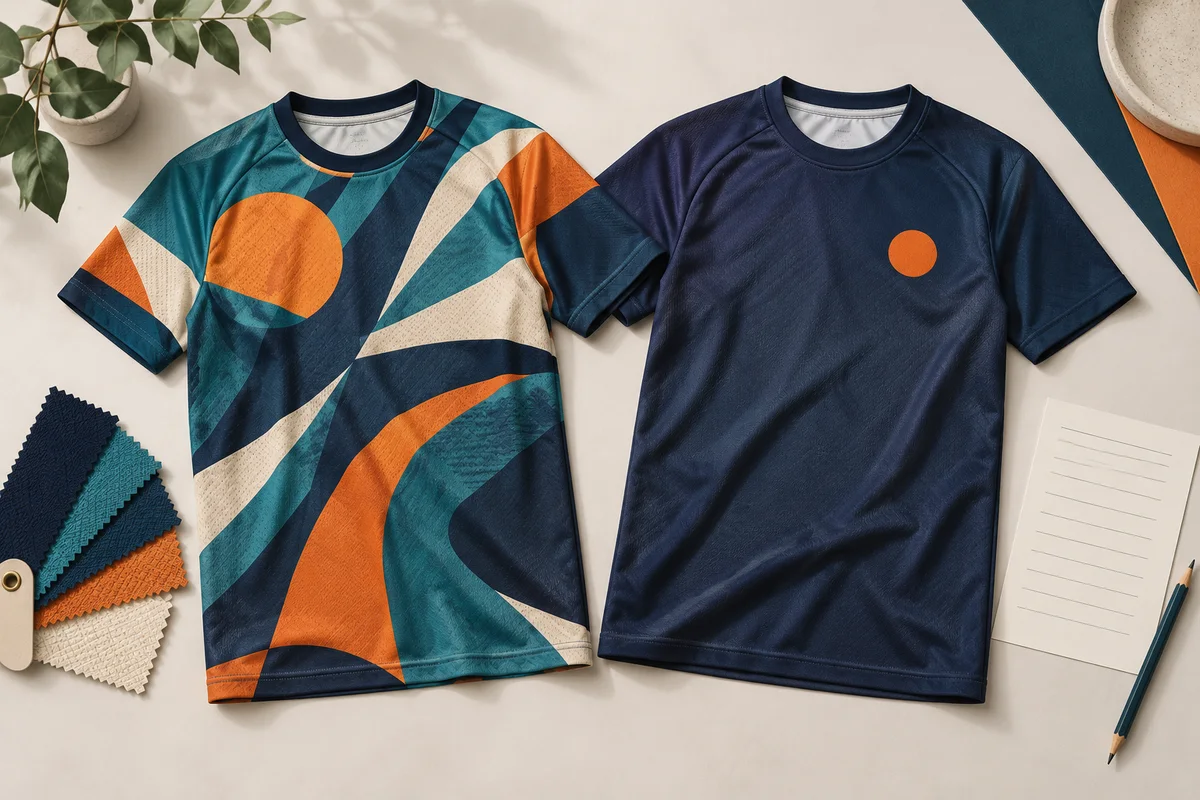
Start with sublimation when the jersey’s identity depends on an integrated, full-color fabric design. Start with screen printing when an available stock garment already supplies the right fit and team color, and you mainly need a repeatable logo or graphic. Then compare the complete roster order and the next replacement—not just the first unit price. Names, numbers, fabric, approval timing and add-on rules can change which route makes sense.
For a company sports league, charity tournament or employee running club, the best jersey is the one your actual participants can wear and your organizer can reorder. A spectacular mockup is not much help if the final roster arrives after the production cutoff or one new player cannot get the approved design.
Publisher perspective: Brand Sauce publishes this guide as a branded-merchandise provider. This is our purchasing framework, not a claim that every process, supplier program or jersey described is available through Brand Sauce. Exact style, destination-country availability, decoration, minimums and price remain quote-needed until confirmed.
You may be comparing two different purchases
Screen printing and sublimation are decoration processes, but a quote may package them with very different garments. One proposal might decorate a stock shirt; another might include a custom garment built around printed fabric panels. Before deciding that one printing method is expensive, identify what each price actually buys.
SanMar’s screen-printing overview describes ink passing through a stenciled screen onto fabric and then being cured. It also notes that equipment and logo size constrain placement. For buyers, the practical takeaway is to specify each print location rather than treating “printed jersey” as unlimited coverage.
Sawgrass describes sublimation as heat transferring dye into compatible materials, including polyester. That is a different starting point from choosing any cotton shirt and adding a logo. Ask the supplier to identify the actual fabric and process; a product marketed as a sublimation-compatible transfer system may involve a different finished construction.
Also ask whether the proposed jersey is decorated before or after assembly. If the design crosses a sleeve, side seam or zipper, request the supplier’s template and a finished example. “All-over” is not a promise that every line will align perfectly across every seam and size. Keep critical words and identity marks in positions the supplier can reliably reproduce.
A practical comparison for the buying brief
| Priority | Starting route to investigate | Question that decides it |
|---|---|---|
| Large integrated patterns, gradients or several graphic zones | Sublimation on a compatible jersey | Does the quoted construction deliver the intended coverage and placement? |
| Stock team-color shirt with a shared chest graphic | Screen printing | Is the exact blank available in the required sizes, and is the print system approved for its fabric? |
| Different player names and numbers | Quote the entire personalization workflow | Are these included, separately applied or a different process from the main graphic? |
| One late player or replacement | The route with a documented add-on arrangement | What are the minimum, cost, production time and artwork requirements for one more? |
| A fixed event date with a changing roster | Compare a stock-garment batch with a custom-production plan | Which approval and size-lock dates can the team actually meet? |
This is a shortlist tool, not a ranking of quality. A simple, well-made stock jersey may be exactly right. A custom sublimated design may justify its additional planning when the garment’s overall appearance is part of the event or team identity.
Choose fabric and fit before comparing finish
Do not infer comfort from the printing label alone. Review the exact jersey’s weight, knit or mesh structure, cut, stretch and intended use. An employee running club and a casual indoor tournament may want different silhouettes even if both choose polyester apparel.
Ask for a size chart for each offered cut, and distinguish body measurements from garment measurements. If the team has not worn the style before, obtain fit samples or a clearly explained sizing process before approving personalized units. Do not silently convert everyone’s everyday T-shirt size into a different athletic fit.
For the decorated sample, ask participants to perform ordinary movements from the intended activity: raise their arms, reach forward or bend. Inspect how the artwork sits during movement and whether a large decorated area feels intrusive. This is a proposed wearer review, not a laboratory breathability or durability test.
Keep the comfort question specific. Sublimation’s dye-in-material process is not the same as adding a separate graphic layer, but that does not prove the entire jersey will be cooler or more comfortable than every screen-printed alternative. Fabric and garment design still matter. Equally, screen printing does not have one universal thickness or feel; approve the actual result.
Separate the shared artwork from the roster
Create two approval records. The first defines the common design: style, colors, logos, sponsor marks, positions and artwork version. The second maps each participant to the ordered size, cut, display name and number. A correct common proof cannot catch a number attached to the wrong person.
Use one controlled roster rather than a collection of email edits. Include an internal row identifier so two people with the same name do not become interchangeable. Have the organizer resolve duplicate numbers if the event requires unique numbers, and check any event-specific numbering or sponsor-placement rules with the organizer before artwork approval.
For variable names, proof the longest approved name as well as a short one. Ask what happens to type size or spacing when text grows. For numbers, inspect narrow and wide combinations at the actual intended size. The point is not to make every name the same width; it is to prevent an automatic fit rule from producing an unreadable outlier.
A screen-printed team logo does not establish how the individual names will be produced. They might use a separate process. Require the quote to identify it. Likewise, confirm whether personal details are incorporated into the sublimated design or added afterward. Our personalization guide covers recipient text approval and correction ownership in more detail.
Approve color—and decide whether later decoration is allowed
Use a physical sample or supplier-approved swatch for an important brand match. A bright screen preview is a design aid, not the finished textile. For a useful manufacturer example, CHAMPRO’s Juice FAQ says custom colors require a physical swatch approval and can add lead time. That is a named program’s policy, not a universal production schedule or Brand Sauce promise.
Be particularly deliberate when a supplier proposes a light print on a colored polyester jersey. SanMar’s dye-migration guidance explains that garment dye can contaminate a screen print and that discoloration can emerge hours or days after production. Ask the decorator how the proposed system addresses the actual style and color, and agree when the sample will be inspected.
Do not turn that concern into a blanket rejection of screen printing on polyester. It is a compatibility and process-control question for the decorator. Nor should a buyer copy a generic temperature from an article into a production instruction. Obtain the approved process and care requirements for the finished combination.
Plan future sponsor additions before ordering. In the same Juice FAQ, CHAMPRO specifically says not to put Juice garments through a screen-print dryer. That restriction illustrates why an organizer cannot assume a finished sublimated jersey can later receive another decoration process. Ask the manufacturer and decorator to approve any addition; if they cannot, keep the original design or use a separately approved garment.
Price the season, not just the launch order
Request two written quotes for each shortlisted route: the initial roster and a small add-on using the same approved design. Specify whether freight goes to one organizer or individual employees. Ask what setup charges repeat, what artwork is retained, and how discontinued styles or fabrics are handled.
Do not assume custom sublimation necessarily means a large repeat minimum. CHAMPRO’s cited Juice FAQ distinguishes its new-order conditions from add-on orders and states no minimum for add-ons. That is useful evidence that policies can differ within one program, not a guarantee of today’s price, delivery date or availability through another provider.
Illustrative comparison—not supplier pricing or measured results: suppose Route A totals $960 for 24 jerseys and Route B totals $1,080. Later, four individual replacements cost $60 each under A and $42 each under B, including the assumed delivery charges. The season totals become $1,200 and $1,248. B’s cheaper replacements narrow the gap but do not erase its higher initial total.
Those labels deliberately do not identify printing methods. Replace every amount with quotes for equivalent garments and decoration. If different fabrics, delivery arrangements or personalization are included, disclose that difference rather than calling the result a pure process-cost comparison. Add tax, any unquoted fees and internal administration to your own worksheet.
Bulk can be sensible for a confirmed roster, shared design and common handout date. Individual on-demand ordering can help with later demand when the exact item and process support it. A hybrid might use a coordinated first batch and a documented reorder route. None makes late production instant. The broader on-demand versus bulk guide explains how unused units and fulfillment choices affect the decision.
A seven-part jersey release card
Use the following as a proposed acceptance checklist. Save the supplier’s responses and sample evidence with the order rather than treating the checklist itself as proof that production has passed.
- Garment: exact style, fabric, color or design, offered cuts and sizes confirmed for the destination.
- Construction and decoration: sublimation or screen-print process identified, including whether names and numbers use another method.
- Artwork: common design approved, critical placements checked across the intended size range, physical color approval completed where needed.
- Roster: each size, cut, name and number confirmed against a single locked version; one person owns later corrections.
- Finished sample: appearance, movement, print feel and agreed care check reviewed; any delayed color inspection completed.
- Timing: approval deadline, production start condition, quoted dispatch window and transport allowance recorded separately.
- Continuity: add-on price basis, minimum, retained design reference, replacement process and restrictions on later decoration documented.
For timing, obtain the start condition in writing. CHAMPRO’s published production notes, for example, tie confirmation to artwork approval and describe capacity and additional pre-production work as possible factors. A headline number of production days is not your in-hand event date.
For the sample, use the apparel sample approval guide to record what was actually checked. If your deadline cannot accommodate unresolved fit, roster or color questions, simplify the design, choose an already-approved configuration or revise the delivery plan. Do not approve uncertainty merely to keep an ambitious visual.
Frequently asked questions
Is sublimation always better for sports jerseys?
No. It is worth investigating when the full garment design matters and a compatible fabric and construction fit the use. A stock jersey with a screen-printed shared graphic may be a more practical purchase for a straightforward team identity. Compare finished samples and the entire ordering cycle.
Can the same design go on employee fan shirts?
The visual identity can carry across, but do not assume the same production file, fabric or decoration process will. A fan shirt can use a simplified graphic on a different garment. Approve it separately and describe any color or placement differences intentionally.
Should we buy spare personalized jerseys?
Only if you have a clear use for those exact names or numbers. A spare tied to one person is less flexible than an approved unassigned spare. Agree with the team organizer how spare numbers and sizes would be allocated, and compare that plan with the quoted add-on route.
What should we send with a quote request?
Send the activity, in-hand date, destinations, approximate roster, size and cut requirements, common artwork, variable-name and number needs, and likely replacement pattern. Request a recommended garment-process combination, physical approval plan and itemized first-order and add-on quotes. The right answer should explain what happens after the first team photo, too.
Primary manufacturer documentation checked October 12, 2026. The AI-generated hero is a conceptual illustration, not a catalog product, test result or evidence of a particular printing process.