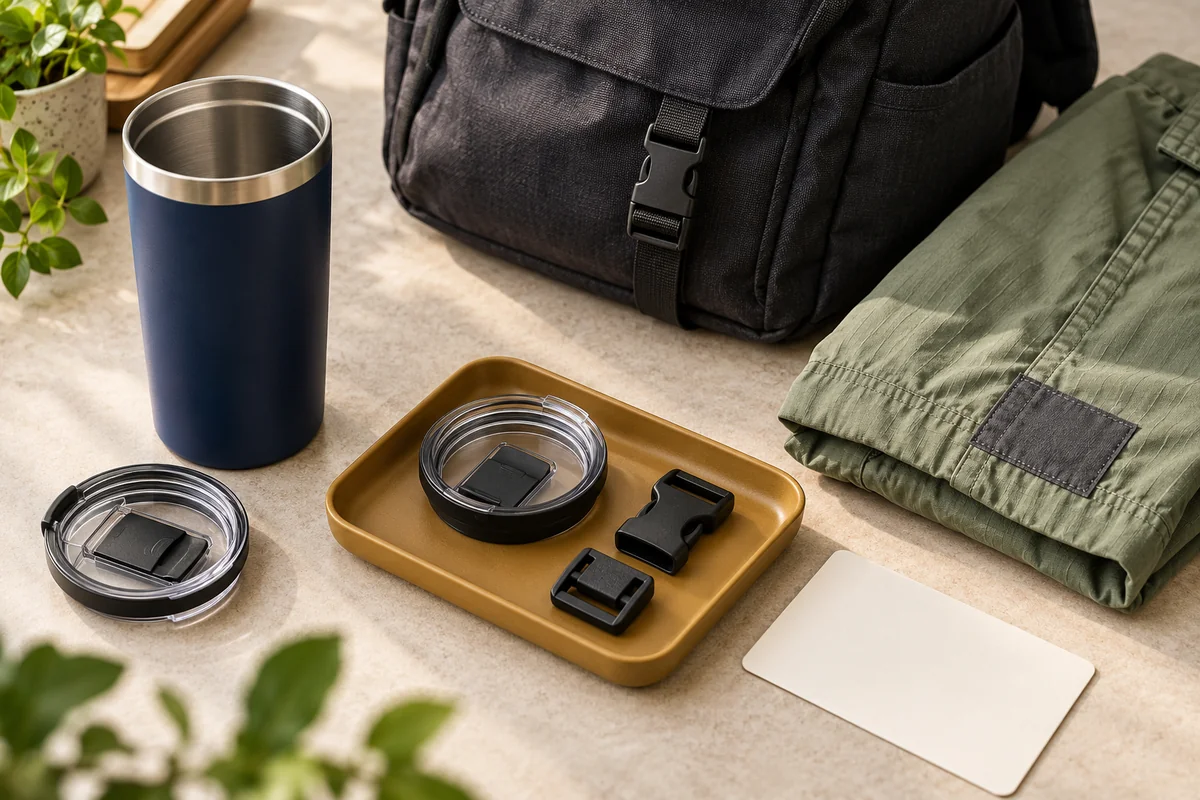
Before choosing a long-use employee gift, check whether its small, replaceable components can actually be obtained and fitted. A durable bottle, bag or jacket is less useful if one missing lid, broken buckle or damaged closure makes the whole item impractical. Approve the product and its service route together—not just the attractive sample.
The buying question is not “Does this brand have a warranty?” It is “If a serviceable component needs attention after normal use, what would we do next?” The answer may be an individually purchased part, a manufacturer repair, an approved local service or a complete replacement. Each route has different costs and demands on the recipient.
Brand Sauce publishes this guide and provides company-store services. The audit below is our recommended purchasing method, not a claim that every product we source has spare parts or that repairs are included in every program. Manufacturer examples are U.S.-site references checked October 23, 2026; confirm the actual model, decoration route and destination before buying.
Make serviceability a buying criterion, not a universal requirement
For an ongoing employee assortment, serviceability means having a credible way to restore useful function without automatically replacing the whole gift. It does not mean every component is user-replaceable, every repair is economical or every recipient wants to perform maintenance.
Apply this criterion most strongly to products you expect people to keep using: everyday bags, reusable drinkware and outerwear. For a simple, low-cost item with few components, a complicated repair program may add little value. Start with the product's purpose and the recipient's willingness to keep using it.
| Buying situation | Prefer this route when verified | Reason to choose differently |
|---|---|---|
| A removable component can be lost while the main item remains sound | Exact replacement part available individually | The part is unavailable in the recipient's country or delivery costs outweigh its value |
| A structural component needs specialist work | Manufacturer or approved repair service | Turnaround is incompatible with an essential daily need |
| The product is needed immediately for work | Approved spare or temporary substitute, with repair assessed separately | Maintaining a reserve creates more unused stock than the program can justify |
| The recipient no longer wants the item | A supported alternative or no further gift | Repairing an unwanted item does not restore its usefulness to that person |
This is an assortment decision, not a mandate to build a repair department. A buyer can favor a product with a clear self-service parts page while leaving purchases to recipients, or fund a limited support allowance. Either can work if explained honestly.
Separate a retail part, a repair service and a warranty
A retail replacement part is something a person can order. A repair service accepts an item for assessment and work. A warranty sets conditions for remedies. These can coexist, but one does not establish the others.
For example, YETI's U.S. MagSlider Lid page lists separate lid sizes and specific compatible vessels. It also excludes Rambler bottles, jugs and travel mugs using the Stronghold lid from that compatibility. A replacement-parts listing is useful evidence, but a shared brand or capacity is not enough to approve a match.
Osprey's U.S. All Mighty Guarantee page provides a repair-start route. That establishes an avenue for service, not a public inventory of every buckle or a promise that any employee can replace a structural component at home. Ask which route applies to the exact product.
Patagonia's product care and repair page separates repair guidance from starting a repair and includes guides for issues such as buttons, zipper sliders and buckles. The useful distinction is the presence of both guidance and a service route. It is not proof that a particular decorated garment, damage type or destination qualifies for a particular remedy.
These examples illustrate evidence types, not a ranking or a claim of current Brand Sauce availability. For eligibility, receipts, decoration responsibility and who submits a claim, use our separate branded-gift warranty and support guide. This audit addresses what to buy before that support question arises.
Build a component map for the shortlist
Do not try to catalog every stitch and screw. Identify the small components whose loss or failure would materially change the recipient's use. Mark whether each is removable by design, service-only or not separately supported. Leave uncertain entries unresolved rather than converting a supplier's “probably” into a purchasing promise.
| Product | Component to investigate | Evidence to request | Do not assume |
|---|---|---|---|
| Drinkware | Lid, cap, straw or seal where separately supported | Exact manufacturer part number, compatible models and use instructions | A cap that physically fits preserves the original beverage or leak-resistance claims |
| Everyday backpack | Removable buckle, zipper pull or detachable strap | Part route or service assessment, attachment method and model identification | A similar-looking buckle is interchangeable or suitable for a load-bearing repair |
| Jacket | Button, zipper slider or damaged fabric area | Approved repair route, care instructions and limits around decoration | Replacing a slider fixes damaged zipper teeth, or any patch restores original performance |
The distinction between a zipper pull and the zipper itself matters commercially: replacing an easy-to-grip pull is not the same work as replacing sewn-in hardware. Ask the supplier to identify the part, not merely offer a bag of assorted accessories.
Include the product's identifying marks in the map. A recipient may not retain packaging or know the purchase year. Record where a model label can be found and whether a photo is sufficient for the supplier to identify it. Keep internal purchase references separate from the simple help information given to employees.
Run a five-step sample audit before assortment approval
- Locate the route without a salesperson's help. Starting from the model name, find the official part page or repair instructions. Record the URL and date. If the route requires the corporate buyer, name that owner explicitly.
- Check destination and purchasing friction. Confirm whether the part or service is available to the actual country, whether single quantities are possible and whether an employee can order without a company account. Unknown shipping or service charges remain quote-needed.
- Inspect a separately supplied part when practical. For a user-replaceable component, request the actual replacement alongside the sample. Check packaging and model identity, then follow the manufacturer's fitting instructions. A picture of the original product is not a parts test.
- Check restored use, not just attachment. Confirm that the approved replacement preserves the intended use under the manufacturer's instructions. Do not improvise pressure, heat, load or destructive tests. Structural damage belongs with the manufacturer or an appropriate repair professional.
- Document the fallback. If the part is unavailable, identify whether the answer is service, a different approved product or no employer-funded remedy. Record any effect on the original logo, appearance and recipient choice.
A practical stop rule: if identification, compatibility or safe installation is unresolved, do not advertise that component as user-replaceable. You can still approve the item on other merits, but remove the unsupported repairability claim from its selection page.
For bags, this audit complements—not replaces—the basic backpack fit and use evaluation. An excellent service route cannot rescue a bag that never fits the employee's laptop or daily load.
Compare delivered remedies, not part prices
A cheap component can have a surprisingly expensive fulfillment path. Build a remedy worksheet with the part, shipping, any installation or service fee, coordination time and a temporary replacement if genuinely needed. Compare that with a complete replacement delivered and decorated to the same approved standard.
Illustrative arithmetic only—not a supplier quote, failure forecast or measured result: suppose a compatible part costs $8, delivery costs $7 and the company spends 15 minutes coordinating at an internal planning rate of $32 per hour. The modeled remedy costs $23: $8 + $7 + $8. If a complete delivered replacement costs $45, the difference for that one assumed event is $22. It is not a $22 saving on every gift purchased.
If the more serviceable option costs $5 more for each of 100 gifts, its illustrative purchase premium is $500. At $22 less per successful remedy, at least 23 such events would be needed to offset that premium on this simplified financial basis. That is a threshold, not a prediction that 23 failures will occur. Change shipping, labor, uptake or product availability and the comparison changes.
Other reasons may justify the premium: the employee likes the existing item, the original decoration remains intact or replacement would interrupt daily use. Record those as decision factors, not fabricated dollar savings. Likewise, a repair option alone does not establish a quantified environmental benefit or prove that a product will last longer.
Choose how much parts inventory to own
Direct ordering can suit distributed recipients and occasional needs. It avoids storing speculative parts but depends on current availability, destination access and someone knowing the model. An on-demand company store does not automatically provide on-demand spare parts.
A small bulk reserve can make sense for a standardized, stable assortment used repeatedly at one location. Store parts with their original identification and instructions, keep incompatible generations separate and record issues. The reserve should solve an observed need—not become a second unmanaged swag closet.
A hybrid might hold a few confirmed, easily fitted components locally while routing structural repairs to the manufacturer and full replacements through the current assortment. Recheck compatibility whenever the supplier changes the base model. The purchasing model should follow actual use, not an assumption that inventory is always bad.
Set a review point tied to assortment changes and actual support activity. Look for parts that are never requested, requests that cannot be fulfilled and products whose revisions have made the reserve obsolete. For the wider stocking decision, see our on-demand versus bulk guide.
Copy this serviceability approval record
- Product identity: manufacturer, exact model, version, size and visible identification location.
- Priority component: the part whose loss or damage would interrupt the intended use.
- Verified route: retail part, manufacturer service, approved local repair or complete replacement.
- Evidence: dated official link, part number, compatible models, country and any written supplier clarification.
- Sample result: what was actually inspected or fitted, by whom, and what remains untested.
- Costs: delivered part or service quote, coordination assumption and comparable replacement quote.
- Ownership: who orders, who pays, whether the recipient may decline repair and how help remains available.
- Decision: approve; approve without a repairability claim; request clarification; or choose another product.
For an illustrative employee-choice collection, this could lead to keeping a bag with a service-only repair route, preferring a tumbler with a verified retail lid and retaining a simple non-apparel option for people who want neither. The goal is a supportable assortment, not a uniform repair score across unrelated products.
Frequently asked questions
Does a lifetime warranty mean spare parts will always be sold?
No. Warranty terms, repair services and retail parts availability are different evidence. Confirm the route needed for the exact model instead of treating a warranty headline as a parts catalog.
Should the company give every employee a spare part with the gift?
Only when a clear use case justifies it. Unneeded spares add cost and can be lost or confused with incompatible models. A good identification record and accessible ordering route may be more useful.
Can a generic replacement be approved if it looks identical?
Appearance alone is insufficient. Obtain reliable compatibility and use guidance for the exact application. Do not transfer the original manufacturer's performance claims to an unverified substitute.
Should employees be expected to repair their own gifts?
No. Present a supported option, not an obligation. Some people will welcome an easy part swap; others need service or prefer a different remedy. Keep the choice proportionate to the gift and the program's stated funding policy.