Choose raglan or set-in sleeves by checking the actual garment on people and the actual logo on its panels. Raglan construction brings the sleeve up toward the neckline; a conventional set-in sleeve joins the body around the armhole. That changes the seam map, but neither name guarantees better movement, a more generous fit or an easier decoration job.
For company apparel, the useful decision is whether one construction helps your team wear the garment comfortably while leaving a workable location for your branding. A shoulder detail that looks appealing in a product photo can become a problem when the smallest offered size has less uninterrupted space for a chest mark.
This is Brand Sauce’s buying framework, not a wear-test ranking. Manufacturer examples below explain specifications; they are not promises of current Brand Sauce inventory, decoration eligibility or international availability. Obtain a quote for the exact style, color, size range, decoration and destination country.
What actually changes between raglan and set-in sleeves?
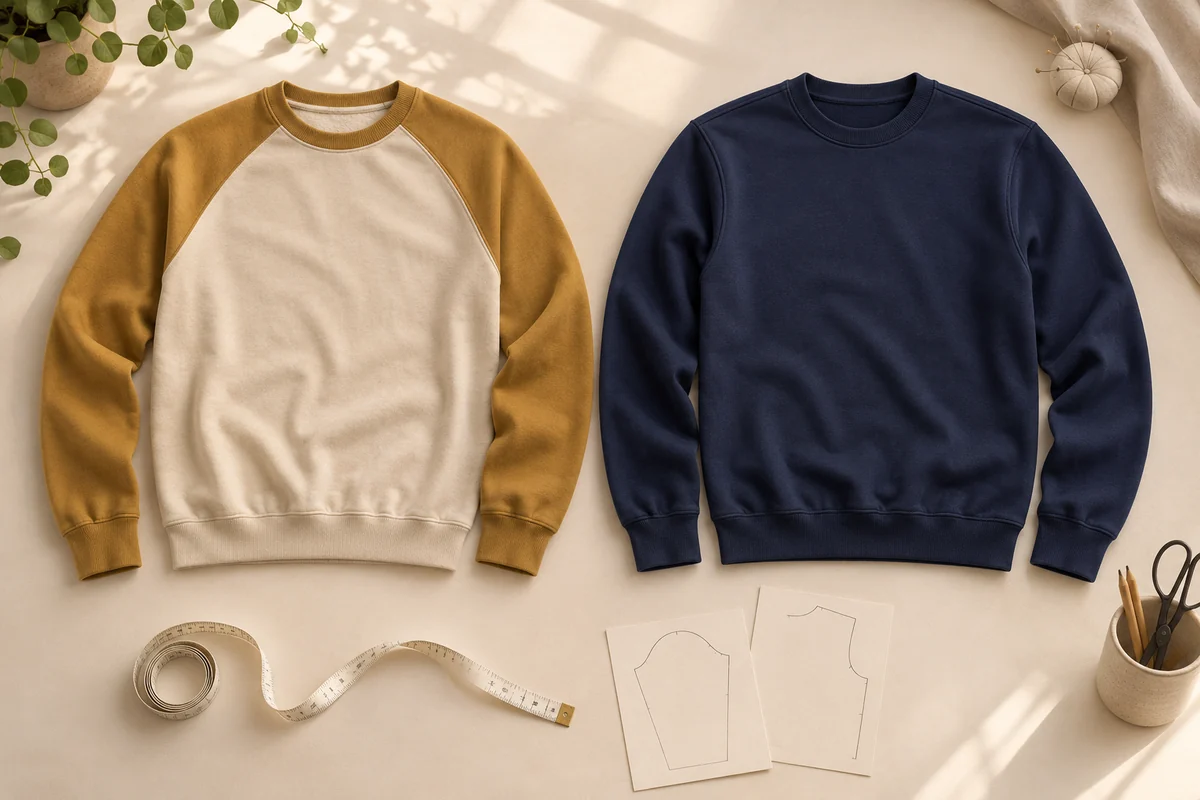
On a typical raglan top, the sleeve extends into the neckline, with diagonal joining seams running toward the underarm. On a conventional set-in top, a shoulder seam connects the neck area to the armhole, where the sleeve is attached. Inspect both the front and back: a photograph of one side is not a complete construction drawing.
Do not confuse sleeve construction with fabric, stretch, sleeve length or colorblocking. Raglan does not mean polyester, and set-in does not mean formal. A contrast sleeve can highlight a seam without telling you how the garment will fit.
Two official examples make the distinction concrete. AS Colour’s Australian Supply Crew 5100 page describes a raglan-sleeve sweatshirt. SanMar’s Sport-Tek ST550 polo page specifies set-in sleeves. These are different garment categories, not comparable candidates for a performance contest. The point is to read the construction field instead of inferring it from “crew,” “polo” or “athletic.”
| Buying question | Raglan consideration | Set-in consideration |
|---|---|---|
| Where are the joining seams? | Typically diagonal from neckline toward underarm | Around the armhole, meeting a shoulder seam |
| What should the fitting check emphasize? | Neckline behavior, underarm room and sleeve reach | Shoulder placement, upper-arm room and sleeve reach |
| What could affect chest artwork? | A diagonal seam approaching the upper chest | The armhole boundary and any other chest details |
| What decides the winner? | The complete garment, required size range and approved decorated result—not the sleeve label alone | |
Do not use raglan as a shortcut for “fits everyone”
A raglan garment removes the familiar set-in shoulder junction as one visual fitting reference. It does not remove the need for appropriate chest room, upper-arm space, body length or sleeve reach. A recipient can still find it tight, baggy, short or awkward at the neck.
Likewise, a set-in garment is not automatically restrictive. Compare complete patterns and fabrics, not an imagined loose raglan against an imagined tight set-in. If two samples differ in fabric weight, stretch and overall cut, you cannot attribute every preference to the seam arrangement.
Write the everyday tasks before ordering samples. A front-desk team might prioritize seated comfort and reaching across a counter. A conference crew might need comfortable repeated reaching while setting out materials. An optional sweatshirt gift might be worn over another shirt. Those are different fitting briefs even when all three programs use the same company logo.
Ask participants to describe an observable issue: the collar pulls backward when reaching, the cuff rides above the preferred position, or the upper arm feels constrained. “Raglan is more comfortable” is too broad to guide a replacement order. Record which style, size and task produced the observation.
Compare measurement paths before comparing numbers
Sleeve length is especially easy to misread. A number measured from the center back of the neck is not directly comparable with one measured from the shoulder seam. Raglan construction makes guessing the intended starting point particularly unhelpful.
For example, SanMar’s T475 measurement sheet defines sleeve length along a path beginning at the center of the neck, continuing across the shoulder and down to the sleeve hem. It separately defines garment chest width and a body-size chart. Follow those definitions for that item; do not transfer a measurement convention to another supplier without checking.
Put the start point, end point and units next to every sleeve measurement in your comparison. If a sheet gives a number without a diagram or method, ask for clarification. An apparently longer sleeve may simply include more of the shoulder in the measurement.
For the wider distinction between body sizing and laid-flat clothing dimensions, see our company-store size-chart guide. A familiar size letter is not a reliable bridge between two different cuts.
Approve a logo zone, not just a logo file
The main branding consequence is the relationship between the artwork and the garment’s seams. A diagonal raglan seam may approach the desired left-chest area. A set-in armhole, placket, pocket or other panel detail can also limit placement. Neither construction provides a universally safe rectangle.
Ask the decorator to mark a usable decoration zone on each shortlisted garment. Review the proposed artwork at its actual dimensions inside that zone. Include the production method and any required clearance from seams; do not invent one universal clearance measurement for every process.
STAHLS’ guidance on heat printing around seams explains that raised garment features can interfere with press pressure and describes isolating the print area with an appropriate platen. The purchasing implication is not that raglan tops cannot be decorated. It is that a flat digital mockup does not establish a workable application setup.
For embroidery, ask the decorator to confirm access, support and the finished appearance on the real garment. Do not assume a transfer-approved location is automatically approved for stitching. Our embroidery-versus-printing guide covers that separate method decision.
If the requested mark conflicts with a seam, consider a smaller approved artwork version, a different placement or another garment. Moving the logo is a brand decision as well as a production adjustment: show the revised position on a worn sample before accepting it.
Check the size range—not only the middle sample
A decoration proof on a middle size does not settle the whole order. Your company may offer several fits and sizes, each with a different relationship between neckline, chest panel and armhole. A single artwork width can occupy a very different proportion of those panels.
Ask the supplier which sizes need additional placement checks. At minimum, make the smallest offered size and each distinct garment cut explicit in the approval conversation. Add other sizes when the seam layout or intended appearance changes materially. This is a proposed approval strategy, not a claim that every garment must use different artwork.
| Record for each approved style or size group | What it resolves |
|---|---|
| Style code, color and covered sizes | Which garments the approval actually includes |
| Artwork version and finished dimensions | Whether the same design or a controlled alternate is used |
| Placement reference and production tolerance | How the decorator locates and checks the mark |
| Seam clearance and access confirmation | Whether the intended method is workable |
| Front and side sample photographs | How the result appears when worn, not just laid flat |
Keep the visual standard consistent without insisting that every size use an identical coordinate. The goal is a considered, repeatable presentation. Any alternate placement should be intentional and approved, not discovered after delivery.
Run one fitting session and one decorated review
Start with blank samples to resolve fit before spending effort on the final decoration. Include representative wearers and the normal underneath layer. Give people room to reject a fit privately rather than asking them to explain body measurements to the whole team.
- Check at rest. Look at neckline position, body length, shoulder or raglan seam placement, cuffs and upper-arm room.
- Try ordinary movements. Sit, reach forward and perform the relevant routine tasks. Stop any movement that is uncomfortable; this is a clothing review, not an exercise test.
- Compare the intended sizes. If sizing up solves arm room but creates an unsuitable body fit, keep another cut in the shortlist rather than declaring the problem solved.
- Photograph the proposed mark. Use an actual-size placement template for discussion, then obtain a real decorated sample for production approval.
- Review after agreed care. Follow the garment and decoration instructions. Check fit, placement and appearance again, documenting the conditions instead of claiming a lifetime result.
- Release or revise. Approve the identified configuration, request a correction, or reject it. Retain the decision and reference sample.
Our branded-apparel sample approval guide provides the broader release process. The additional check here is the seam-to-logo relationship across the actual cuts and sizes being offered.
An illustrative decision: one team, two acceptable constructions
Imagine an employer choosing apparel for a welcome collection. One raglan sweatshirt gives several participants their preferred silhouette, but the original chest artwork sits too close to a joining seam on a smaller sample. A set-in alternative accommodates that artwork but is not the preferred fit for everyone.
The buyer has more than two choices. They can approve a revised mark on the raglan, choose the set-in garment, or offer both with separately approved decoration records. The correct answer depends on the sample review, recipient options and complete delivered quote. These are hypothetical circumstances, not results from a Brand Sauce client or named product test.
Reject the raglan only if the unresolved constraint matters to the brief. Reject the set-in option only if its actual fit or presentation fails. Do not turn a solvable decoration issue into a universal rule about sleeve construction.
Choose fulfillment after the garment is approved
On-demand ordering can suit an ongoing choice program when the exact garment and approved decoration are available for individual orders. Confirm the destination country, size/color coverage and production method. A manufacturer’s regional product page is not proof of that fulfillment capability.
Bulk can be appropriate for a known team, a fixed distribution date or a decoration setup better handled as one run. Collect sizes before committing where practical, and compare the complete costs rather than only the blank garment price. A hybrid program can hold approved event stock while offering separately verified styles through an ongoing store.
Whichever model you choose, do not permit an automatic substitution from raglan to set-in—or the reverse—based only on color and fabric weight. Recheck fit, measurements and the decoration zone. Bring those requirements to a Brand Sauce apparel-planning conversation; pricing and exact availability remain quote-needed.
Frequently asked questions
Are raglan sleeves always better for broad shoulders?
No. The actual pattern, garment dimensions, upper-arm room and fabric matter. Try the intended size and movements. A construction label cannot guarantee fit for a body shape.
Can a raglan top have a left-chest logo?
Potentially, yes. Have the decorator approve the artwork size, seam clearance and application setup on the chosen garment, including relevant smaller sizes. Do not rely on a generic mockup.
Should every size have exactly the same logo placement?
Use an approved visual standard and documented production references. Whether identical coordinates work depends on the garment’s pattern and size range. Review exceptions before ordering.
Does a raglan sleeve make a garment stretchier?
It describes construction, not a stretch specification. Evaluate fabric behavior and complete-garment movement separately rather than treating the seam name as a material claim.
Primary manufacturer and decoration-equipment references checked November 6, 2026. The custom editorial image is an AI-generated conceptual garment comparison, not a photograph of the cited products.