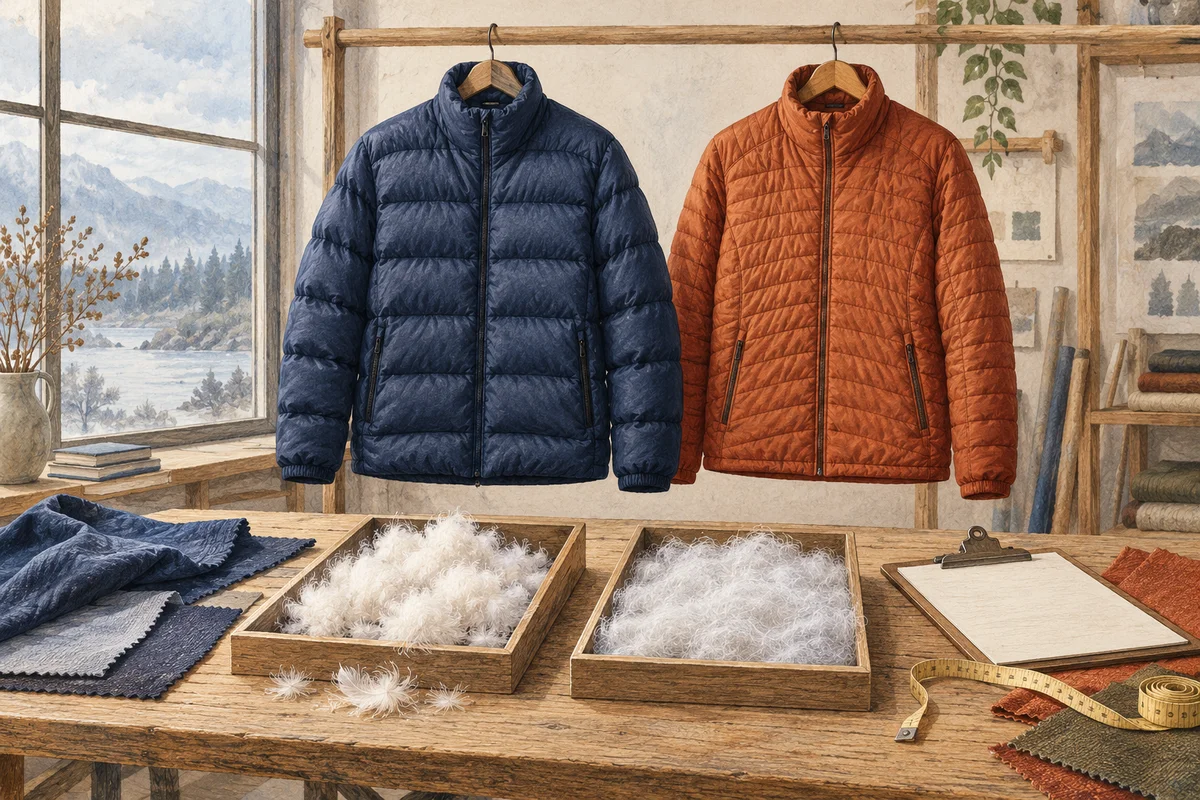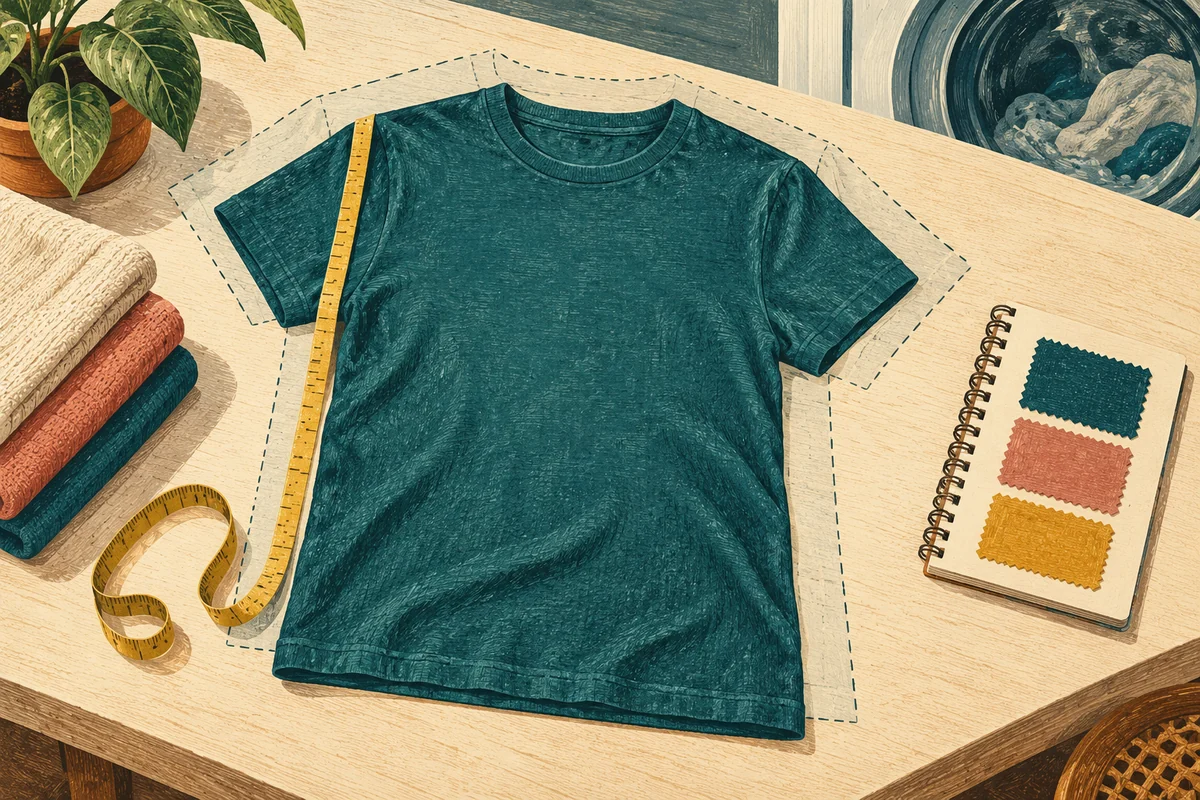
Do not approve company shirts on the word “preshrunk” alone. Approve a defined finished garment, an agreed care routine and acceptable post-wash measurements. A shirt that fits at the sample meeting can still be wrong for the program if its usable length, width or shape changes after employees wash it.
The buying question is not whether a fabric has been treated to control shrinkage. It is whether the decorated item will remain suitable for its intended wear under the care instructions you will actually give recipients. This guide turns that question into a small, documented acceptance process rather than a blanket instruction to order one size larger.
Publisher perspective: Brand Sauce publishes this buyer framework as a company-store provider. The checks below are recommendations, not claimed Brand Sauce laboratory results, standard supplier guarantees or promises about a particular product.
Separate a manufacturing claim from an acceptance result
CottonWorks’ shrinkage guidance explains that dimensional stability depends on construction and processing as well as finishing. Relaxation drying, compaction and other finishing approaches can reduce residual shrinkage. Reduction is different from a guarantee of no subsequent change. The same guidance distinguishes shrinkage from growth and highlights related concerns such as skew and seam puckering.
For procurement, treat “preshrunk,” “prewashed” and similar descriptions as starting points for questions, not interchangeable performance specifications. Ask the supplier what the exact claim means for the selected style and what evidence supports it. A process description without measurements cannot tell you how much usable garment length remains after the agreed care routine.
| Information offered | What still needs an answer | Buying action |
|---|---|---|
| “Preshrunk” on a product page | Which dimensions, care conditions and remaining change? | Request the specification or supporting report. |
| A fabric test report | Does it represent the finished garment, seams and decoration? | Confirm its scope before applying it to the order. |
| A washed sample that “looks fine” | What was its starting size and how was it washed and dried? | Repeat with a recorded baseline if necessary. |
| A percentage shrinkage limit | Does the resulting fit still work for the wearer? | Pair the limit with minimum usable dimensions. |
Keep starting size, dimensional change and appearance separate
There are three different approval questions. First, did the supplied shirt start within the agreed garment measurements? Second, how did those measurements change after care? Third, does the garment still look and function acceptably? Passing one question does not settle the others.
A shirt could arrive shorter than its specification and then change very little in the wash. That is a starting-size problem, not evidence of excellent fit. Another shirt could remain within your length and width limits while its side seam twists noticeably. Do not average these issues into a single “quality passed” checkbox.
AATCC lists separate methods for dimensional changes of fabrics after home laundering (TM135), dimensional changes of garments (TM150), seam twist in garments (TM207) and apparel appearance after laundering (TM143). If commissioning professional testing, ask the laboratory which current methods and conditions fit your question. Naming a method in an email does not mean your informal office wash check follows it.
Start with the correct measurement language. Our body-versus-garment size-chart guide explains why flat shirt width and body circumference are not equivalent. Here, record dimensions on the garment itself and use the same measuring points before and after care.
Define the care routine before choosing the sample
Write down who will clean the item and how. An employee-washed recognition T-shirt and a centrally laundered work shirt have different purchasing requirements. A home-laundering result should not be presented as approval for an unspecified commercial laundry process.
Get the manufacturer’s care instructions and the decorator’s instructions for the final item. Resolve any conflict with the supplier before sampling. Do not invent a new washing instruction to make a troublesome sample pass, or quietly remove a drying restriction from the store page because it makes the item sound easier to own.
The FTC’s Care Labeling Rule addresses regular-care information and the evidence supporting it for covered apparel, with specified exemptions. It is not a universal shrinkage acceptance specification. For this buying decision, request clear, supported instructions for the finished item and make them available before employees choose it.
If your audience needs tumble-dry convenience but the proposed garment requires drying flat, that is a selection mismatch to address before launch. Offering another style can be more useful than asking recipients to maintain a care routine they did not expect. For general recipient instructions, use the separate branded-shirt washing guide; this article is about the buyer’s approval decision.
Use a sample plan that can answer the actual question
The following is an internal buyer screening workflow, not a substitute for a textile laboratory method. Agree the sample scope, number of wash-and-dry cycles, measurement approach and pass criteria with the supplier before starting. Use professional testing when the program needs standardized evidence or a contractual performance claim.
- Identify the exact item. Record manufacturer, style, size, color, fiber description, supplier and any available lot reference. Include decoration method, location and artwork version. Retain the care instructions supplied with it.
- Choose a useful sample set. Ask which variants share the evidence and which differ in fabric or processing. Include sizes that matter to your fit decision. A single medium sample is not proof of performance across every size, color or future production lot.
- Record the baseline. Lay the garment on the same flat surface without pulling it into shape. Photograph the measuring points and record units, length, flat chest width and any critical sleeve or opening measurement. Retain an unwashed reference if practical.
- Record the care sequence. Follow the agreed instructions and log washing, drying and cycle count. Do not compare a line-dried sample with a tumble-dried sample as if only the garment changed.
- Remeasure consistently. Compare dry garments in the agreed condition using the same points. Record each sample individually. Do not stretch a shirt until it matches the original number.
- Inspect the whole item. Note seam alignment, neck shape, hem appearance and the area around the decoration. A measurement pass does not erase a visibly distorted logo area.
- Close with a decision. Approve the defined scope, request corrective action and a new sample, or reject the style for this use. Keep the evidence beside the decision.
Build this into the broader finished-apparel sample approval record. That prevents a logo proof approval from being mistaken for a fit-after-care approval.
Calculate change without hiding the fit consequence
For a simple internal record, calculate signed dimensional change as (after-care measurement − before-care measurement) ÷ before-care measurement × 100. A negative result means that dimension decreased. Calculate length and width separately; do not collapse them into one average.
Illustrative example only—not a measured product result: a sample starts at 28 inches long and measures 27.3 inches after the agreed care sequence. Its length change is −2.5%. Its flat chest width changes from 22 inches to 21.78 inches, or −1.0%. Those are two different changes, not a single 1.75% answer.
Suppose the buyer had independently agreed that the washed length must be at least 27.5 inches for the intended fit. The example fails that requirement even if the supplier’s percentage limit would allow the change. Neither 27.5 inches nor 2.5% is a recommended universal threshold; they illustrate why the acceptance agreement needs both performance limits and a fit requirement.
Do not automatically solve a length failure by sizing everybody up. That changes the starting fit as well. Request a different cut, a different style or a revised specification, then check the proposed solution. Where the result is close to your limit, obtain repeat measurements or a professional assessment rather than treating extra decimal places as certainty.
Give the supplier a one-page acceptance card
Use a shared record with the following fields. Fill in the blanks together before the purchase, rather than negotiating the meaning of “acceptable” after a complaint.
Scope: [style, variants, sizes, decoration and intended use]
Starting dimensions: [measurement points and permitted variation]
Care conditions: [instructions, wash/dry sequence and cycle count]
Evidence: [supplier report, laboratory report or internal screening record]
After-care limits: [change allowed by dimension and minimum usable measurements]
Appearance: [specific seam, neckline and decoration requirements]
Decision: [approve / revise / reject, owner and date]
Remedy: [claim window, evidence needed and agreed resolution route]
Recheck trigger: [style, fabric, decoration, care or supplier change]
Ask the supplier to identify any limits it cannot support. An honest qualification before ordering is more useful than a vague promise that every item will be fine. Testing, samples, replacements and any special production control remain quote-needed; this framework assumes no included service or universal warranty.
Apply the same gate to on-demand, bulk and hybrid programs
On-demand ordering reduces the quantity committed before each employee selects, but it does not establish dimensional stability. Keep the approved specification tied to the orderable item. Ask what happens when the blank, decoration process or fulfillment source changes, and who decides whether a new sample is necessary.
Bulk can be appropriate when a known group needs the same item for a fixed date and you want to examine samples from the production being purchased. That still requires an agreed sampling and remedy plan; inspecting one piece is not proof that the entire batch is identical. Leave time for corrective action before the event, not just time to print.
A hybrid program can use a controlled core shirt for routine issue and a separate choice assortment for gifts. Keep separate approvals where the actual products differ. Do not transfer a passing result from the core shirt to every cotton item in the store.
Frequently asked questions
Does preshrunk mean a shirt cannot shrink?
No. Do not read it as a zero-change guarantee. Ask for the exact product’s supported performance and care conditions, then decide whether its after-care dimensions suit the program.
Is there one acceptable shrinkage percentage for all company apparel?
This guide does not propose one. Set criteria for the garment and intended fit with the supplier. A percentage alone does not tell you whether the remaining sleeve or body length is usable.
Can a blank-shirt report replace a decorated sample?
It can inform the decision, but first establish what it covers. If the buying question includes the final decoration’s appearance and the complete care instructions, obtain evidence for that finished configuration.
What should support collect when an employee reports shrinkage?
Record the item and order, supplied size, care used, photographs and available measurements. Do not assume employee misuse or a production defect from a single description. Compare the evidence with the approved specification and agreed remedy, while arranging a practical resolution for the recipient.
The useful approval is specific: this finished garment, under these care conditions, stays within these agreed fit and appearance limits. That gives purchasing, the supplier and employee support a common basis for the next decision.