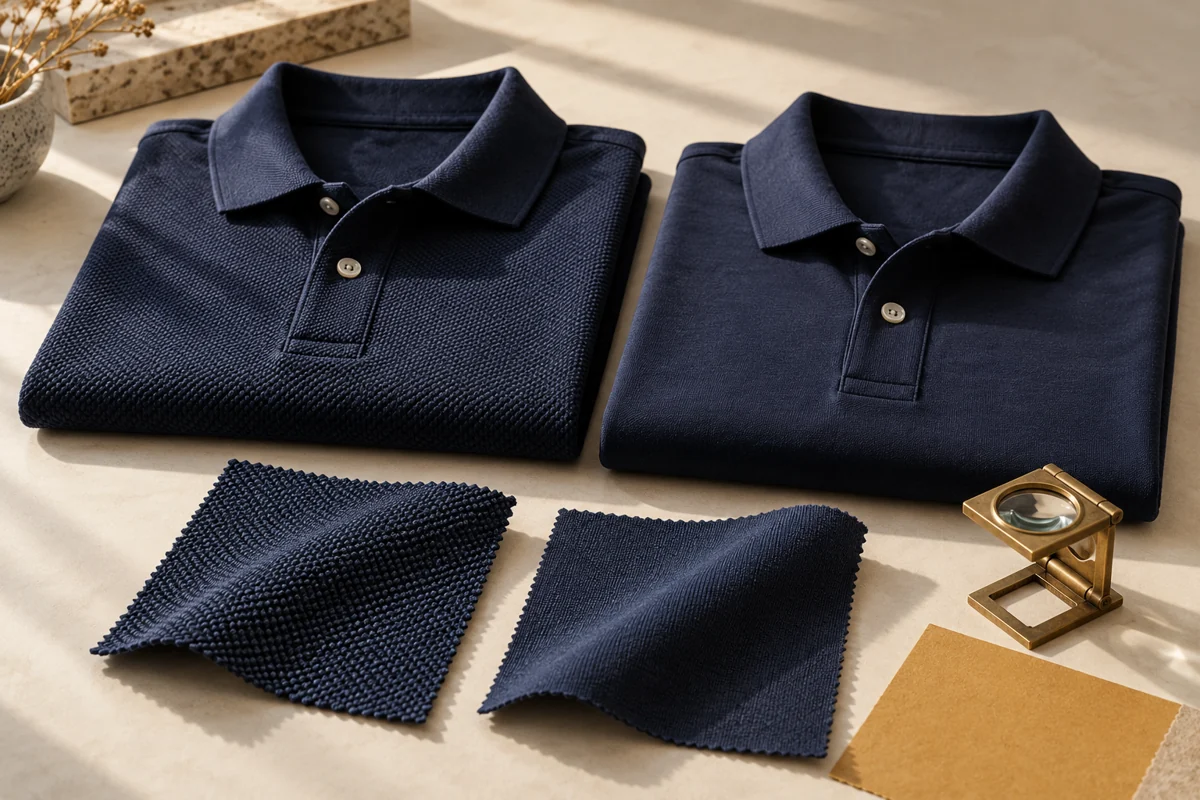
Choose piqué for a deliberately textured polo appearance; shortlist jersey when a smoother, T-shirt-like surface is the preference. Then approve the exact finished shirt—not the fabric name. Neither construction alone establishes softness, cooling, durability or logo quality. For a company program, the important decision is whether surface texture is part of the uniform specification or an employee choice.
That distinction matters when a supplier offers an “equivalent navy polo.” Matching the color name and fiber blend does not make a smooth jersey shirt visually interchangeable with a textured piqué. This guide helps a buyer define that boundary before opening orders, comparing quotes or accepting replacements.
Publisher perspective: Brand Sauce provides company-store services. This is our buying framework, not independent product testing or a promise of availability. Manufacturer specifications were checked October 29, 2026. The examples below are reference garments, not a confirmed Brand Sauce assortment; decorated pricing, destination-country availability and production minimums require a current quote.
Piqué and jersey describe construction, not cotton content
In polo buying, piqué generally signals a visibly textured knit, while plain jersey has a comparatively smooth face. Cotton Incorporated’s CottonWorks knit-construction reference explains jersey as repeated knit stitches and single piqué as a combination of knit and tuck stitches. It also distinguishes multiple piqué constructions. “Piqué” is therefore a useful starting label, not one exact fabric recipe.
The same reference describes interlock separately. If a supplier offers a smooth interlock polo, do not silently rename it single jersey for a comparison spreadsheet. Ask for the manufacturer’s actual construction description and retain it. The buyer needs a reliable product identity more than a tidy two-column classification.
Keep construction separate from fiber percentages, fabric weight and finishes. Those variables can change simultaneously between candidate shirts. A wearer’s preference for one sample does not prove that every piqué or every jersey will feel the same. If the main decision is cotton content versus a performance-oriented fabric, start with our cotton-versus-performance polo guide; this article addresses the additional surface-construction decision.
Two real specifications show why category labels are insufficient
These current supplier examples demonstrate the information worth keeping together. They are not a controlled head-to-head trial: composition, weight and garment details differ, so a performance difference could not fairly be attributed only to the knit.
| Specification | Piqué example | Jersey example |
|---|---|---|
| Exact reference | Port Authority Silk Touch K500 | Port & Co Core Blend Jersey Knit KP55 |
| Listed fabric | 5-ounce, 65% polyester / 35% cotton piqué | 5.5-ounce, 50% cotton / 50% polyester |
| Collar and cuffs | Flat knit | 1×1 rib knit |
| Care detail worth noticing | Cool iron permitted if necessary | Do not iron |
| What the listing does not settle | Your finished logo result, wearer preference, current stock in every variant, delivered decorated price or country eligibility | |
The listed jersey example has the higher fabric weight. That alone is enough to reject the shortcut “jersey always means the lighter polo.” It does not establish which garment feels cooler. Likewise, different collar constructions mean a collar preference should not automatically become a verdict on the body fabric.
Retain the complete current care instructions with each candidate; the table highlights one difference, not a complete washing guide. Ask the decorator for the finished garment’s instructions before publishing care copy. Do not combine whichever parts of two labels are most convenient.
Decide whether texture is mandatory, optional or irrelevant
Before requesting samples, choose one of three appearance rules. This is the decision that prevents a subjective disagreement after people have ordered.
| Program rule | Suitable situation | Consequence for the store |
|---|---|---|
| One texture required | A team must present a closely coordinated shirt appearance | Approve a defined fabric family and assess substitutes against a retained sample |
| Two textures approved | Employees share a color-and-logo standard but may choose the feel they prefer | Show the choices clearly, with separate photos and product specifications |
| Texture not a requirement | A voluntary gift where fit, usefulness and preference matter more than matching colleagues | Do not reject a suitable shirt solely because its knit differs from the launch sample |
Make the rule observable. “Navy collared shirt with an approved chest mark; smooth and textured options permitted” is clearer than “smart polo.” Conversely, if a buyer requires the textured appearance of a particular sample, record that explicitly instead of expecting a supplier to infer it from the word “uniform.”
A shared color name is not a color-match guarantee. View candidate garments together rather than comparing separate online images. If they only need to coordinate, say so. If the requirement is a close visual match, establish the acceptable relationship with physical samples before a purchase order is issued.
Review the surface at three useful distances
A macro photograph, a worn shirt and a group of colleagues answer different questions. Use all three perspectives, but do not mistake this internal review for laboratory testing.
Close up: does the surface communicate the intended choice?
Look at the actual sample’s body fabric and its reverse. Photograph both candidates under the same light, at the same scale. A close-up can explain the textured-versus-smooth distinction to employees better than calling one “classic” and the other “modern.” Keep those photos tied to the correct style and color; a conceptual editorial image is not a substitute for an orderable product photograph.
While worn: does the finished shirt work as a shirt?
View the chest, placket, sleeves and hem on a wearer in a suitable size. Ask whether the surface and drape look appropriate while seated and standing. Inspect coverage in the intended lighting, especially for a light color. Do not conclude that one construction is universally transparent or opaque from one sample. Record the exact color and fit that passed.
Across the team: is mixing the options intentional?
Place the approved styles beside one another with the same proposed logo treatment. For an employee-choice program, ask whether they read as an intentional range. For a tightly coordinated uniform, ask whether the difference violates the written appearance rule. The answer can legitimately differ between those programs without either fabric being inferior.
Approve the logo against the fabric surface
A logo mockup shows proposed placement; it cannot establish the result on a particular knit. Give the decorator both candidate styles and the real artwork. Ask which details need attention on each surface and whether the same method and dimensions are appropriate. Require an explicit revision if the decorator recommends changing small text, logo size or treatment.
Inspect the finished mark at ordinary viewing distance and close up. Can the lettering be read? Are the edges acceptable? Does the area lie as intended while worn? Does the reverse feel acceptable against an undershirt or skin? These are acceptance questions, not a claim that piqué always needs embroidery or that jersey always prints better.
If identical logo dimensions produce an unsatisfactory result on one shirt, decide whether a revised treatment is permitted or whether that style should leave the shortlist. Do not approve a poor result simply to preserve identical specifications. Use our decorated-apparel sample approval checklist to retain the exact garment and artwork combination that was released.
Separate texture preference from fit complaints
Give wearers a way to describe what they dislike without forcing a fabric verdict. “Rough at the collar,” “tight across the chest” and “do not like the visible texture” are different observations. The first may concern a trim, the second the cut, and only the third directly states an appearance preference.
For a small internal trial, use three prompts: what did you notice first, what bothered you during normal wear, and would you choose this exact shirt again? Record the size and style with the answer. Avoid asking “Which fabric is more professional?” unless you have already defined what professional means for that program.
Wash the decorated samples according to their approved instructions and repeat the relevant checks. Preserve before-and-after photos and record the routine used. Treat this as a practical release check, not a lifetime durability forecast. If a wearer likes the shirt before washing but not afterward, the program needs to address that actual result rather than defend the category name.
Set replacement rules before stock changes
Consider a hypothetical visitor-services team whose original order uses a textured polo. Months later, the requested size is unavailable and a smooth shirt is offered in a similar navy. The replacement may be perfectly usable, but “same color and collared” does not answer whether it satisfies the team’s appearance rule.
If texture was mandatory, hold the substitution for review. If both textures were approved, confirm that the proposed replacement is the approved second style—not merely another smooth polo. If this is a voluntary gift and the employee chose piqué for its feel, offer a choice rather than treating the alternate as automatically equivalent. This is an illustrative scenario, not a Brand Sauce client account.
Write a compact substitution note: approved style, texture requirement, acceptable alternate, logo reference, recipient-consent requirement and who can authorize a change. Our gift substitution guide covers the broader recipient and funding process. The fabric-specific point is simple: preserve the reason the shirt was selected, not just its category.
Choose production after defining the approved range
For a known team with confirmed sizes and a fixed launch, request a bulk quote for the approved garment. Consolidated production can be a sensible choice when demand is predictable. Include distribution and a realistic replacement plan rather than purchasing arbitrary extra sizes because the unit price falls.
For ongoing individual selections, evaluate on-demand availability for each exact approved style, color, size and decoration. A broad statement that a vendor offers polos is not confirmation of that combination. A hybrid can pair a launch order with individual replenishment, provided the supplier can maintain the agreed specification. On-demand does not guarantee blank stock, and bulk does not guarantee continuity after a style change.
Compare delivered quotes on the same scope: garments, decoration, setup, samples, freight, applicable taxes and any separate replenishment charges. There is no defensible universal price winner between piqué and jersey. If two options remain in the store, confirm that both are genuinely accessible under the program’s funding and size rules.
Frequently asked questions
Is piqué always cotton?
No. The K500 example is a polyester/cotton blend. Construction and fiber composition are separate fields; keep both in the buying record.
Does a textured polo prove it will be cooler?
No. Texture alone is not a comparative cooling result for finished garments. Consider the complete specification and ordinary wear feedback in the intended setting. Do not turn a general fabric description into a temperature-performance promise.
Should all employees receive the same construction?
Only if the program needs that consistency. A deliberately approved two-texture range can preserve a shared color-and-logo standard while allowing preference. Explain the difference without describing either option as second-class.
Can a jersey shirt replace an unavailable piqué?
It can be an approved alternative, but not an automatic equivalent. Check the appearance rule, fit, logo result, care and the recipient’s original choice before substitution.
The buying decision is complete when another person can reorder the right shirt without guessing what “a navy polo” meant. Keep the construction, exact style, texture rule and finished-sample reference together. That is more useful than declaring one knit the universal winner.