Buy odor-control company apparel for a defined freshness benefit—not as protection against illness and not as permission to skip required laundering. Before paying more, identify what the treatment targets, which exact garment contains it, what evidence supports the claim after care, and whether employees actually value that feature. An untreated shirt with better fit and easier care can be the better purchase.
Brand Sauce publishes this guide from a company-store provider’s perspective. It is a purchasing framework for ordinary branded apparel, not an assessment of medical protective clothing. The examples and approval worksheet are editorial recommendations, not client test results. Primary sources were checked October 17, 2026. Named technologies illustrate differences; they do not establish Brand Sauce availability, decoration compatibility or country coverage.
Odor control and antimicrobial treatment answer different questions
“Odor control” describes a desired outcome. “Antimicrobial” describes activity against microorganisms. Those labels are not interchangeable, and neither by itself tells a buyer how a finished polo will perform during a workday.
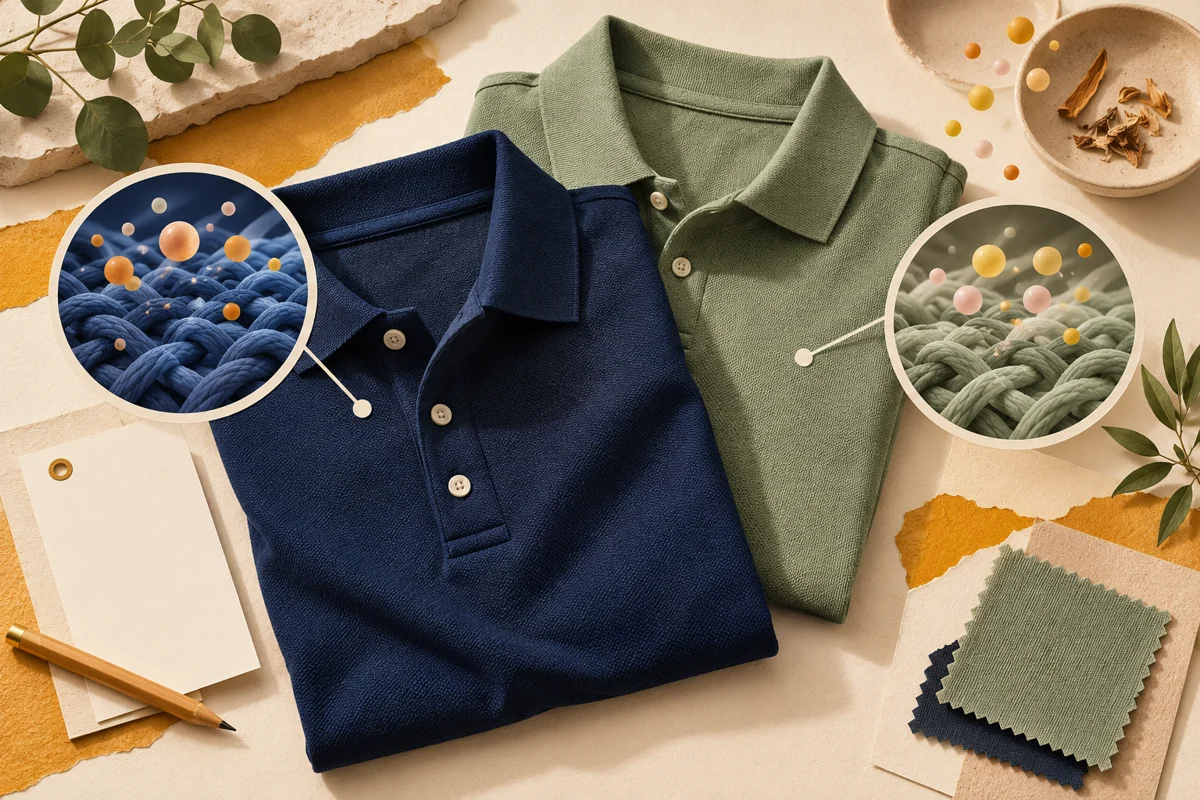
Polygiene describes StayFresh as a silver-chloride-based treatment that inhibits odor-causing bacteria in textiles. Its current OdorCrunch2.0 page describes a different mechanism: capturing odor molecules within the textile and releasing absorbed odors during laundering to refresh that capacity. These are the technology supplier’s descriptions, not our independent performance findings.
The practical distinction is the target. Evidence about bacterial reduction does not automatically answer a question about retained cooking smells. Likewise, evidence about odor capture does not establish that a product protects its wearer from pathogens. Ask suppliers to connect each proposed benefit to the relevant evidence instead of presenting one impressive-looking result as proof of everything.
| Proposed feature | Buying question | Do not assume |
|---|---|---|
| Control of odor-causing bacteria in fabric | Which treatment and finished garment are covered? | Protection of the person wearing it |
| Capture of odor molecules | Which odors were evaluated, and under what conditions? | Antimicrobial activity |
| Moisture management | What evidence supports the stated moisture behavior? | Odor control simply because the shirt is called performance apparel |
| Durability through washing | What care procedure and number of cycles support the claim? | Identical performance after any laundry routine |
Keep product freshness separate from wearer protection
For U.S. buying, the EPA explains that the treated-articles exemption concerns qualifying treatments intended to protect the article itself. It does not extend to public-health claims. EPA also says qualifying products need appropriate clarifying statements; an absent registration number alone is not proof that a product qualifies.
For an ordinary company polo, do not turn a supplier’s fabric-freshness statement into copy suggesting protection against infection. Keep the exact scope and qualifications attached to the claim. If a supplier proposes a health-protection benefit, ask it to provide the applicable product authorization and supporting documentation for review before publishing that language.
This also affects visual merchandising. A product tile with a medical shield or a “germ protection” badge can imply more than the accompanying fabric description. Review imagery, promotional emails and selection-page filters alongside the technical text. The safest buying decision is not to infer a new use from a marketing adjective.
Decide whether freshness is worth prioritizing
Start with the workday, not the treatment name. For optional employee gifts, ask whether recipients want travel apparel, an office polo, a workout shirt or something unrelated to clothing. For required apparel, establish the actual care routine and role requirements before comparing finishes.
A travel-oriented gift may justify evaluating a freshness feature alongside comfort, packing and easy care. A shirt collected for laundering after every shift may offer a different value proposition. Do not model fewer washes when the operating routine will not change. A technology premium must compete with other uses of the budget: a better cut, broader size availability, a second shirt or a more suitable fabric.
Our cotton versus performance polo guide covers the underlying garment decision. Set that baseline first. An odor-control claim should not rescue a style that employees dislike wearing or cannot comfortably size.
Keep an alternative available when choice is part of the program. Employees should not need to disclose a personal medical explanation to prefer another garment. Describe verified features clearly and let recipients choose without presenting treated apparel as the responsible option and everything else as inferior.
Ask for a claim-to-garment evidence record
A technology brochure establishes what the technology supplier says. It does not, by itself, prove that every style in a distributor’s collection uses that treatment, uses the same generation, or carries the same claim in every market. Build one evidence record for the actual item you intend to order.
| Field | What the supplier should identify |
|---|---|
| Product identity | Brand, style number, color, fabric composition and covered variants |
| Treatment identity | Technology name, version and whether the exact garment includes it |
| Claim scope | The specific outcome and approved wording, including limitations |
| Evidence scope | Whether results concern an ingredient, fabric specimen or finished garment |
| Test conditions | Method, measured target, comparison basis and relevant care history |
| Durability | Supported wash conditions and duration, rather than an unexplained lifetime claim |
| Finished-item care | Instructions reconciled with the proposed decoration process |
| Commercial scope | Country availability, quantities, pricing, lead time and replacement options |
When a percentage appears in a presentation, ask what changed, relative to what, and when it was measured. A result for one organism or one odor under controlled conditions should not become a universal statement about a whole workday. Keep the report reference beside the approved claim so the next administrator can understand the boundary.
Do not promote a pending certification to an awarded one. For example, the current OdorCrunch2.0 page explicitly lists certain certifications as pending. That is another reason to record the version and retrieval date rather than borrowing badges from a related technology page. Verify any certification claim for its exact scope before adding it to your store.
Use a pilot to answer buying questions—not to invent scientific proof
A small employee trial can reveal whether a shirt fits, feels comfortable, works with the approved care routine and seems worth selecting. It cannot establish a broad antimicrobial efficacy claim. Separate those two forms of evidence in the approval record.
Make participation voluntary and keep feedback private. Ask about the garment rather than asking colleagues to judge one another’s bodies or smell. Useful prompts include: Was the shirt comfortable through the intended activity? Were the care instructions practical? Would you choose it again instead of the comparison option? What made it unsuitable?
Use a finished decorated sample, not only an untreated blank or a technology swatch. Ask the manufacturer and decorator whether the intended processing is compatible with the treatment and what remains unverified. Our finished-apparel sample approval guide provides the broader inspection workflow.
Record mixed results honestly. If employees prefer the untreated option for its fit, do not discard that feedback because the treated option has a more sophisticated feature sheet. If one participant likes the freshness benefit, do not publish that preference as proof that the treatment works for everyone. The pilot’s purpose is to improve this purchasing decision.
Compare the complete offer, including an untreated option
Request like-for-like quotes where possible: garment, decoration, size range, quantities, freight and service scope. If the shirts differ in fabric weight, construction or brand, call that out. You cannot attribute the full price difference to odor control when several product features change at once. Prices remain quote-needed until the actual configuration is confirmed.
Illustrative decision, not a measured result: a buyer shortlists two polos for a voluntary travel gift. Option A has the preferred fit and no odor-control claim. Option B includes a named treatment but lacks a suitable length variant for part of the team. The buyer keeps A available and considers B only for employees who prefer it after seeing accurate details. There is no need to declare one universal winner.
For a required uniform, a more consistent assortment may be necessary. Evaluate whether both options satisfy the role specification before offering them. Do not let gift-style freedom accidentally introduce an unapproved uniform variant.
Bulk purchasing can be sensible for a confirmed team and stable specification. On-demand can suit ongoing individual selection without pre-buying every size, provided the exact treated style and decoration are actually supported. A hybrid can combine a scheduled uniform run with later replenishment. None of these models proves treatment performance, and none guarantees identical substitute garments.
Use a six-part release card
- Identity: the purchase order, product page and supplier evidence refer to the same style and treatment version.
- Purpose: the feature addresses a real recipient or role need, with an appropriate alternative considered.
- Claims: every feature statement has a source and preserves its qualifications; no wearer-protection implication has been added.
- Care: garment and decoration instructions agree, and operating laundry requirements remain intact.
- Commercials: current availability, destinations, quantities, decorated price and replacements are confirmed.
- Change control: someone owns reapproval when the garment, treatment, source documentation or production configuration changes.
A missing answer should become a named follow-up, not a marketing assumption. You can select a different verified garment while resolving the gap. If a stocked item is later unavailable, do not silently substitute another “performance polo” and retain the old feature copy. Use an explicit gift substitution policy and recheck the claims.
Frequently asked questions
Does odor-resistant mean antibacterial?
No. Ask what produces the odor-control effect. A capture-based treatment and a treatment aimed at odor-causing bacteria are different approaches. The exact product documentation should explain which applies.
Can employees wash treated shirts less often?
Do not promise a new washing schedule from the feature name. Follow the finished garment’s care instructions and workplace requirements. A possible personal-use benefit is not an instruction to bypass a required laundry routine.
Does adding our logo invalidate the treatment?
Do not assume either outcome. Obtain compatibility guidance for the exact garment, treatment and decoration process. A general technology page is not approval for your finished configuration.
Should we advertise water or energy savings?
Not without evidence applicable to the claim you intend to make. A supplier scenario about changing wash frequency is not a measured result for your employee program. If your team has not measured that change, do not present it as achieved savings.
What is the simplest buying rule?
Choose the garment for fit and use, verify the treatment for the exact item, and communicate only the supported benefit. Freshness can be a useful feature without becoming a health promise or the deciding factor for every employee.