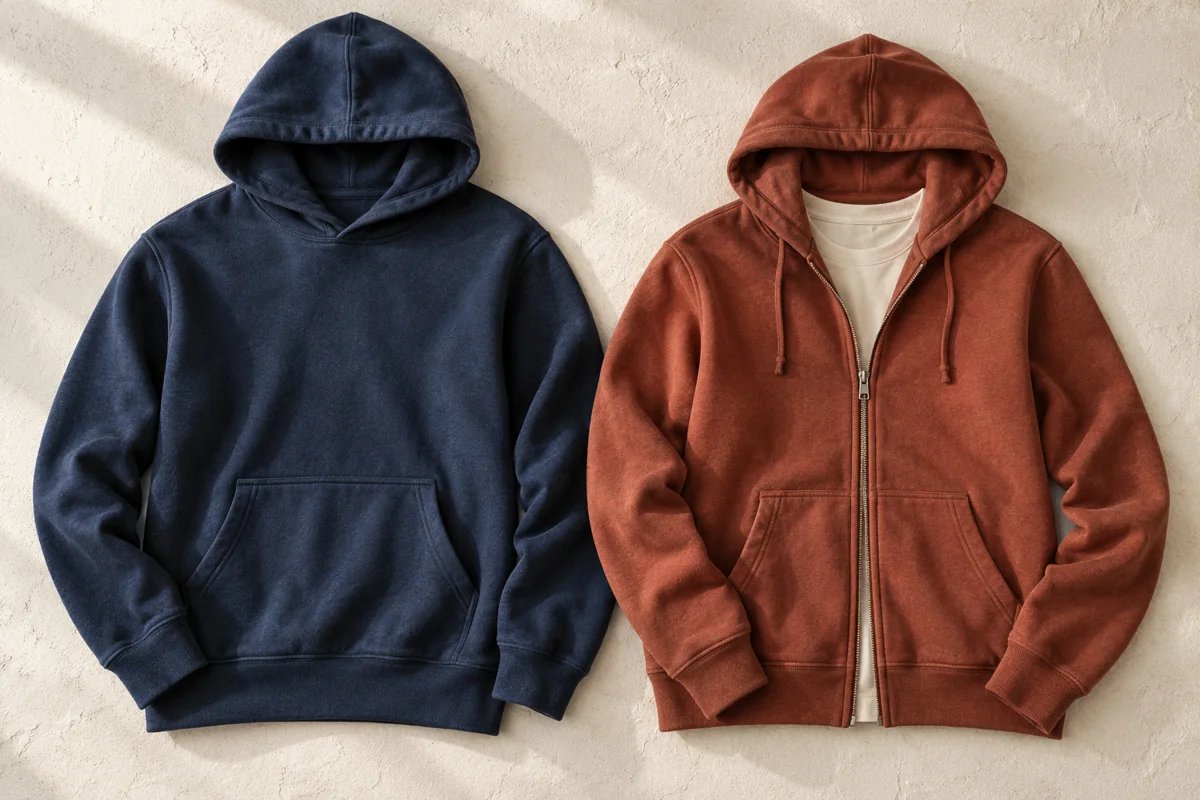
Choose a full-zip company hoodie when employees need an adjustable layer they can remove without pulling it over their heads. Choose a pullover when an uninterrupted front graphic is central to the design and recipients prefer that silhouette. Offer both only when the second option solves a real wearing need—and your budget can support two approved configurations.
The closure is not a minor finishing detail. It changes how someone puts the garment on, wears it at a desk and displays the artwork. Yet buyers often select a sweatshirt fabric first, approve a large front logo second and discover the zipper conflict last.
This guide is about choosing the garment format for an adult employee-merchandise program. It is not a fabric comparison, a claim that hoodies suit every workplace, or a ranking of branded products.
Publisher perspective: Brand Sauce publishes this buying framework. Recommendations are editorial analysis, not wear-test results or measured customer outcomes. Manufacturer references explain specific construction and decoration considerations; they do not establish Brand Sauce stock, partnerships or availability. Exact style, color, size, decoration, destination coverage and prices are quote-needed. Sources checked October 9, 2026.
Compare the wearing job before the product photo
| Decision | Full-zip starting point | Pullover starting point |
|---|---|---|
| Frequent changes between warmer and cooler rooms | Can be worn open or closed without removing the garment | Ask whether taking the whole layer off is convenient |
| Large, centered front artwork | Needs a zipper-aware design and production review | Offers an uninterrupted chest, subject to pocket and seam limits |
| Small, understated company mark | Consider a chest placement clear of the closure | Consider chest placement without assuming the same coordinates |
| Getting dressed | Avoids an overhead opening but requires operating the zipper | Avoids zipper operation but requires getting through the neck opening |
| Program simplicity | One approved style can be simple if it meets recipient needs | One approved style can be simple if it meets recipient needs |
Neither column is a universal winner. Ask recipients about tasks, not just preferences: “Would you want to take this off while seated?” produces more actionable feedback than “Which one looks premium?” A full zip may suit someone who layers over a collared shirt; another person may prefer a pullover for off-duty use. Those are possible use cases, not predictions about your workforce.
Before choosing either, confirm that a hooded garment fits the intended workplace. If the program supplies clothing for a particular job, have the responsible workplace owner approve the format. An appreciation gift and required workwear are different briefs.
Decide what the logo must do
A full-length zipper divides the front into two panels. That does not make front decoration impossible, but it does make a standard centered design a separate production question. Do not send a pullover mockup to the decorator and simply replace the underlying garment photograph with a zip hoodie.
For a full zip, start with a small mark on one side of the chest, a suitable sleeve treatment or a back design. Consider how it looks with the garment open, not only zipped flat. If the concept depends on a continuous image across the zipper, ask the decorator to demonstrate the exact result on the chosen style before approving it.
SanMar's PC850ZH decoration sheet, for example, identifies left- and right-chest areas and a back area. It explicitly makes decoration area dependent on garment size, method and equipment. Those dimensions are not a universal hoodie template. The practical implication is to approve the placement on your actual garment rather than transferring measurements between styles.
A pullover gives you a continuous chest surface, but not an unlimited canvas. Locate the pocket seam, neckline and hood before choosing artwork size. On either format, view a back design with the hood resting normally; a beautiful flat proof can hide information beneath the hood when worn.
Use a simple artwork hierarchy: the company identifier must remain readable, while a campaign illustration or slogan can occupy a secondary location. If the full-zip version needs different artwork, record it as a separate approved version. Do not let the production team improvise a split logo to rescue a file designed for a different garment.
Keep the comparison fair
A heavy pullover and a lightweight zip hoodie do not isolate the closure decision. Someone who picks the softer sample may be voting for its fabric, not its opening. Start with candidates as similar as practical in fabric weight, interior finish, intended fit and quality level; document unavoidable differences.
Our French terry versus fleece guide addresses interior texture separately. Use it to settle the fabric brief, then test whether the full zip or pullover better serves the wearing job. Neither closure alone establishes warmth, durability or a premium feel.
Even the color can change the comparison. SanMar's PC850ZH product specification lists different cotton/polyester blends for its standard colors, Athletic Heather and Dark Heather Grey, and exceptions to its cotton-face description. That is a concrete reason to compare the proposed color, not whichever sample happens to be available.
Do not assume that matching color names from different styles produce a matched set. Request physical samples if the two options must look coordinated at an event. A slight difference may be perfectly acceptable for employee choice; it may be unacceptable for a tightly specified visual presentation. Set that expectation before ordering.
Run a closure-specific wear check
Invite a small, willing group to compare samples over their usual clothing. Keep feedback private and product-focused. This is a practical approval exercise, not a representative employee study, and participants do not need to disclose a medical explanation for preferring one opening.
- Put it on and remove it. Is the overhead opening comfortable? Is the zipper easy for that wearer to start and pull? Do not declare one format accessible to everyone.
- Sit at a normal work surface. Check the hem, front closure and pocket position while seated rather than judging only in a mirror.
- Adjust the layer. Try the full zip open and closed. Ask the pullover wearer whether removing the whole garment would be practical during their day.
- Reach and move. Check whether the chosen fit supports ordinary movement over the intended underlayer. Do not use a larger size as the automatic solution to a cut that does not suit the wearer.
- Inspect the branding in use. Look at the chest when the zip is open and at the back when the hood is down.
- Record a specific outcome. Use “zipper pull difficult to grip” or “front artwork obscured when open,” not just “didn't like it.”
Keep an alternative route for recipients who cannot use either candidate comfortably. A crewneck or another gift may solve the problem better than adding a third hoodie with the same limitation. Choice should address wearing needs, not merely multiply colors.
Approve the finished garment, including the closure
For the full zip, operate the zipper before and after the agreed care check. Look for fabric catching near the slider, a front that sits unexpectedly or decoration that interferes with normal use. Report observations to the supplier rather than diagnosing the cause yourself.
YKK's zipper usage manual explains that direct ironing can damage zipper components and that temperature suitability varies by zipper type. This is not a heat-press recipe for your hoodie. Ask the decorator to account for the exact closure, fabric and application process, and follow the finished garment's care instructions.
For the pullover, inspect the neck opening, pocket-adjacent decoration and inside finish after the same agreed care process. A blank garment that feels good does not establish the comfort of a large added print or embroidery backing.
Use our decorated-apparel sample approval process for the full record. The closure-specific addition is to check functionality and appearance in each wearing state. If two styles use different artwork or production methods, approve both; one passing sample is not evidence for the other.
Should the store offer one format or both?
Start with one if the audience has a clear shared use case, the sample meets the required fit range and an alternative is available for exceptions. Add the other format when recipient feedback reveals a meaningful unmet need, such as avoiding overhead dressing or preserving a preferred pullover fit.
Two formats create more than two product photographs. Each style brings its own size/color availability, artwork approval, care details and support information. A second option earns its place when it serves people the first one does not—not simply because a larger store looks more impressive.
Illustrative configuration calculation, not measured results: one format offered in two colors and seven sizes creates 14 size-color combinations to verify. Offering both formats at that same breadth creates 28. Keeping two formats but one color each returns the check to 14 combinations, while retaining closure choice. This is an assortment-planning count, not a prediction of stockouts or a supplier inventory requirement.
Do not trim sizes to make that arithmetic look tidy. Simplifying colors may be reasonable; removing the only size that serves a recipient defeats the purpose of choice. Also confirm whether both options are fully funded. A closure preference should not become an unexpected employee payment unless the program explicitly communicates an optional upgrade.
Choose the ordering model after the garment decision
On-demand can fit an ongoing program with uncertain format and size preferences, provided both decorated configurations are actually eligible. Confirm minimums, production estimates, size/color availability and replacement handling for each one. “On-demand hoodie” is not a guarantee that every logo placement or style qualifies.
Bulk can fit a fixed event with confirmed choices and enough time to collect sizes. Quote the actual split between full zips and pullovers rather than assuming they share a price or production setup. Bulk may be the sensible choice when the selected decoration needs a particular production run.
A hybrid can use a collected group order for launch and a narrower ongoing selection for later hires. Explain any difference in choice before opening the program. Compare the complete quotes: garments, decorated configurations, samples, shipping, applicable taxes and handling of problems. Our on-demand versus bulk decision guide covers the broader economics; neither model automatically costs less.
A copyable supplier brief
- Wearing job: where the garment will be used, the normal underlayer and whether frequent removal is expected.
- Format: full zip, pullover or both, with the reason for each approved choice.
- Exact garment: style, proposed colors, size range, fiber/finish specification and measurement chart.
- Artwork: version, placement, dimensions and how it should appear with the hood down or zipper open.
- Approval: decorated sample, closure check, agreed care check and one release owner.
- Commercial confirmation: destination, quantity or ordering model, all-in quote and rules for unavailable configurations.
Frequently asked questions
Is a full-zip hoodie more professional?
Not inherently. Workplace expectations, fit, color and artwork all affect the impression. Ask the intended workplace owner to approve an actual outfit rather than relying on a category label.
Can a logo cross the zipper?
Possibly, but it needs a garment- and method-specific production review. Require a decorated sample if continuity across the opening matters. A digital mockup does not prove the finished result.
Is the pullover always cheaper?
No price rule should replace a quote. Compare the exact garments, decoration, quantities and delivery requirements. Do not treat closure type as an all-in cost estimate.
Can employees use the same size in both?
Do not assume so. Provide each style's current measurement guidance and let recipients compare it with a garment they find comfortable. Matching letter sizes do not prove matching fit.
The buying decision is complete when you can explain why each format belongs, show its approved decorated sample and fulfill it under clear terms. If the second hoodie adds no distinct wearing benefit, keep the assortment focused. If it solves a real need, make that choice easy to understand.
The hero is AI-generated conceptual editorial imagery, not a photograph of products offered for sale.