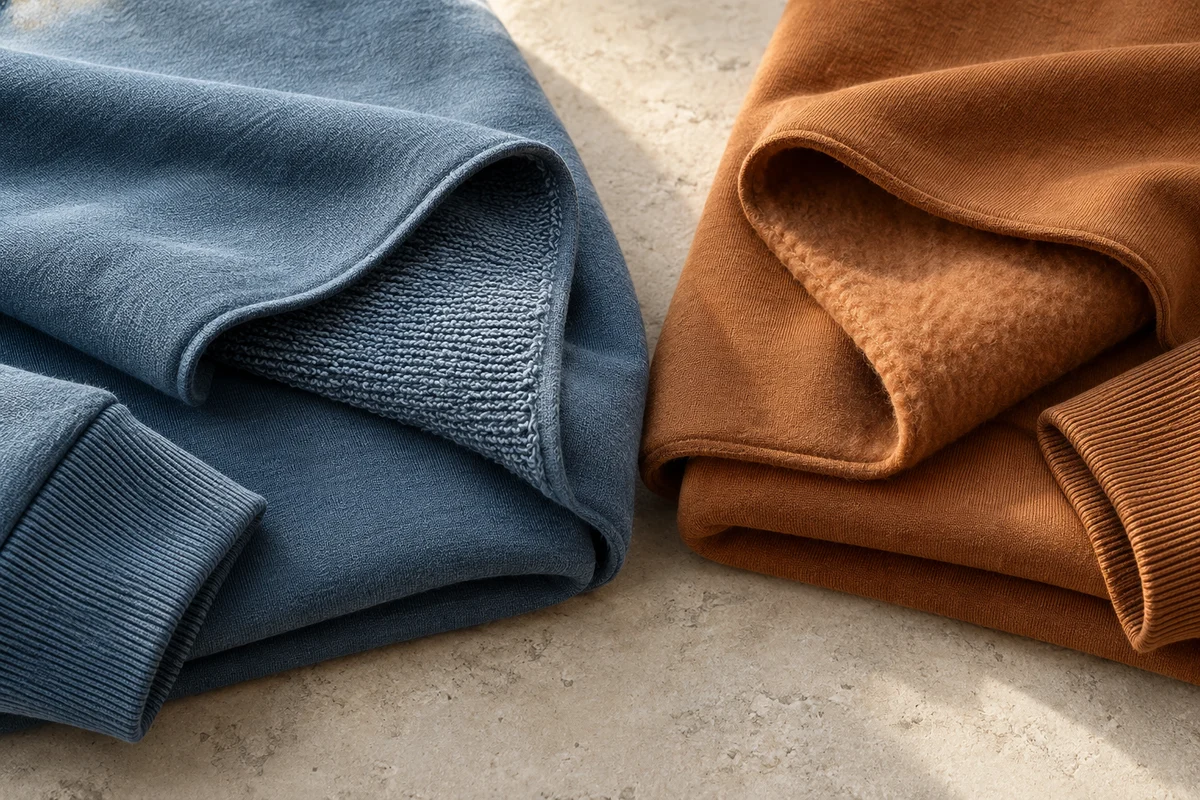
Choose French terry when employees want an unbrushed, loop-backed sweatshirt; shortlist brushed fleece when a plush interior is the priority. Then compare the actual weight, fit and finished decoration—not just the fabric name. For a mixed workforce, two clearly differentiated choices can be more useful than declaring one material the universal winner.
The important purchasing question is whether the sweatshirt will become a useful layer or an impressive-looking gift that stays in a drawer. A photograph of the outside rarely answers that. Request an inside view, a complete specification and a sample before committing your company-store assortment.
Publisher perspective: Brand Sauce provides company-store services. This is our buying framework, not laboratory testing or a claim that we have worn these products. The manufacturer examples explain specification differences; exact decorated availability, destination coverage, minimums and pricing are quote-needed. Sources checked October 8, 2026.
Start inside the sweatshirt
French terry and brushed sweatshirt fleece can have similar-looking outer faces. The useful distinction is on the reverse: French terry retains visible loops, while brushing or napping produces fleece’s fuzzy interior. Cotton Incorporated’s guide to knit constructions explains that French terry is an un-napped fleece construction and that the knit structure can remain the same after napping.
That terminology matters when a vendor uses “fleece” as a broad category. Ask whether the exact garment has a loopback or brushed interior. Do not reject an otherwise suitable product because its catalog category differs from your preferred wording.
This guide concerns sweatshirt fabrics, not a direct comparison of every polar fleece, sherpa or technical outerwear material. Cotton Incorporated also identifies cotton, cotton/polyester blends and synthetic options within fleece. Neither “French terry” nor “fleece” is a complete fiber-content statement.
| Question | French terry starting point | Brushed fleece starting point |
|---|---|---|
| What touches the wearer? | Unbrushed loopback surface | Raised, fuzzy interior |
| What preference should you investigate? | Does the wearer like the looped texture? | Does the wearer want a plush texture? |
| What must still be checked? | Weight, fit, layering and finished care | Weight, fit, layering and finished care |
| What should the store show? | A clear interior photograph | A clear interior photograph |
Use those descriptions to set expectations, not to promise a temperature rating. A person buying for an air-conditioned office may have a different comfort target from someone selecting a weekend layer. Ask about that intended use before asking which sample feels most luxurious.
Fabric weight is not a winner’s podium
Three current manufacturer specifications demonstrate why “French terry means lightweight” is an unreliable purchasing rule. These are examples to investigate, not a ranked shortlist or a statement of Brand Sauce inventory.
| Manufacturer example | Published fabric specification | What it helps you notice |
|---|---|---|
| District DT671 Women’s Featherweight French Terry Hoodie | 4.5-ounce / 153 GSM; 70% cotton, 30% polyester | A lighter French terry example with its own silhouette |
| Allmade AL4000 Unisex Organic French Terry Pullover Hoodie | 8.3-ounce; 100% organic combed ring-spun cotton French terry | French terry is not confined to light fabrics |
| District DT6100 V.I.T. Fleece Hoodie | 8.3-ounce / 280 GSM; three-end fleece; 65% cotton, 35% polyester, with 60/40 specified for heathers and frosts | The same nominal weight can accompany a different construction and blend |
Sources: SanMar’s DT671 specifications, AL4000 specifications and DT6100 specifications. Confirm the exact selected color and current label; a color family can change the blend.
Fabric weight describes material, not the boxed garment’s shipping weight. It also does not measure softness, construction quality or how the complete hoodie fits under a jacket. Comparing only the two 8.3-ounce entries would miss their different interiors and fiber recipes. Comparing the lightest and heaviest entries as if they were otherwise identical would miss their different cuts.
For a fair shortlist, try to hold the intended silhouette and use constant. If you compare a fitted lightweight hoodie against a roomy substantial pullover, record that you are choosing between complete garments—not isolating the effect of brushing.
Choose the wearer’s situation before choosing the fabric
Write a use statement concrete enough to eliminate unsuitable options. “Optional desk layer worn over a T-shirt” is useful. “Premium hoodie everyone will love” is not a testable brief.
- Desk layer: compare how both samples feel while seated, with sleeves at a keyboard and the hood resting behind the neck. Favor the garment people will actually keep on.
- Commuting layer: try the intended coat or bag over each sample. Record restriction at the shoulders, hood crowding and whether the hem stays where the wearer wants it.
- Cozy appreciation gift: include a brushed option if plushness is central to the brief, but provide another choice for recipients who dislike that texture.
- Coordinated team appearance: evaluate the group’s finished look, fit coverage and replacement plan. Matching fabric words do not establish matching silhouettes.
Do not assign materials solely by office location. Climate can inform a shortlist, but it does not tell you whether an individual runs warm, prefers a heavier layer or plans to wear the gift away from work. A small, understandable choice can handle those differences without requiring employees to explain personal comfort needs.
If this is required workwear, separate workplace requirements from optional gifting preferences before considering either fabric. An appealing sweatshirt description is not evidence of suitability for a specialized work environment.
Approve the exterior and the interior together
The recipient experiences the finished garment, including the logo. A blank that feels right can become less appealing with a decoration area that feels stiff, rubs or sits awkwardly. Ask the decorator to recommend a method for the actual style, color, artwork and placement.
The DT6100 specification separates overall blend from face composition: it lists a cotton face for solids, Grey Frost and Light Heather Grey. Do not extend that statement to every heather or assume that the fabric’s overall percentage describes the printing surface by itself.
SanMar’s DT6100 decoration sheet also makes available area conditional on garment size, method and equipment. A nominal chest rectangle is a planning aid, not approval to put the same artwork anywhere on every size.
Review a finished sample with the hood up and down, the wearer seated and the garment layered as intended. Check whether a hood obscures back artwork and whether the chosen front treatment competes with a pocket or seam. These are layout questions that a fabric label cannot settle.
Use our embroidery-versus-printing decision guide for the method tradeoff. Neither French terry nor fleece automatically makes one decoration method correct.
Run a comparison that produces a decision
A sample review should tell you what to list, not just produce comments such as “nice and soft.” Use the following buyer screening exercise. It is not a standardized textile test or a durability certification.
- Identify each finished candidate. Record style, color, size, interior finish, blend, weight, logo and care instructions. Keep photos of both surfaces.
- Give testers the same use brief. Ask them to wear samples for a representative task, rather than judging only by touching the folded garment.
- Separate fit from texture. Record whether a negative reaction concerns the interior, the cut, the hood, the cuffs or the decoration. Otherwise you may discard a fabric when the real problem is sizing.
- Follow the confirmed finished-product care directions. Note settings and completed cycles. Compare dimensions, seams, surface appearance and decoration with the original record.
- Make a scoped decision. Keep one option, retain two meaningfully different choices, or request another candidate. Document unresolved issues instead of averaging them away.
A useful feedback card asks: Would you wear this for the stated task? What would stop you? Which interior do you prefer? Is a different size likely to resolve the problem? Those answers are more actionable than a single overall score.
Before the trial, agree on rejection conditions: for example, no workable fit for a required size group, uncomfortable decoration or an unacceptable change after the documented care check. Do not invent universal shrinkage or pilling tolerances. If the program needs measurable limits, agree them with the supplier and ask what evidence supports them. Our finished-apparel sample approval guide provides the broader release record.
Make the store choice understandable
If you keep both fabrics, explain the difference in ordinary language: “loopback interior” and “brushed interior,” supported by photographs of the actual products. Avoid labeling one “basic” and the other “premium” unless you can explain what the price difference buys.
Show style-specific measurements, fit guidance, composition, care and approved decoration on each listing. Do not silently transfer a size choice from one style to the other. Offer a help route when neither works, rather than expecting the employee to choose a bad fit because the allowance expires.
Illustrative assortment scenario: a company is selecting an optional annual sweatshirt for both desk-based and traveling staff. A trial finds that one group prefers the loopback candidate and another the brushed candidate, while a few people need a different cut. The useful response is two clearly explained fabric choices plus a fit exception—not six near-identical colors or a claim that the majority’s favorite suits everybody. This is a hypothetical decision example, not a customer result.
A second option earns its place when it solves a distinct recipient problem. If both samples serve the same people equally well, one approved sweatshirt may be enough. See our company-store assortment framework for keeping the wider selection focused.
Choose the purchasing model after the sweatshirt
On-demand can suit optional orders spread across the year when the exact garment and decoration are supported. Confirm the actual size, color and destination combination, replenishment process and delivery expectations. “No inventory” does not guarantee that a particular blank will remain available forever.
Bulk can make sense for known quantities needed together, especially after employees have selected sizes. Compare the full decorated quote and distribution work, and decide who owns any reserve stock. Do not assume bulk is wasteful when demand is committed, or on-demand is cheaper without like-for-like quotes.
A hybrid can keep a confirmed event order separate from ongoing individual gifting. The key rule is that a shortage must not turn a loopback choice into a brushed replacement without an agreed substitution process. Interior feel is part of the selected product, even when the replacement looks similar in a thumbnail.
Frequently asked questions
Is French terry always lighter than fleece?
No. The cited French terry examples span 4.5 and 8.3 ounces, while the fleece example also lists 8.3 ounces. Compare the actual specification and finished garment instead of ranking by category name.
Does fleece mean polyester?
No. Read the fiber label. The cited DT6100 is a cotton/polyester blend, and fleece construction is not restricted to one fiber recipe.
Which one should a year-round company store carry?
Start with the intended use and a finished-sample comparison. Keep both only if they solve meaningfully different needs. There is no need to carry two fabric labels just to make the assortment look broader.
Can we use the same logo on both?
You can propose the same artwork, but have the decorator approve each garment and application. Confirm placement and finished feel; approval of one style does not automatically approve the second.
Bottom line: buy the sweatshirt employees can confidently choose, not the most persuasive fabric adjective. Show the inside, compare real specifications and preserve the approved product when orders begin.