Buy a company umbrella on the evidence for the exact model, not the biggest wind-speed number in the brochure. A useful approval separates four questions: what was tested, whether the canopy can recover after inversion, whether recipients can comfortably use it, and who pays when it breaks. “Windproof” does not answer all four.
For an employee gift or a shared office supply, the practical choice is often between a compact umbrella that people will carry and a larger model that stays near the door. Wind-performance evidence matters within that decision. It should not turn an inconvenient umbrella into the default gift, or turn a laboratory result into a promise about safe outdoor conditions.
Publisher perspective: Brand Sauce publishes this buying framework for company merchandise programs. Manufacturer examples explain evidence and tradeoffs; they are not a product ranking, a Brand Sauce inventory list or independent testing by our team. Sources checked November 6, 2026. Exact decorated models, destination-country availability, minimum quantities and prices are quote-needed.
Separate strength, recovery, usability and support
| Question | Useful evidence | What it does not establish |
|---|---|---|
| Does the frame withstand the stated test? | Model-linked report or documented test conditions and result | A comfortable or safe operating limit for a person outdoors |
| What happens if the canopy turns inside out? | Manufacturer recovery instructions for that model | That every inversion is harmless or every model recovers the same way |
| Will people actually carry and operate it? | A sample review of grip, packed size, weight and opening cycle | A durability rating for the whole production run |
| What happens after damage? | Applicable warranty, repair route and replacement responsibility | Automatic coverage simply because the product is called wind-resistant |
Keep these as separate approval fields. A product can have a strong test result and an inconvenient packed format. Another can be easy to carry but have an unclear service route. Neither fact makes the product universally good or bad; it changes which program should buy it.
For reception lending, a long umbrella may be perfectly practical because nobody needs to fit it into a laptop bag. For a mixed commuter audience, compactness may matter more. For an outdoor employee event, an umbrella is a convenience item—not the event's weather contingency plan.
Read a wind claim as a test result, not a universal rating
Doppler describes testing its carbonsteel umbrellas in a BMW wind tunnel at speeds above 100 km/h. That is a manufacturer statement about a named product family and test setting. It is not evidence that an unrelated promotional umbrella with a steel component performs identically.
EuroSCHIRM describes testing trekking and golf models at the Karlsruhe Institute of Technology and identifies tested products with Beaufort-scale seals. Its page also describes a specific model surviving short-term wind-tunnel speeds up to 120 km/h. The words “short-term,” the model identity and the test setting are important parts of that claim.
Our purchasing inference is straightforward: numbers from different pages are not a reliable league table unless the underlying methods and pass criteria are comparable. Converting units makes the numbers easier to read; it does not make different experiments equivalent.
Ask the supplier for a compact evidence record:
- Identity: the exact model, size, revision and configuration represented by the result.
- Setup: how the umbrella was held or mounted and its orientation to the airflow.
- Exposure: speed, duration, direction changes and any repeated cycles.
- Outcome: what counted as passing—remaining open, recovering from inversion, avoiding breakage or still operating afterward.
- Scope: whether the evidence applies to the proposed finished item, and what remains unverified.
These are recommended procurement questions, not a claim that all suppliers publish the same test standard. If only a marketing summary is available, record that limitation. You may still select the umbrella for ordinary use, but avoid publishing a more specific performance promise than the evidence supports.
Do not confuse inversion with permanent failure
Fulton's FAQ explains that flexible frames reduce stress and that many of its umbrellas are designed to recover from inversion through normal closing. The same FAQ excludes wind damage and wear from its own warranty, and says its repair service has been discontinued. Those statements illustrate why recovery design, warranty coverage and repair availability need separate checks.
Do not intentionally invert a sample unless the manufacturer supplies an appropriate procedure. A buyer's approval session should not become an improvised wind test. Ask for model-specific instructions, review how an owner is supposed to respond, and establish where a damaged item should go.
For a shared supply, give the receiving team a simple rule: an umbrella that binds, has an exposed broken component or no longer closes normally leaves the ready-to-lend supply until reviewed. Do not force it back into shape to keep the rack full. For personal gifts, provide the support route without asking employees to diagnose the frame.
A useful recipient message is modest: follow the manufacturer's operating instructions and contact the named support team if operation changes. Avoid “storm-proof at any speed,” “unbreakable” or similar expansions of a product claim.
Compare samples without pretending to run a laboratory
Start with the intended carrying job, then inspect the same features on every shortlisted sample. Use a clear indoor space and the supplied instructions. Record observed differences instead of assigning unexplained quality scores.
- Carry: place the closed sample in the intended bag or reception storage location. Does the handle or tip interfere with other items? Can the recipient reasonably bring it along?
- Grip: ask willing reviewers whether the handle feels comfortable for the intended routine. Record individual feedback, not a universal accessibility claim.
- Operation: complete opening, closing, reset, fastening and sleeving. Button operation alone does not establish an easy full cycle.
- Condition: look for a binding mechanism, loose fittings or visibly uneven assembly. Report concerns to the supplier rather than treating a workaround as acceptance.
- Finished presentation: review the actual logo location, orientation and appearance with the umbrella both open and packed.
Do not use desk fans, vehicle windows, rooftops or storm exposure to “verify” a headline wind speed. A practical sample review answers whether the product fits the program. It does not reproduce a controlled performance test.
Approve the decorated sample or clearly document what remains conditional. Ask whether the proposed decoration changes any applicable care or warranty terms; do not assume that either it always does or it never does. Keep the approved product reference and artwork together so a later reorder does not quietly substitute another frame.
Choose the buying model after choosing the use case
An always-on store can make umbrellas an optional choice rather than a mandatory gift for people who already have one. That is useful only if the chosen product, decoration and destination can actually be fulfilled in the required quantities. Verify those combinations; a company's general on-demand offer is not proof that every umbrella qualifies.
Bulk can be the better fit for a known reception supply or an event with a fixed handout date. It can also make sense when a particular print configuration requires a production batch. The tradeoff is ownership of the remaining units, including storage and replacement availability. Our on-demand versus bulk decision guide explains how to compare those commitments without assuming one model always wins.
A hybrid plan might hold an approved shared supply at the office while allowing employees to choose a personal umbrella or another gift through a separate program. Avoid describing the shared stock as employee-choice inventory if employees cannot actually select it.
Illustrative planning example, not measured demand: an office wants 12 ready-to-lend umbrellas and a reserve of 4, so the initial shared purchase is 16. Separately, 60 employees receive a gift invitation with an umbrella option. Those invitations are not 60 confirmed umbrella orders. Keep the 16-unit lending commitment separate from the personal-gift forecast, then compare supplier quotes for the actual production routes.
Budget for the support promise, not just the purchase
Ask who handles the first employee enquiry: the company, the decorator or the manufacturer. Confirm what evidence is needed, where a damaged item goes, whether a replacement retains the approved logo, and who pays freight. A warranty for the blank item and a service commitment for the decorated gift may involve different parties. See our branded-gift warranty guide for the broader handoff.
For ongoing programs, decide what happens when the model is no longer available. A different umbrella with the same color is not automatically an equivalent replacement. Recheck the carry format, operation, decoration and relevant evidence before approving a successor. Our serviceability buying audit helps distinguish a real repair route from an unsupported expectation that parts will be available.
Do not invent a failure rate to justify a premium model. Compare verified purchase and service costs, then leave uncertain replacement demand as an explicit planning assumption. A higher unit price may be worthwhile for a better fit or documented support; it is not automatically proof of lower lifetime cost.
Use a one-page approval card
Company umbrella buying approval
Program: personal choice / shared supply / event handout
Exact model, revision, color and destination country: ______
Carrying and storage requirement: ______
Wind claim, source and date checked: ______
Test conditions and pass criteria received: ______
Unverified limits or missing evidence: ______
Manufacturer inversion/recovery instructions: ______
Full-cycle sample review and unresolved issues: ______
Decoration proof and final sample reference: ______
Warranty exclusions, support owner and freight responsibility: ______
Confirmed quantity, production route, lead time and quote: ______
Approved customer-facing wording: ______
Decision: approve / approve with narrower claims / hold
The middle decision is useful. You do not have to reject every product whose brochure omits detailed test conditions. You do have to narrow the promise and decide whether the remaining uncertainty is acceptable for the intended use. Hold the purchase when the missing fact is essential to the brief.
Frequently asked questions
Does a higher advertised wind speed mean a better company umbrella?
Not on its own. Establish comparable testing and the exact model first, then compare carrying comfort, operation, decoration and support. The highest number does not resolve those decisions.
Is an umbrella defective if it turns inside out?
Not necessarily; some designs allow recovery. Follow the exact manufacturer's instructions and assess the item afterward. Do not assume every umbrella tolerates inversion or force a damaged frame back into service.
Should the store call the umbrella windproof?
Use only wording supported for the exact product, preserving relevant qualifications. Where the evidence is limited, a narrower factual description is more useful than an absolute promise.
Should everyone receive the same premium umbrella?
Only if that suits the program. Shared office stock benefits from a consistent approved model. Personal gifting can offer another choice for people whose commute, storage space or preferences make an umbrella less useful.
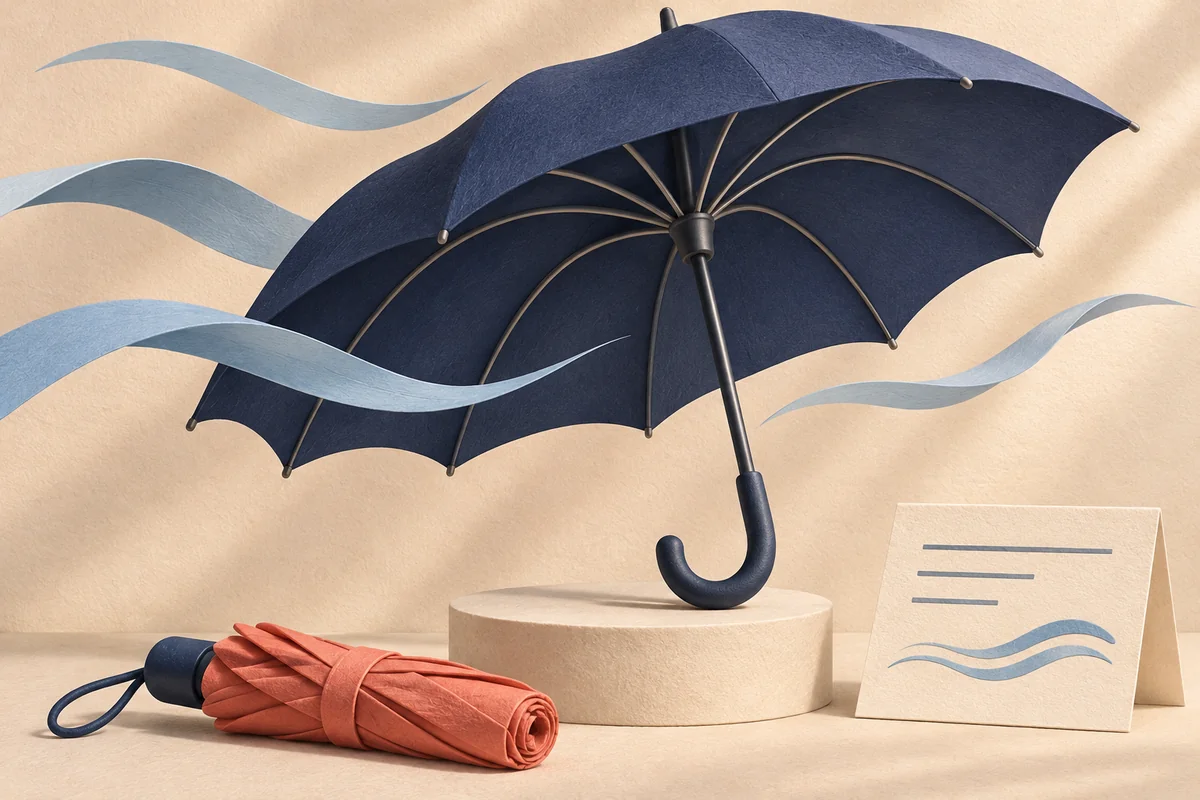
Hero image: AI-generated conceptual editorial artwork, not a tested product, laboratory photograph or performance demonstration.