Choose company sweaters and sweatshirts for pilling resistance by evaluating the exact garment, its evidence and its appearance after realistic use—not by fiber name, softness or an “anti-pill” label alone. Ask suppliers what was tested, under which method and conditions, then use a small wear-and-care pilot to decide whether the garment suits your program. A laboratory grade is useful evidence, but it is not a promise about how every employee's sweater will look after a year.
This guide addresses a specific buying decision: whether a knitwear candidate has enough appearance-retention evidence to approve for a company store or group order. It does not rank brands or report tests we have conducted. Brand Sauce publishes this guide as a merchandise-program provider; the approval workflow below is our recommendation, not a textile testing standard. Primary sources were checked October 14, 2026.
First, identify the surface change you are trying to avoid
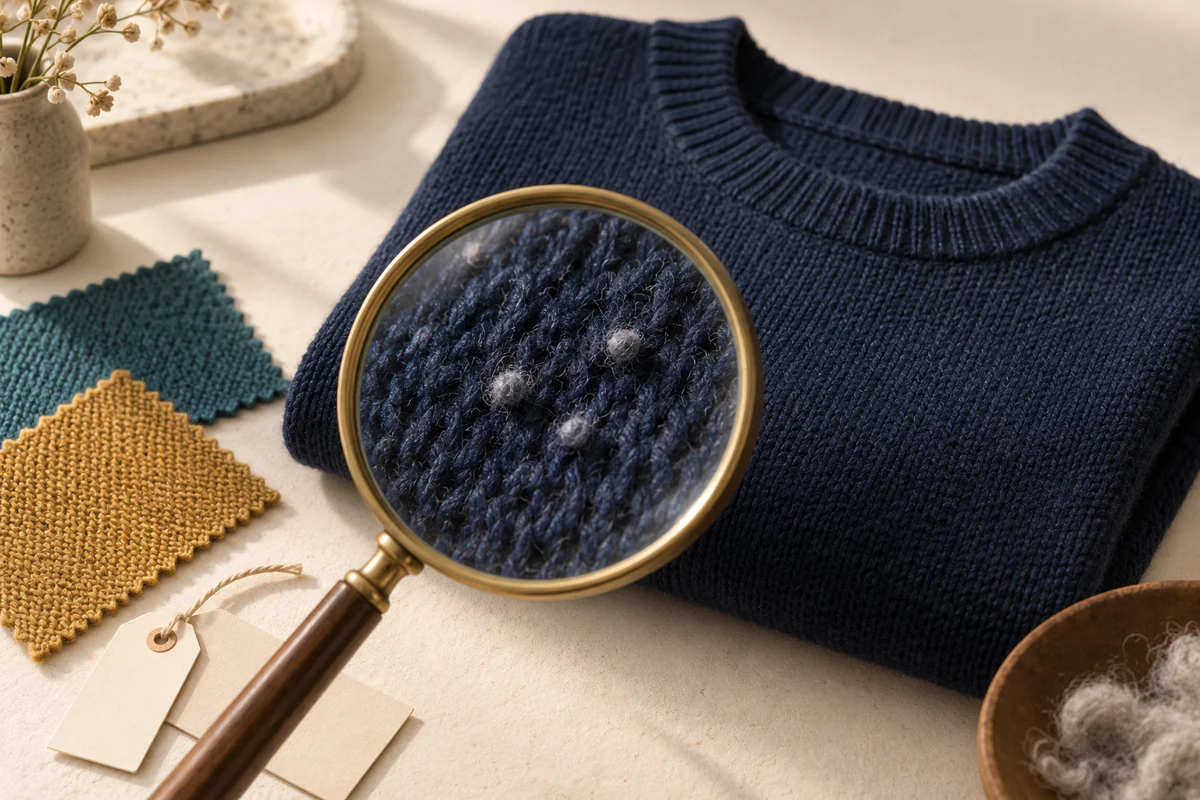
Pilling is the formation of small fiber balls on a textile surface. Woolmark's pilling guidance explains that rubbing during wear contributes to it and identifies contact areas such as sleeves and underarms. That makes the intended use relevant: an occasional appreciation gift and a cardigan worn at a reception desk every day deserve different buying briefs.
Do not group every appearance complaint under “pilling.” Ask for a clear photograph and distinguish small attached balls from general fuzziness, loose lint, a snag, a hole or a change in shape. The purpose is not to diagnose a manufacturing defect from a photograph. It is to describe the concern accurately enough for the supplier to investigate and for the buyer to request the right evidence.
| Observation | Useful buyer question | Do not assume |
|---|---|---|
| Small attached fiber balls | What pilling evidence applies to this exact material? | Every garment made from the same fiber will behave alike. |
| A generally fuzzy surface | Is this the intended finish or a change from the retained sample? | A textured new garment has already failed. |
| Loose material on the surface | Is this lint, shedding or an attached surface change? | A pilling grade answers every lint complaint. |
| Holes, pulled loops or distorted fit | Which separate construction, snagging or care issue needs review? | Good pilling resistance proves overall durability. |
Start the specification with an observable expectation: “This is daily front-desk apparel, and visible surface change on the front matters to us.” That is more actionable than “premium quality.” For optional gifts, include wearer comfort and care practicality as equal selection considerations; a garment that nobody wants to wear has not become a good gift merely by scoring well on one test.
Treat fiber labels and anti-pill language as starting points
A fiber-content label identifies composition, not a complete performance ranking. A premium price, substantial weight or luxurious first touch should not substitute for evidence about the proposed garment. Likewise, “anti-pill” needs an explanation: ask what the supplier means, which product configuration the statement covers and what supports it.
Woolmark's guidance describes design factors including fiber length, yarn twist and fabric cover, while also emphasizing that pilling is complex. It does not offer a universal guarantee that wool will never pill. Avoid turning a single material feature into a promise the finished item cannot support.
Shortlist garments that already meet the role, fit and care brief. If you are still deciding between sweatshirt constructions, use our French terry versus fleece guide first. Then compare appearance evidence within the relevant shortlist. Otherwise, a dense office cardigan and a soft casual fleece can end up competing on a score that ignores why employees would choose either one.
Read a test report as a defined observation
ASTM's official page for D4970/D4970M-22(2026) identifies a Martindale pilling method. It describes a visual rating from 5, no pilling, to 1, very severe pilling, and requires reporting the tested fabric's state. It also cautions about using this method for acceptance testing. Those qualifications matter: a score without its method and conditions is an incomplete purchasing specification.
A different official method, ASTM D3512/D3512M-22, uses a random tumble pilling tester. It too warns against acceptance-testing use. Buyers should not treat the existence of a numbered result as an automatic shipment pass. Ask the laboratory and supplier how the evidence should inform the particular commercial decision.
Request the following information together. This is a buyer's evidence checklist, not instructions for performing either laboratory procedure.
- Identity: report date, laboratory, report reference and specimen identification.
- Product match: style, fabric, composition, color and production connection; explain any gap between the tested material and the garment being quoted.
- Method: exact standard and edition, plus any stated deviations.
- Exposure: the test duration or cycles and the stages at which observations were recorded.
- Preparation: whether material was tested as received, after laundering or in another stated condition.
- Result: the grade, scale, observations and any photographs or limitations the laboratory provides.
- Interpretation: what the supplier is prepared to commit to for your order, separately from what the report says.
When two reports differ in method, exposure or preparation, do not silently rank their headline numbers. Ask for comparable evidence or mark the comparison unresolved. There is no need to invent a universal minimum grade for all corporate apparel. The appropriate commercial requirement depends on the product, use and an agreed evaluation approach.
Decide what to do when evidence is missing or mismatched
| Supplier response | Recommended next step | Buying status |
|---|---|---|
| A report clearly matches the proposed material and explains conditions | Review its limitations and proceed to finished-garment evaluation. | Candidate for approval, not a lifetime guarantee. |
| A report covers a related fabric or older configuration | Ask what changed and whether fresh testing or written technical clarification is needed. | Conditional; document the evidence gap. |
| Only an anti-pill marketing statement is available | Request supporting evidence or evaluate a small pilot without repeating the claim as proven. | Unknown performance; avoid a large unsupported commitment. |
A small optional gift order may justify a simpler evaluation than a large daily-wear uniform rollout. That is a decision about the cost of uncertainty, not a declaration that untested items are defective. If the required evidence cannot arrive before the deadline, choose a better-supported alternative or reduce the initial commitment. Do not manufacture confidence because the launch date is close.
Pair laboratory evidence with a practical wear-and-care pilot
A pilot answers whether the proposed garment fits your actual experience expectations. It does not reproduce a standard or predict a service life. Start with the exact decorated sample, since the logo, fit and finished appearance also need approval. Our broader branded-apparel sample approval guide covers those accompanying checks.
Retain an unworn reference and photograph the sample front, back, sleeves and relevant contact areas before use. Use consistent lighting, distance and framing for subsequent photographs. Identify the garment rather than the wearer in the record. Do not put a fabric shaver across the sample before documenting the original concern.
Ask willing reviewers to use the garment in the intended setting and record ordinary contact, such as desk work or carrying their usual bag. Agree on a review window and check-in points before starting. Keep the routine realistic; improvised rubbing with abrasive objects is not a substitute for a controlled laboratory method.
Follow the finished garment's care instructions and record actual wash and dry settings. CottonWorks' quality-testing overview explains that laundering and drying abrasion can change appearance, including fuzzing and pilling. It also treats dimensional stability and colorfastness as distinct quality considerations. Record those separately instead of collapsing every change into a single pilling verdict.
At review, ask two questions: is there a meaningful change from the retained reference, and does that change matter for this program's use? Record comfort feedback too. A small pilot is a screening exercise with limited coverage; do not publish its outcome as a measured company-wide failure rate or a guarantee of years of wear.
Use a three-way decision, with explicit conditions
Approve when the evidence, pilot and care expectations are adequate for the intended role. Retain the configuration, supporting documents and sample photographs. Approval applies to that selection; it is not blanket approval of everything bearing the same brand.
Approve with limits when the garment suits one use but not another, or when uncertainty justifies a small initial quantity. For example, an optional occasional-use gift may be acceptable even when you would not select the same item for daily visitor-facing apparel. This is a hypothetical decision distinction, not a report about a tested product.
Hold or replace when the evidence is materially mismatched, the finished appearance is unsuitable or required care is impractical. Give the supplier the documented concern and allow an explanation or alternative. An unexplained change of blank, fabric or finishing should reopen the relevant approval fields.
Knitwear release record
Intended role and visible-appearance expectation: ______
Exact garment, color, composition and decoration: ______
Evidence reference, method and conditions: ______
Evidence gaps and agreed follow-up: ______
Pilot use and care record: ______
Photographs and retained sample location: ______
Decision, quantity limit and conditions: ______
Care information and support owner: ______
Reapproval triggers and approver/date: ______
Choose the order model and support process around the decision
On-demand can limit an initial commitment where the approved garment and decoration are available individually. It does not improve the fabric's pilling resistance or eliminate the need for sample approval. Confirm the exact style, size range, destinations and replenishment terms rather than assuming a generic no-minimum promise covers this item.
Bulk can be sensible for an approved daily-wear program with known selections and a supplier that supports the required quantity. A hybrid can start with a small evaluated issue and expand after review. Compare garment, sampling, any additional testing, decoration, freight and support costs using real quotes. Unknown testing or replacement charges should remain quote-needed, not be filled with invented estimates.
Before release, agree what happens when a recipient reports a surface problem. Collect the order identifier, garment details, photographs, approximate use and care history without assuming misuse. Ask the supplier to assess the specific case under its actual terms. The gift warranty and support guide explains how to keep that handoff from becoming the employee's administrative burden.
Offer garment-specific care information. Woolmark describes gentle pill removal options for wool, but that is not blanket authorization to shave every decorated knit. Follow the manufacturer's advice, and document any unresolved complaint before cosmetic treatment. Maintenance instructions should help recipients enjoy the item, not become an excuse to dismiss a quality concern.
Frequently asked questions
Does anti-pill mean the garment cannot pill?
Do not read it as an unlimited guarantee. Ask for the exact claim, supporting evidence and applicable terms. Keep store copy within what the supplier can substantiate for the selected item.
Can we compare two suppliers' grade 4 results directly?
Only after checking that the methods, exposure, preparation and specimen relevance make the comparison meaningful. Matching numerals alone do not establish equivalent evidence.
Is one home wash enough to approve a sweatshirt?
It is an observation, not a complete durability assessment. Use the intended role and consequences of a poor selection to decide what additional evidence and review are warranted.
Should we remove every garment that receives a pilling complaint?
No automatic rule fits every case. Investigate the reported item, compare it with the approved record and review whether multiple reports suggest a wider concern. Pause a questionable reorder while that review is unresolved rather than rewriting the evidence after the fact.