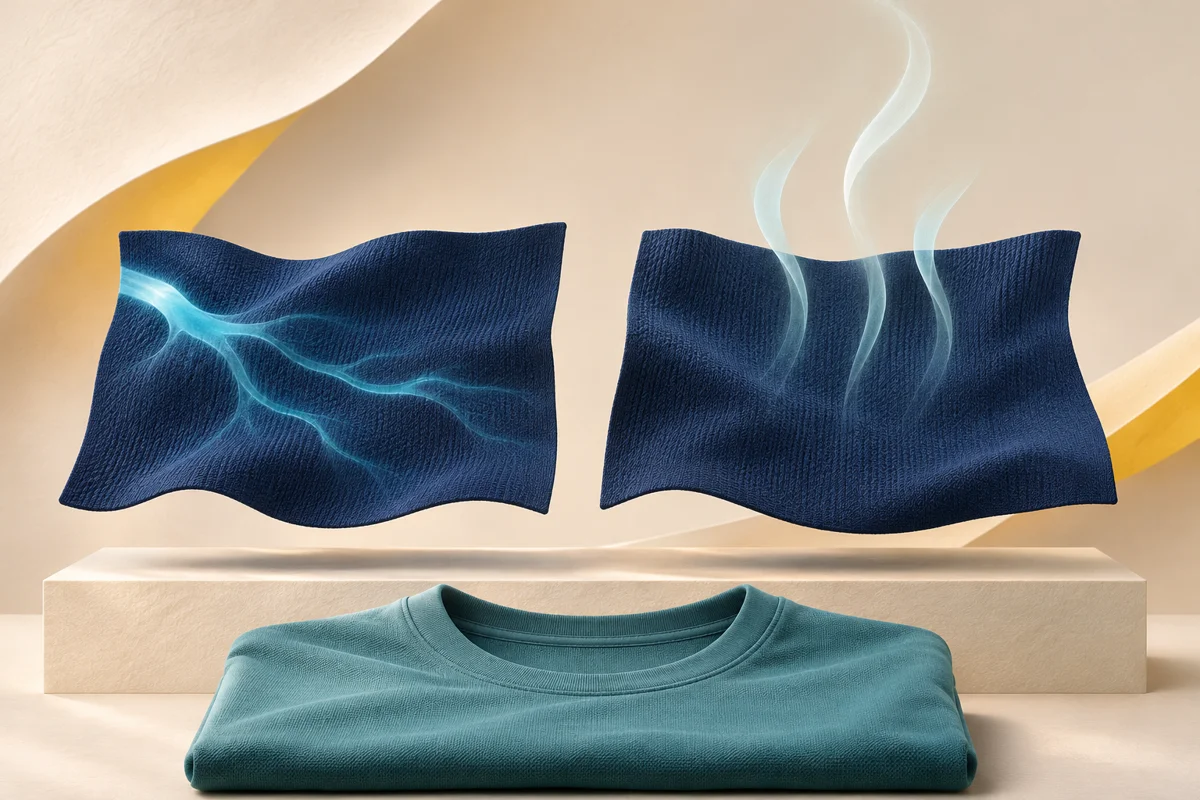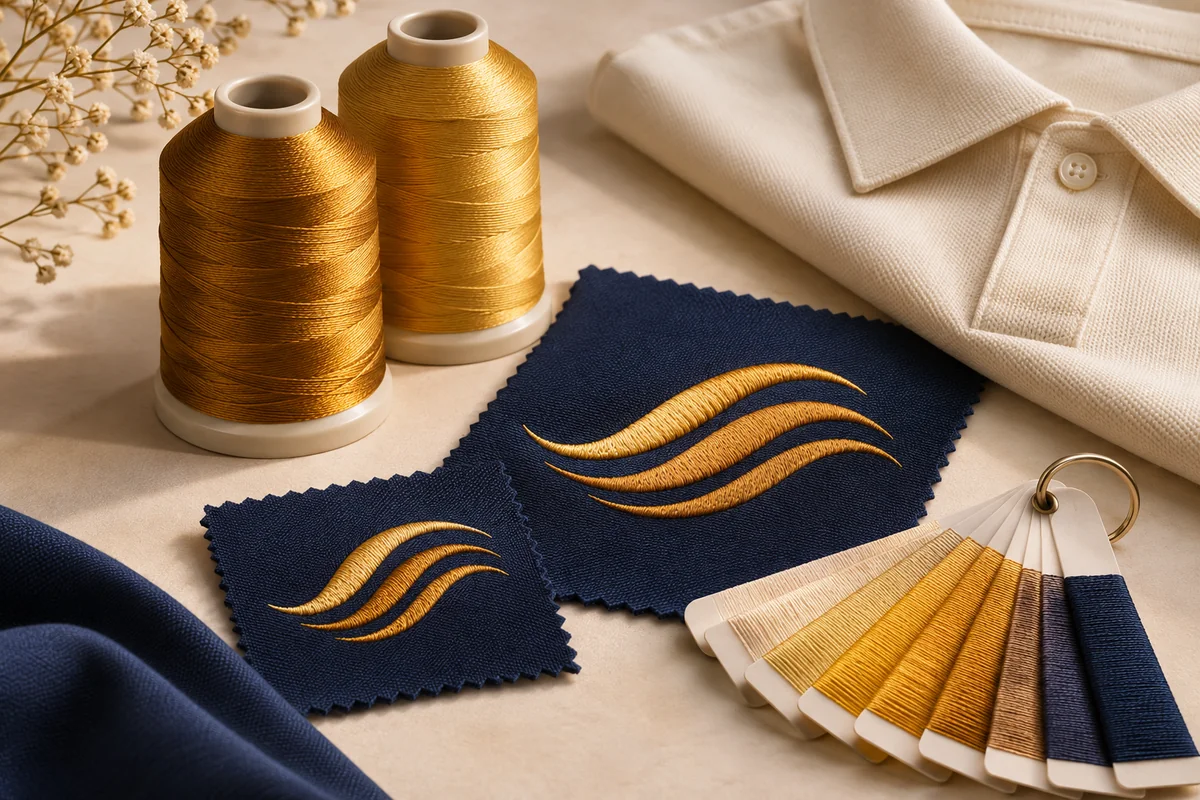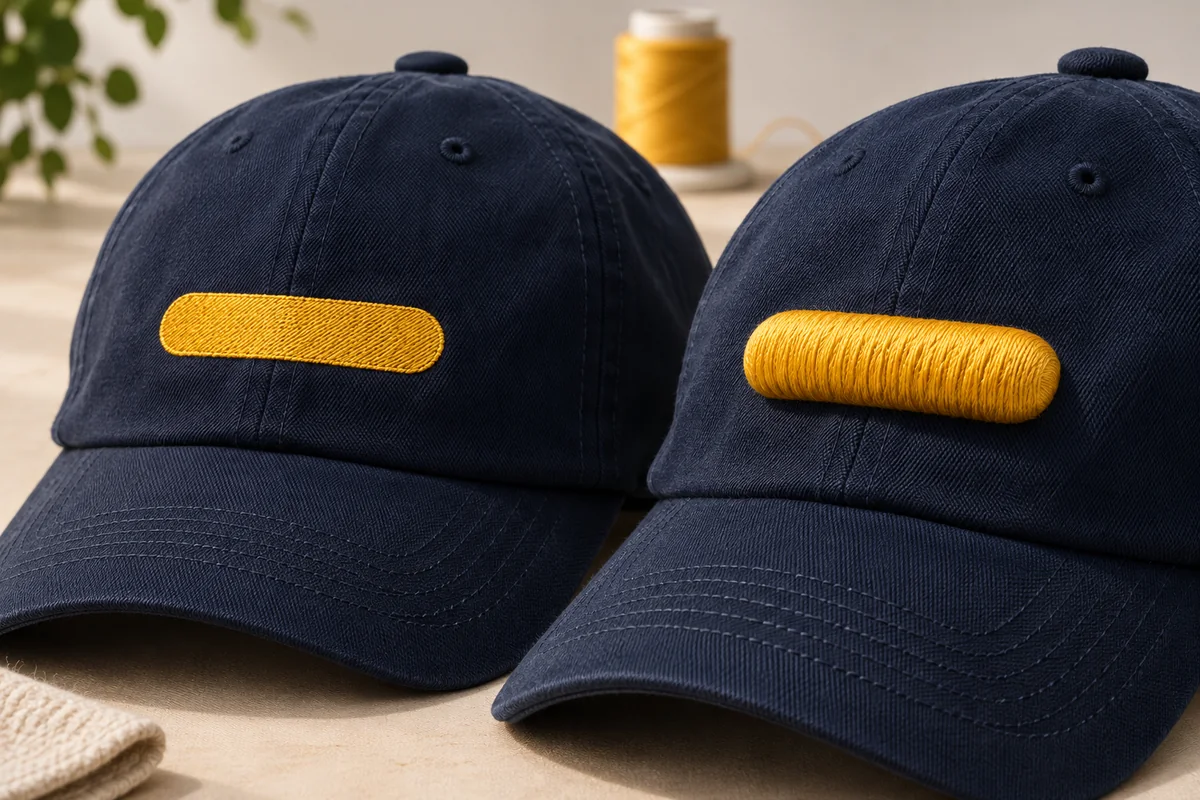
Choose stretch company apparel by how the finished garment moves and recovers—not by the highest spandex percentage. Mechanical-stretch fabrics can provide flexibility without elastane. Elastane blends are another route to stretch, but the fiber label alone does not tell you whether a shirt will bind at the shoulders, stay stretched at the elbows or work with your logo.
For a company-store buyer, the useful decision is which exact garment, size range and decoration combination passes the job your employees actually do. This guide separates the terminology, gives you a comparison brief and shows how to approve a stretch garment without turning an informal try-on into a false laboratory claim.
Publisher perspective: Brand Sauce publishes this buying guide for company merchandise programs. The checks below are an editorial purchasing framework, not results from Brand Sauce testing. Named materials and products illustrate specifications; they are not a promise of catalog availability or fulfillment in a particular country.
Separate three questions hidden inside “stretch”
Ask what creates the flexibility, which way the fabric moves and what happens after it is released. These are different questions. “Mechanical stretch,” “four-way stretch” and “5% spandex” are not interchangeable answers.
- Mechanism: Is the flexibility coming from fabric construction, elastic fiber or a combination?
- Direction: Does the supplier describe widthwise movement, lengthwise movement or both? Ask for the directions explicitly rather than interpreting a marketing label.
- Recovery: After movement and normal care, does the garment return to the shape and appearance required for its role?
The LYCRA Company's fiber FAQ identifies LYCRA as a brand of spandex, also called elastane, and explains that it is a fiber combined with other fibers to make fabric. A label saying “spandex” does not automatically identify the LYCRA brand. Nor does the percentage state a finished garment's stretch distance or recovery performance.
Mechanical stretch is not limited to one fiber composition. Cotton Incorporated's NATURAL STRETCH technology is one specific example of engineered flexibility in woven cotton without added synthetic fibers. That establishes that cotton can be engineered to stretch; it does not establish that every cotton shirt has that construction or performance.
Mechanical stretch versus elastane: what to request
| Buying question | Mechanical-stretch candidate | Elastane-blend candidate |
|---|---|---|
| What does the label establish? | Request fiber composition separately from the stretch description. | Composition identifies the elastic-fiber share, not the complete performance. |
| How much movement is useful? | Ask which garment tasks the supplier intends the construction to support. | Ask the same question; do not substitute a percentage comparison for it. |
| Will it keep its shape? | Request available recovery evidence and review a worn, cared-for sample. | Request the same evidence; added elastane is not a blanket guarantee. |
| What care is permitted? | Use the exact garment instructions, not a general assumption about “mechanical.” | Use the exact garment instructions, not a universal rule for every blend. |
| Can it carry this logo? | Approve the decorated garment in motion and after care. | Approve the decorated garment in motion and after care. |
The practical result may be either construction—or a non-stretch garment with a better cut. Do not pay a premium for a feature unless it resolves a defined requirement. Conversely, do not remove a candidate simply because its fiber label lacks spandex.
A real specification that prevents a common mistake
SanMar describes the OGIO Extend Short Sleeve Button-Up OG160 as a mechanical-stretch knit shirt with a 65/35 polyester/cotton composition. Its published care instructions include cold machine washing, no fabric softener, no bleach and low tumble drying. Those are instructions for that product, not a recipe for all mechanical-stretch apparel.
The example matters because a buyer filtering only for “contains spandex” would exclude a shirt explicitly described as having stretch. It also shows why “button-up” does not necessarily mean a conventional woven fabric. Read composition, construction and care together. Check current color, size, decoration and destination availability with the supplier before making the item an employee choice.
Keep the product sheet attached to the approval record. A later substitute with a similar color and fiber blend is still a new candidate if its construction, cut or instructions differ.
Write a movement brief before collecting samples
A useful brief starts with an ordinary work sequence, not “maximum stretch.” For an office presentation shirt, the sequence might be sitting at a desk, reaching to a screen and carrying a light bag. For a visitor-services polo, it might include reaching across a counter and bending to a low drawer. Keep any exercise within the wearer's normal, comfortable movement.
Define the visible and personal outcomes you want: no uncomfortable pulling during the sequence, acceptable coverage, a front opening that remains appropriate and a garment that looks presentable afterward. These are proposed acceptance criteria for your program, not universal textile thresholds.
Ask wearers for private feedback. “I prefer a looser silhouette” is a valid selection reason even when another person likes a close fit. Do not pressure people to demonstrate body movement publicly or record body measurements in a shared merchandise spreadsheet.
Compare the size recommendation for each candidate separately. Two medium shirts are not automatically comparable. Use the distinction between body measurements and garment measurements to choose suitable trial sizes. Stretch should not be used to make an obviously unsuitable size appear acceptable.
Approve in five stages, from blank to cared-for garment
1. Establish the blank-garment baseline
Record the style, color, size, supplier and care-label version. Photograph the garment laid flat without pulling it taut. Ask the wearer to try the agreed movement sequence and note where any limitation occurs. If the blank is uncomfortable, stop there: decoration is not the next problem to solve.
2. Separate fabric movement from garment fit
If the wearer reports shoulder restriction, compare another suitable size or cut before demanding a higher elastane content. Note whether the issue occurs at a seam, sleeve opening, button line or across the body. This does not diagnose fabric engineering; it gives the supplier a specific problem to investigate instead of a vague request for “more stretch.”
3. Review the actual decoration
Request the proposed logo size, position and production method on the selected garment. Repeat the same movement sequence. Look for an uncomfortable decorated area, distortion, puckering or visible changes around the artwork. A blank that passes and a decorated sample that does not should trigger a decoration review, not immediate rejection of every garment in that fiber family.
Discuss a different logo placement, size or method with the decorator, then approve the revised sample. The broader embroidery-versus-printing guide helps frame that conversation, but the specific stretch garment still needs its own decision.
4. Observe recovery using a repeatable routine
After the agreed wear period, allow each candidate the same recorded rest interval before taking comparison photographs. Look at the areas that mattered during movement. Record visible bagging or changes as observations, not as a standardized recovery score. Use consistent lighting and garment placement so your pictures are useful.
Do not invent a home pulling test and publish its result as a technical specification. If a contract requires a numerical stretch or recovery threshold, ask the supplier or a qualified textile laboratory to identify an appropriate method, specimen preparation, direction, load, repetitions and recovery interval. Numbers without a shared method are poor grounds for comparing suppliers.
5. Repeat after the intended care routine
Care for the sample according to its instructions, with the decorator's guidance for the finished item. Record the actual process and number of cycles. Repeat the fit, appearance and movement checks. If the garment's care requirements conflict with the program's laundry process, resolve that mismatch before ordering; do not approve an unsupported wash routine because it is convenient.
A short sample review cannot prove years of service. It can identify reasons not to release a particular combination. Retain the approved sample and use your apparel sample approval record for the complete production decision.
Turn a failed check into the right next action
| Observation | Next step | Avoid concluding |
|---|---|---|
| Blank binds during a normal reach | Review size, cut and the location of restriction. | Every shirt needs a higher spandex percentage. |
| Blank passes; decorated sample feels restrictive | Ask the decorator to review artwork area and method. | The blank supplier misrepresented all stretch performance. |
| Garment looks bagged after the review | Record conditions and ask for recovery evidence or another candidate. | All mechanical stretch—or all elastane—fails. |
| Appearance changes after care | Compare the recorded care process with both garment and decoration instructions. | A fiber name alone explains the change. |
| Wearers disagree about close fit | Consider a second approved silhouette. | One preference is the objectively correct fit. |
Keep the material decision separate from the ordering model
On-demand ordering can suit an ongoing store when employees select different styles and sizes over time. It does not remove the need to approve a decorated sample or verify continuing product availability. A one-piece order that uses an unapproved substitute is still an unapproved order.
Bulk purchasing may suit a stable uniform requirement, a known roster and a fixed issue date, provided the size mix, storage and replacement plan are credible. A hybrid can hold approved core uniform stock while offering optional gift apparel through the store. Neither method is inherently the right answer because a garment contains elastane.
For an illustrative calculation only, if one approved option costs $4 more per finished garment and the program expects 120 garments, the difference is $480 before any other cost differences. Ask what that additional spend buys in the approved sample. Do not assume it will reduce returns, extend service life or save a measured amount unless you have evidence. Obtain actual quotes for decoration, samples, size surcharges, delivery and replacements.
A supplier brief you can reuse
We are selecting company apparel for [role and movement sequence]. Please identify the exact style, fiber composition, fabric construction and stated stretch directions. Provide current size measurements, care instructions and any available stretch/recovery test information with its method. Quote a decorated sample using [artwork, size and position], plus the required sizes and destinations. Identify substitutions in advance. Approval will cover the specific garment and decoration together; a matching fiber percentage alone is not an approved substitute.
Add your owner, response date and decision status. Before release, confirm that the storefront describes the approved item accurately, shows useful sizing information and does not turn a supplier's fabric claim into a promise of universal comfort.
Frequently asked questions
Can a cotton shirt stretch without spandex?
Yes. Cotton Incorporated describes a specific mechanical-stretch technology for woven cotton. That is evidence of a possible construction, not evidence that any particular cotton shirt uses it. Check the exact product specification.
Is 5% elastane better than 2%?
Not enough information. The percentage does not identify the cut, stretch direction, finished decoration or recovery under your use conditions. Compare the actual garments and ask for method-based evidence if numerical performance matters.
Does “four-way stretch” mean it contains elastane?
Do not infer composition from a direction claim. Request both the fiber breakdown and an explicit description of lengthwise and widthwise movement. Treat recovery as a separate question.
Should uniforms and employee gifts use the same stretch shirt?
Only if the same garment meets both needs. A required uniform may need a consistent appearance and a defined care process; an optional gift can allow more variation in silhouette and personal preference. Approve for the intended use, then choose the ordering model.
The buying rule: select the garment that moves appropriately, recovers acceptably and works with your decoration and care process. Mechanical stretch and elastane are ways to get there—not substitutes for that decision.