For company T-shirts, combed versus carded describes cotton preparation; ring-spun versus open-end describes how the yarn is made. They are not four competing grades on one quality ladder. Use those specifications to shortlist blanks, then approve the actual shirt, decoration and washed result. A combed ring-spun description is useful evidence about construction, not a guarantee that a garment will fit better, last longer or suit every employee.
The buying decision is whether a proposed blank meets your program’s requirements—and whether a substitute really is equivalent. This guide gives procurement and company-store owners a way to answer that without turning every purchase into a textile-engineering project.
Brand Sauce publishes this guide and provides company-store services. The sample protocol and purchasing framework below are editorial recommendations, not laboratory findings or a claim that we stock every referenced garment. Primary sources were checked October 24, 2026. Exact styles, colors, decoration methods, destinations and pricing need confirmation in a scoped quote.
Separate two specifications before comparing quotes
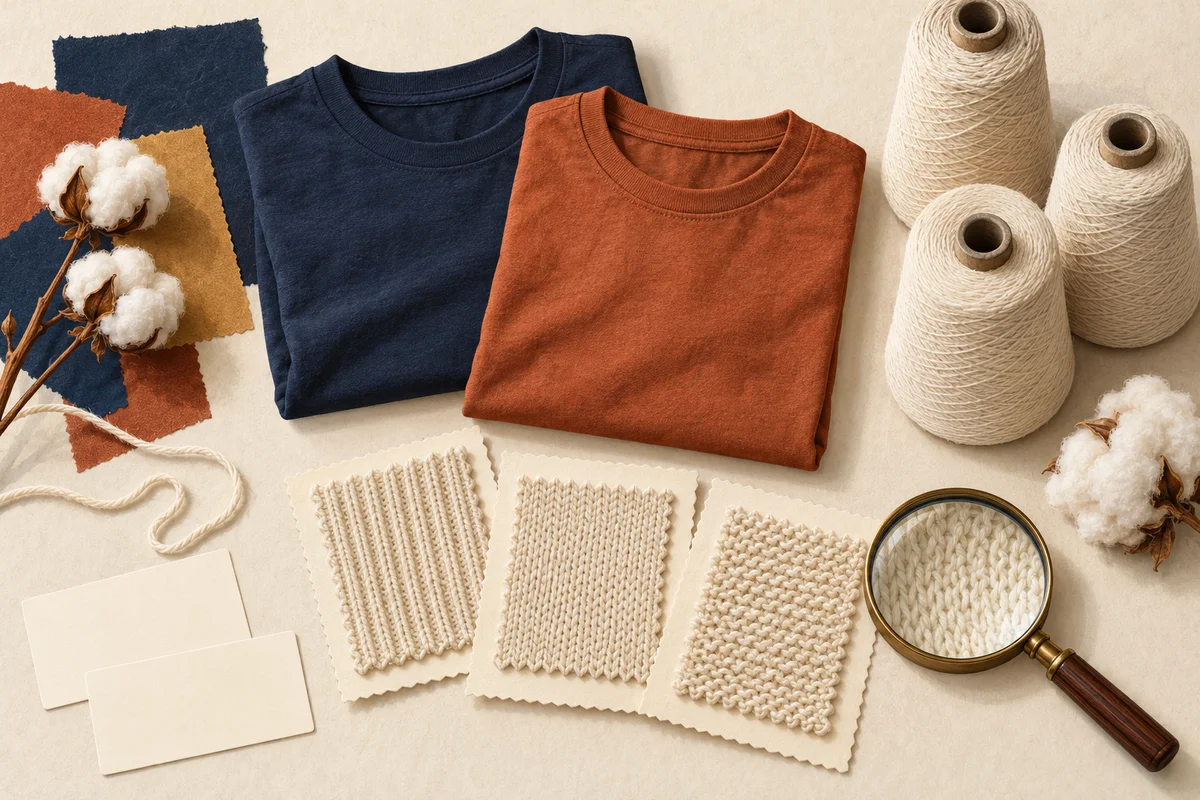
CottonWorks explains that carding aligns and cleans cotton fibers, while combing adds a step that removes short fibers. Combing supports finer yarns and can improve the resulting fabric’s feel. Crucially, its preparation guidance describes both carded and combed material entering the ring-spinning route. “Ring-spun” does not, by itself, mean “combed.”
CottonWorks’ spinning guide distinguishes ring spinning from rotor, also called open-end, spinning. Different processes create different yarn structures. It also explains that ring spinning’s additional processing steps and slower production contribute to higher yarn costs. That is a manufacturing explanation, not a current price quote for a decorated shirt.
| Wording in a quote | What it tells you | What to ask next |
|---|---|---|
| 100% cotton | Fiber composition | Which preparation and spinning specifications are documented? |
| Carded ring-spun cotton | Preparation and spinning route | Does this exact blank pass our sample checks? |
| Combed ring-spun cotton | Additional preparation plus spinning route | What are its weight, fit, care instructions and decorated price? |
| Carded open-end cotton | Preparation plus rotor-spun yarn | Is the finished garment suitable for this use and artwork? |
| Premium cotton | A positioning claim without enough detail | Which verifiable specifications support “premium”? |
If a specification is absent, record it as unknown. Do not assume that every shirt labeled only “cotton” is open-end, or that every ring-spun shirt has been combed. Ask the supplier for the manufacturer’s current style documentation rather than filling gaps with a reseller’s general description.
Buy a finished shirt, not a winning adjective
Start by writing down what the wearer needs. Is this a lightweight shirt for an indoor team event, a substantial everyday layer, or merchandise employees will select for themselves? Decide what would make a sample unacceptable before reviewing brand names or prices.
Our recommended approval record separates five decisions: fabric specification, garment fit, visual coverage, decoration result and care performance. A candidate can pass one and fail another. For example, a team might prefer the feel of one sample but reject its length, or like a blank until a large chest print changes the wearing experience. Those are valid reasons to choose a different shirt without declaring its yarn category universally superior.
Keep fabric weight separate from yarn language. Our guide to company-shirt fabric weight versus whole-garment weight covers that measurement decision. Here, the important purchasing rule is simpler: do not compare two shirts of noticeably different weight and cut, then attribute every preference to combing or spinning.
Likewise, do not use these terms as proof of organic content, manufacturing origin, certification or shrinkage performance. Require evidence for each separate claim. A highly detailed yarn description should not distract from a missing size chart or an unapproved decoration sample.
Read the exact style and color, not just the headline
A useful real example is the official BELLA+CANVAS 3001 product page. At the time checked, its standard fabrication lists Airlume combed and ring-spun cotton, while the Ash color has a separate 99% cotton/1% polyester specification. The page also directs shoppers looking for heathers to the 3001CVC.
This is a specification-reading example, not a claim of current Brand Sauce availability or a recommendation for every program. It demonstrates why a supplier response saying “same brand, same family” is not enough. Capture the exact style, color and variant associated with the sample and quote.
Build one row per proposed variant. Include the manufacturer reference, fiber percentages, stated preparation and spinning details, weight with units, size range, care instructions and approved decoration. Where the manufacturer has not published a field, ask for confirmation or leave it explicitly unknown. Do not convert a color exception into a blanket claim about the whole range.
Run a controlled sample comparison
The following is a practical purchasing screen, not a standardized textile test. Its purpose is to identify a suitable shirt and document a repeatable decision. It cannot establish certified durability, environmental superiority or a guaranteed service life.
- Choose comparable candidates. Request the closest practical match in fit, color, weight and intended use. If they cannot be matched, document the differences. You can still select a winner for your program, but you cannot isolate the effect of yarn construction.
- Code the samples. Present them as A, B and C during the first review. Keep the manufacturer labels intact for traceability; simply avoid leading with price and marketing descriptions. Ask reviewers which they would actually wear and why.
- Record specific observations. Replace “nice” with notes such as preferred sleeve length, acceptable coverage under ordinary office lighting, comfortable neckline or unwanted stiffness. Record disagreements rather than forcing a single universal preference.
- Apply the intended artwork. Use the real logo size, placement and proposed production method. Compare the completed shirts, not one decorated sample against another undecorated blank. Have the decorator identify any changes needed before approval.
- Follow the care instructions. Agree a small repeat-wash screen in advance, photograph each sample consistently and record the actual wash and drying settings. Review fit, surface appearance, seams and decoration afterward. Do not extrapolate a few washes into a lifetime claim.
- Approve a named configuration. Sign off the style, color, size coverage, artwork version and decoration method together. Retain an unworn reference and the reviewed sample when practical. Record who can approve a replacement.
For the wider approval workflow, use our branded-apparel sample approval guide. The additional control here is to record preparation and spinning as separate fields, so the next buyer knows what was specified rather than merely what the garment was called.
Choose a route that fits the program
| Program | Recommended buying priority | Reason to reconsider |
|---|---|---|
| Employee-choice everyday tee | Shortlist for wearer preference, fit coverage and repeat availability; include a combed ring-spun candidate | The preferred fabric is offered in too narrow a size range or fails the decorated sample review |
| Fixed-date event with known quantities | Compare complete decorated samples and delivered bulk quotes | The cheaper candidate misses the deadline or fails the agreed wearing standard |
| Ongoing staff replacement program | Prioritize a stable, approved configuration and a documented backup | Routine substitutions change fit or appearance without approval |
| Mixed event and year-round needs | Consider a bulk event run plus an approved ongoing-store option | The two options are presented as identical despite material differences |
A carded or open-end option deserves evaluation when its actual sample meets the brief and its complete quote makes sense. Do not reject it solely because another description sounds more premium. Conversely, do not choose it solely to minimize blank cost when the program depends on recipients wanting to wear the finished shirt.
Production model and yarn choice are separate decisions. On-demand can suit uncertain, ongoing individual demand; bulk can suit a committed event quantity with an approved size allocation. A hybrid can serve both. None of those models makes a particular cotton specification automatically right, and supplier-specific minimums, lead times and decoration routes still need checking.
Put a limit on the premium you will pay
Compare the total for equivalent scope: shirt, decoration, setup, sample costs, delivery and any other quoted charges. Ask whether larger sizes, additional print locations or individual delivery change the amount. Do not compare a blank-only price with a delivered decorated price.
Illustrative calculation—not supplier pricing or measured results: suppose two approved options have equivalent-scope delivered prices of $12 and $15 per shirt for 200 shirts. The second option adds $600: 200 × ($15 − $12). The decision is whether its observed advantages justify that incremental spend within this program’s budget.
Do not convert that $600 into invented retention, engagement or wear-rate benefits. Write the actual justification instead: reviewers preferred the fit, the approved artwork looked better, or the garment offered the required sizes. If no meaningful benefit was observed, the more expensive specification alone is not a reason to spend more.
Keep the sample exercise proportionate. A recurring program merits a stronger approval record because future orders depend on it. A small one-time order may need fewer candidates, but still needs a confirmed style and acceptable decorated result.
Use this supplier brief and substitution rule
Send a concise brief that makes an answer easy to compare:
- Use: who will wear the shirt, when and for what purpose.
- Variant: manufacturer, exact style, colors and required sizes.
- Fabric: composition by color, preparation, spinning specification and weight with units; identify unknown fields.
- Decoration: artwork version, placement, size and proposed production method.
- Approval: physical decorated sample, care review and named decision-maker.
- Commercial scope: quantity or order pattern, delivery destinations, deadline and complete quote.
- Substitution: no replacement configuration without documented review and approval.
For an always-on store, define what triggers that review: a new style number, changed color composition, different stated yarn construction, different fit specification or changed production method. Require the provider to identify the difference, not merely certify the replacement as “equivalent quality.” Our company-store assortment framework can help keep the approved range manageable.
Frequently asked questions
Is combed cotton the same as ring-spun cotton?
No. Preparation and spinning are separate specifications. Ask for both when that detail matters to your purchasing brief.
Should every employee T-shirt be combed ring-spun?
No. It is a sensible candidate to sample for an everyday tee, but the decision should reflect fit, wearer preference, artwork, budget and reliable supply. Approve the finished configuration.
Can I accept a ring-spun substitute for a combed ring-spun shirt?
Not on that wording alone. The proposed substitute may be suitable, but its description does not establish the same specification. Obtain the exact documentation and review the changed sample before authorizing it.
Does a more detailed cotton description guarantee less shrinkage?
Do not treat it as a shrinkage guarantee. Ask for the garment-specific information and review the sample using the stated care instructions.
The practical rule: specify clearly, compare fairly and approve the actual garment. The best company-store shirt is the one that meets your documented requirements—not the one with the longest string of adjectives.