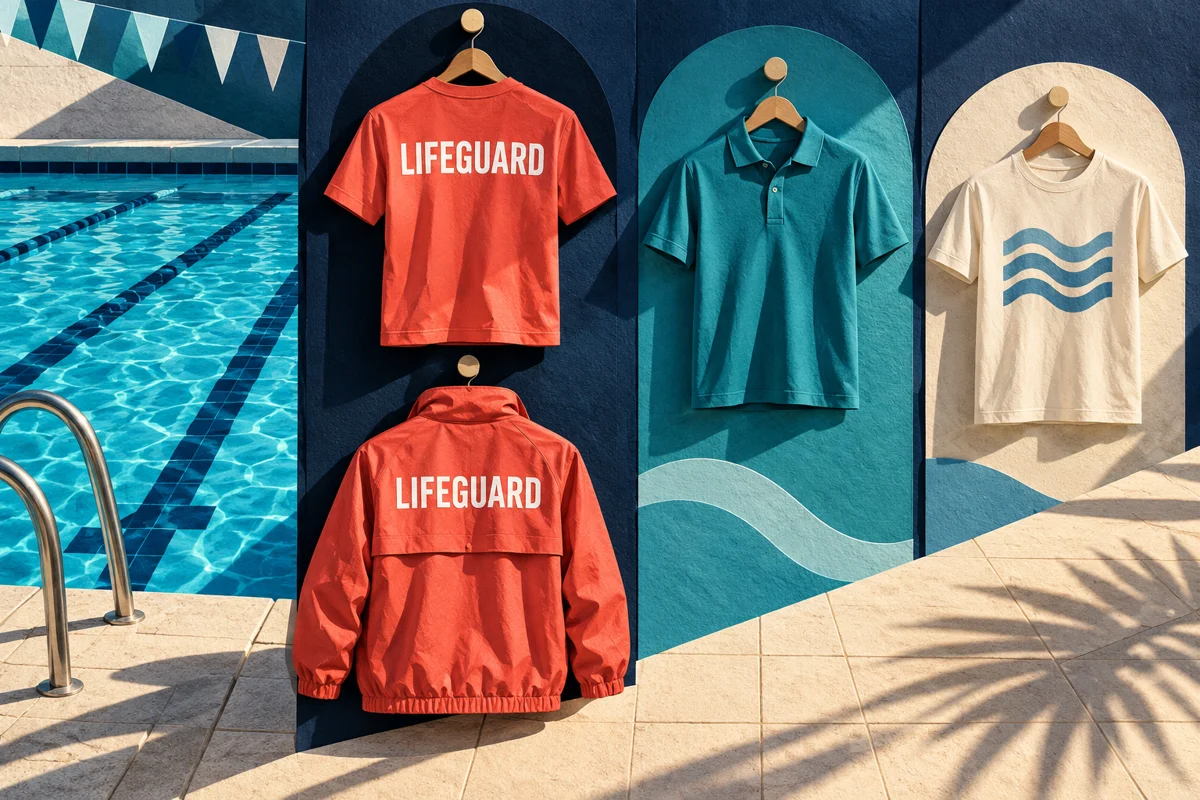
An aquatic center should approve apparel by the role it communicates, not just by the logo it carries. Keep lifeguard identification, other staff clothing and public merchandise distinct—and check every outer layer, replacement and ordering route against that distinction. A matching collection can look excellent in a catalog while becoming ambiguous on a pool deck.
This guide helps a U.S. aquatic-center buyer build an apparel specification and ordering process. It is not a lifeguard training program or a substitute for the facility’s operating requirements. Brand Sauce publishes it from a company-store provider’s perspective. The worksheets and scenarios are our purchasing recommendations, not measured client results. Primary sources were checked October 17, 2026; exact products, customization, delivery coverage and prices need confirmation.
Start with the role people need to recognize
The first purchasing question is not “Which red shirt?” It is “What should a visitor understand when they see this person?” Lifeguards, swim instructors, admissions staff and members of a swim team can all share a facility without sharing the same responsibilities. An apparel program should not erase those differences.
The American Red Cross’s guidance for visiting swimming facilities identifies easily recognizable lifeguard attire as one sign to look for. That supports treating identification as a functional purchasing criterion, not merely a branding preference.
For a concrete reference, section 5.8.5.3.5 of the CDC’s 2024 Model Aquatic Health Code, fifth edition calls for recognizable lifeguard attire and prominent “Lifeguard” or “Guard” wording on the outermost uniform layer. Do not present that model provision as a universal local law. The CDC’s MAHC FAQs explain its voluntary guidance role. Have the aquatic director confirm the applicable jurisdictional and facility requirements before approving artwork.
Record the resulting decision in a role-and-artwork register. Include who may receive each design, its permitted use and who can authorize changes. Keep the facility logo consistent where practical, but give role identification priority where required.
| Apparel lane | What the design should communicate | Purchasing control |
|---|---|---|
| Lifeguard issue | The wearer’s assigned lifeguard role under facility policy | Aquatic director approves wording, visibility and complete outfit |
| Instruction, admissions and other staff | The actual staff function without implying a different assignment | Approve distinct role wording and permitted combinations |
| Team, member or visitor merchandise | Affiliation or support, not an on-duty staff role | Review artwork separately from operational uniform designs |
Approve an outfit, not an isolated T-shirt
A shirt proof shows only one state of the uniform. The purchasing brief should also describe the layers people will actually wear during the facility’s operating season. If the approved wording disappears under a sweatshirt or jacket, the original proof has not answered the real identification question.
Create an outfit sheet with a row for each permitted combination: base garment alone, approved warm layer, and any other outer layer the facility authorizes. Photograph actual samples from the viewing directions the aquatic director specifies. Ask that owner to review the result in the intended environment, including ordinary changes in posture and how equipment is worn. This is an identification and usability review, not a certification of safety performance.
Do not solve a failed layer review by improvising a patch on opening morning. Changing placement, garment construction or decoration method needs another approval. A large back print may serve a different purpose from a small chest logo; neither should be assumed to replace the other without the facility’s decision.
Illustrative example: a center approves a clearly marked short-sleeve lifeguard shirt, then purchases plain matching hoodies for cooler mornings. The purchase is visually coordinated but operationally unresolved. The useful corrective action is to approve the outer-layer configuration before issue—not to tell staff that the hidden shirt underneath is sufficient.
Write a specification that survives substitution
“Red performance shirt with our logo” leaves too many decisions to the supplier. It does not identify the cut, size range, wording, artwork dimensions, care requirements or authorized outer-layer combinations. Write the order so a replacement buyer can reproduce the approved configuration without relying on someone’s memory.
- Garment: manufacturer, style, color, cut and approved sizes.
- Role artwork: exact wording, location, dimensions, colors and approved file version.
- Facility artwork: logo placement and its relationship to role wording.
- Use: intended staff assignment and permitted outfit combinations.
- Care: manufacturer instructions and the facility’s practical laundering arrangement.
- Evidence: documentation for any advertised performance claim.
- Fallback: approved substitute, or a clear instruction to hold for review.
Ask the manufacturer and decorator about the exact configuration. Do not infer chlorine resistance, wet-use suitability or ultraviolet protection from a generic “performance” description. If a proposed item has a documented UPF claim, review its scope and the planned customization; our UPF apparel buying guide explains that evidence check. A numerical claim should not migrate automatically to another style.
Use the branded-apparel sample approval process for the production reference, then add the role-and-layer review. Keep brand approval and operational approval as separate sign-offs. The person approving a logo does not necessarily own the facility’s uniform requirements.
Offer fit choice inside an approved boundary
Required apparel and employee appreciation gifts solve different problems. For required issue, let people select appropriate sizes and approved cuts, with a private route to resolve unmet fit needs. Do not make a staff member’s ability to obtain the required garment depend on choosing it instead of an optional gift.
A controlled choice can include two approved cuts or several approved sizes without allowing arbitrary design changes. Show the relevant size chart for each style. If someone needs an option outside the range, route the request to the uniform owner before production. Avoid collecting sensitive reasons in a public order note or a shared roster.
Keep optional end-of-season gifts separate. A staff member might prefer a bag or casual shirt, while the uniform issue remains governed by assignment and operational need. The gift budget should not quietly become the replacement-uniform budget. Record which program paid for each order so exchanges and replacements reach the right owner.
Restrict role-marked ordering and review public merchandise
Our recommendation is to keep operational role-marked designs out of the unrestricted public assortment. This is a program-control recommendation, not a claim that every sale of lifeguard-themed clothing is prohibited. The concern is local confusion: your own merchandise program should not make it harder to distinguish staff responsibilities at your facility.
A hidden category is not enough if an unauthorized shopper can still order through its direct product link. Ask the provider to demonstrate the actual restriction—or use an administrator-controlled order process if the system cannot enforce it. Test both the page view and the attempted order. Confirm who updates eligibility when assignments change.
One store may support these lanes, but only if its controls match the intended permissions. Otherwise, separate the staff issue workflow from public sales. The decision is about reliable authorization, not the number of homepages. For the wider visibility question, see our public, unlisted and private store guide.
Review team and souvenir art beside the uniform samples. A center logo on a visitor shirt may be appropriate; a near-copy of an operational uniform needs closer consideration. Include old designs in the review so clearance merchandise does not recreate a distinction the new uniform program is trying to remove.
Choose fulfillment by the consequence of waiting
Bulk issue is often a sensible option when the roster and first-use date are known. It permits coordinated receiving, inspection and distribution. Its tradeoffs are advance commitment, size-mix risk and responsibility for storing the remaining garments. Order against confirmed requirements rather than assuming one average size distribution fits every season.
On-demand ordering can suit nonurgent optional apparel or ongoing replenishment when the exact item, decoration and destination are supported. It does not create immediate replacement stock. Confirm production timing, shipping, minimums and the response to unavailable sizes before describing it as the uniform solution.
A hybrid can separate initial issue and a deliberately sized local reserve from slower optional purchases. Base that reserve on the facility’s roster, replacement history, available sizes and confirmed replenishment time. There is no universal percentage that makes a reserve adequate.
Compare quotes for the same scope: decorated goods, approved layers, shipping, receiving, fit corrections, replacement orders and any store-management service. A cheaper blank garment is not necessarily a cheaper approved outfit. Conversely, a managed store is not automatically better value than a well-run bulk order. Ask what remains the center’s responsibility and mark unknown costs as quote-needed.
Use a role-and-layer release card before opening orders
Give the buyer one compact record that links the garment specification to the operating decision. The following checks are proposed acceptance tests, not claims about a particular platform’s available features.
| Test case | Evidence to retain | Owner of an unresolved result |
|---|---|---|
| Approved shirt is covered by its intended outer layer | Reviewed outfit photos and wording decision | Aquatic director |
| Supplier substitutes a similar-looking garment | Separate style, fit, artwork and claim review | Uniform buyer and operational approver |
| Public shopper follows a staff product link | Observed ordering restriction or documented manual control | Store administrator |
| Staff member cannot use the listed fit options | Private escalation route and approved resolution | Uniform coordinator |
| Required replacement is needed before replenishment can arrive | Available approved issue route and responsible person | Facility manager |
| Old role-marked stock remains after a design change | Decision on continued issue, withdrawal or disposition | Aquatic director and stock owner |
Close unresolved items before opening the relevant ordering lane. At receiving, compare delivered garments with the retained sample and approved artwork record, not merely the purchase-order quantity. Keep substitutions identifiable. If an issue is discovered later, the center should be able to identify which configuration went to which staff group without reconstructing a season of informal messages.
Aquatic-center apparel FAQs
Does every lifeguard uniform have to be red?
Do not turn a familiar color convention into a universal rule. The cited MAHC identification provision focuses on recognizable attire and prominent role wording. Have the aquatic director establish the actual color and design requirements that apply to your facility.
Can a swim instructor wear the lifeguard design?
Do not decide from job title or purchasing convenience alone. Have the facility determine the appropriate clothing for the person’s assigned role. The merchandise system should implement that decision, not imply a surveillance assignment that has not been made.
Can one company store handle staff issue and souvenir sales?
Possibly. Verify audience restrictions, funding, approved artwork and order administration with realistic test cases. If those distinctions cannot be enforced, separate the workflows rather than relying on shoppers to interpret category labels.
What should we send with a quote request?
Send the role-and-artwork register, exact garment specifications, approved layers, fit requirements, first-use dates, destinations and replacement expectations. Ask for a written list of supported configurations and unresolved items. The first deliverable should be a workable uniform issue plan—not simply a branded storefront.