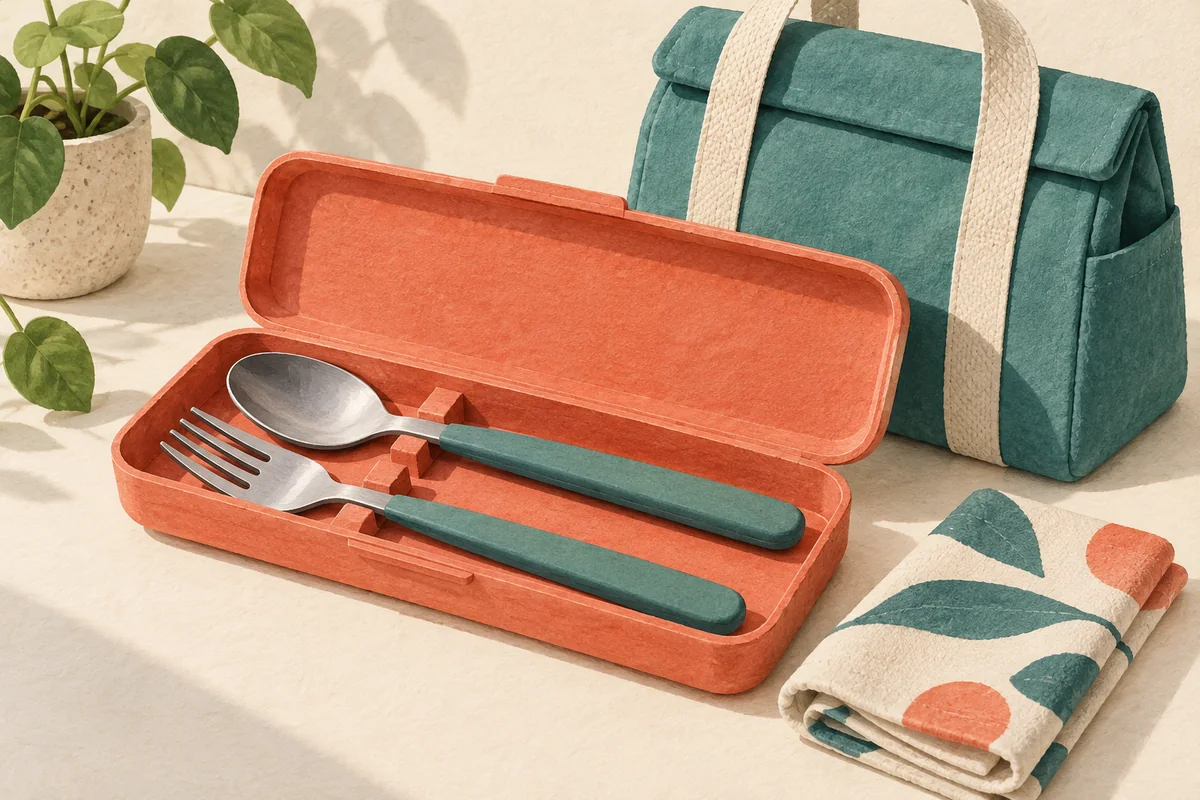
A reusable cutlery gift needs a plan for both journeys: clean utensils going to lunch, and used utensils coming home. A fitted case is not automatically a leakproof container for dirty cutlery. Before adding one to an employee lunch kit, check the maker’s storage instructions and whether recipients can actually wash the utensils where they eat.
For a mobile team or staff eating away from a shared kitchen, that small detail can determine whether the set becomes a useful daily item or stays in a drawer.
Start with the return trip
Joseph Joseph’s GoEat stainless-steel set nests a knife, fork and spoon in a rigid case. Its care instructions say to clean the cutlery before storing it in the case. That is a meaningful requirement—not just packaging copy. If recipients cannot clean their utensils after lunch, do not describe this kind of case as the solution for bringing food-covered utensils home.
Use this routing rule:
- Washing is available: choose a set recipients can clean according to its instructions, dry and return to its case.
- Washing is not available: ask the supplier for an explicit used-utensil transport solution and its cleaning instructions. Do not infer leak resistance from a rigid shell, snap closure or the word “hygienic.”
- The routine is unknown: offer the set as a choice rather than putting it automatically in every lunch kit. Someone who already carries preferred cutlery may value another option more.
Measure the closed case, then try the utensils
Compact storage and comfortable eating are different specifications. Humangear’s GoBites Trio page lists its case at 213 × 51.7 × 19.9 mm and describes full-sized utensils. Joseph Joseph lists its GoEat set at 18 × 5 × 3.2 cm. These dimensions illustrate why “portable cutlery” does not identify one universal shape: one set can be longer and thinner while another is shorter and deeper.
These are manufacturer examples, not a tested ranking or a verified Brand Sauce assortment. Confirm the exact version, decoration options, destination-country availability and delivered quote before choosing a branded set. Retail availability on one regional website does not establish international branded supply.
Check the closed sample in the actual lunch bag with its usual container and bottle loaded. Then take the utensils out. Can the spoon reach the bottom of the intended food jar without the user’s hand entering it? Does the fork feel usable with an ordinary lunch? Can the recipient grip the handles and open the case comfortably? A good fit in the bag is only half the decision.
A lunch-to-home acceptance checklist
Complete this with a proposed sample. It is a buyer walkthrough, not a claim that Brand Sauce has tested a product.
- Pack: put every supplied utensil in its intended position. Close the case normally; do not force the latch or assume a missing utensil explains a poor fit. Record the closed dimensions and the lunch-bag compartment used.
- Unpack: check that a recipient can open it and remove the item they need without scattering the rest. Include people who find tight clips or slim handles difficult; offer another format if needed.
- Eat: try the set with the intended container and an ordinary meal. Assess reach, grip and useful spoon size. A tiny spoon that packs neatly may not suit a large soup serving.
- Return: write down exactly what happens to used utensils. If the maker requires cleaning before storage, the planned routine must allow that or provide a separately specified return solution.
- Reset: follow the supplied cleaning and drying instructions for both utensils and case. Ask whether printed decoration changes the care directions. Keep those directions in the gift rather than relying on the recipient to find a product page.
Release the set only when all five steps have a practical answer. “Dishwasher safe” does not explain how someone gets dirty utensils home from a location without washing facilities.
Worked example: two locations, two useful choices
Illustrative scenario, not a customer result: an employer wants the same lunch gift for office staff and mobile employees. The office has a washing area; the mobile team does not reliably have one at lunch. Instead of issuing a clean-storage case to everyone, the buyer offers that set to employees who can follow its care routine and a different gift to others, unless a suitable return arrangement is confirmed. The exception is about the daily workflow, not one team receiving a lower-value gift.
For the broader choice design, use our accessible employee gift-selection guide. If cutlery is paired with an insulated container, check the separate food-jar preparation guidance; a utensil case does not address food storage or temperature.
Supplier brief: “Confirm the exact utensil and case model, closed dimensions, care instructions for each part, decoration care, and whether the case is intended for clean storage only or used-utensil transport. Supply a sample for our lunch-bag, grip, container-reach and return-routine checks. Confirm destination availability and quote all customization separately.”
Image: AI-generated editorial illustration, not a catalog photograph or product-test result.