Only if the exact power-bank model supports pass-through charging through the input you plan to use. Even then, “pass-through” does not promise that a phone and the bank’s own battery will refill at full speed together.
For a traveling sales team or conference crew, this is a practical gift-selection question: can recipients connect the kit once during a break, or must they swap cables and recharge items in sequence? Approve the charging arrangement, not just the capacity printed on the box.
Three checks behind a single feature label
1. Which input enables it? A hybrid wall charger and power bank may behave differently when plugged directly into a socket versus recharged through USB. A USB input on the specification sheet does not establish pass-through support through that input.
2. What input power is required? The bank may need a minimum incoming power before it supplies another device. Ask for the compatible charger and cable requirements, not just the bank’s maximum output rating.
3. Who gets charged first? “Device connected while bank is plugged in” and “both batteries gaining charge at once” are different promises. If the phone gets priority, the recipient may leave with a charged phone but a bank that still needs time.
Two manufacturer examples that change the buying decision
Anker’s model-specific pass-through instructions say its Power Bank (25K, 165W, Built-In and Retractable Cables) requires at least 20W of input to enable the feature. Below that, it only recharges itself. The same guide lists output limits that depend on incoming power and the ports in use. A headline 165W rating is therefore not a promise of 165W output during this mode.
Belkin’s BU054 troubleshooting guide describes a different restriction: pass-through is supported through the built-in AC plug, not while the bank is recharged through USB-C in battery mode. It also says connected devices charge first, followed by the internal battery. For that model, a plan based on a desk’s USB-C outlet would not reproduce the supported AC arrangement.
These are examples of documented operating differences, not a ranked shortlist or confirmed Brand Sauce catalog stock. Verify the exact regional SKU, destination-country availability, decoration eligibility and complete kit with the supplier; pricing is quote-needed. A support page accessible in a country is not proof that its product or plug variant is supplied there.
Choose the kit around the recipient’s charging opportunity
- Short breaks with a USB charging point: require documented pass-through through that input, plus confirmation that the proposed source meets the model’s requirements. If the source is unknown, do not promise the feature will work there.
- A normal wall socket and time to recharge: a supported hybrid AC arrangement may fit. Confirm the appropriate regional plug and disclose device-first charging when applicable.
- No need to recharge both through one connection: pass-through need not be a buying requirement. A bank used separately from a compatible phone charger may meet the actual need.
Do not silently replace a missing wall charger with a travel adapter in the packing list. Our travel-adapter guide explains the separate plug and voltage questions. Likewise, airline acceptance is its own check; use the power-bank flight checklist before building a travel gift.
Use this one-connection approval record
Request a representative sample of the intended kit. This is a proposed buyer check, not a test Brand Sauce has performed. Follow its manufacturer instructions; do not improvise unsupported port combinations.
Recipient scenario: location, available input and expected charging window: ______
Bank: exact model and regional SKU; manufacturer’s supported pass-through mode: ______
Power source: actual charger/port, supported input requirements and cable: ______
Connected device: model and output port/cable used: ______
Priority: device first / simultaneous replenishment documented / not established: ______
Sample observation: phone and bank starting levels, elapsed time and ending levels: ______
Recipient promise: wording approved for this arrangement; required items not included: ______
Record conditions alongside the result. One successful check is not a universal charging-time guarantee, and a charging icon alone does not establish how much charge either battery gained. If the available break is too short for the desired outcome, change the promise or the kit rather than extrapolating from maximum wattage.
A conference-kit decision, worked through
Illustrative scenario: an organizer wants 24 sales representatives to top up phones and power banks during a single afternoon break. The venue only confirms that its tables have USB ports; it does not provide their power specifications.
The buyer cannot yet approve “recharge both during the break.” The missing evidence is the source specification and a matching supported arrangement—not a larger number of milliamp-hours. The organizer can obtain those specifications and evaluate a sample, arrange suitable approved charging equipment with the venue, or describe the gift simply as portable phone power with separate bank recharging. None of those choices requires pretending that an unknown USB port will meet a model’s input threshold.
Buying rule: specify the input, output and charging priority together. “Pass-through supported” is the beginning of the check, not the finished promise.
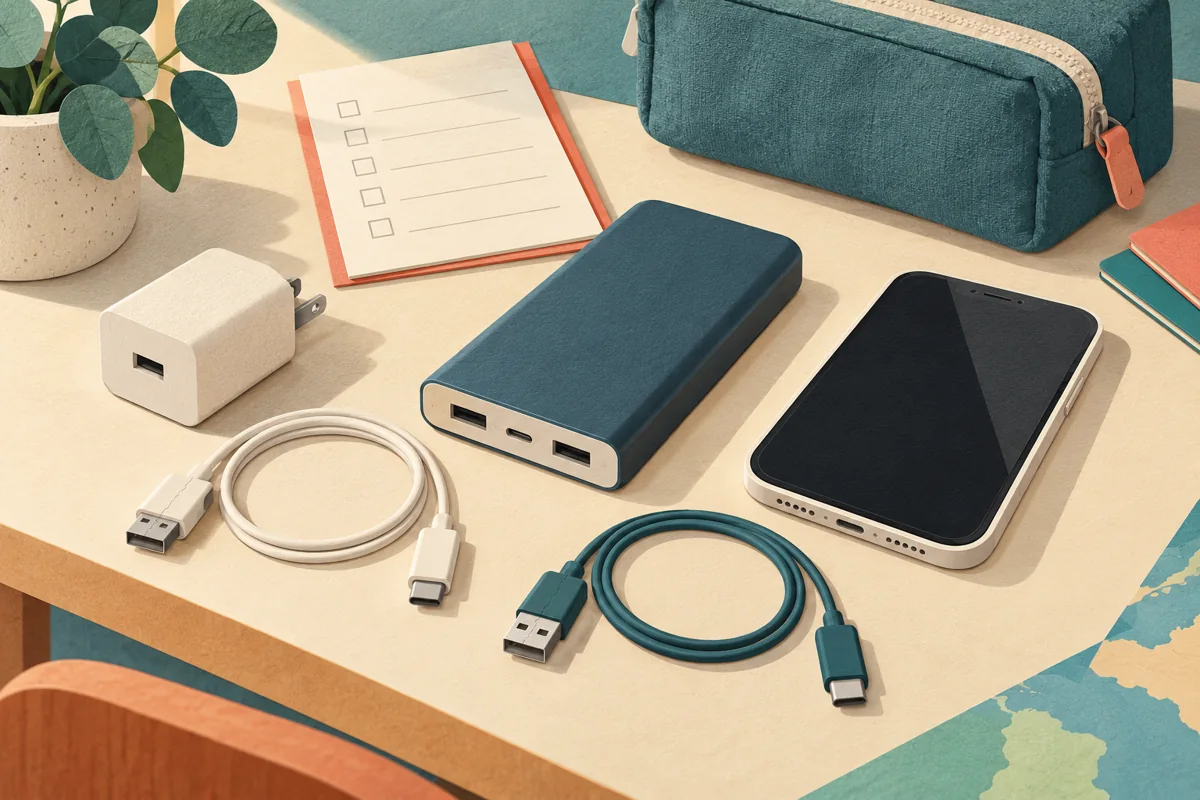
Illustration: AI-generated editorial artwork, not a stocked product photograph, connection diagram or charging-test result. Manufacturer information checked October 30, 2026.