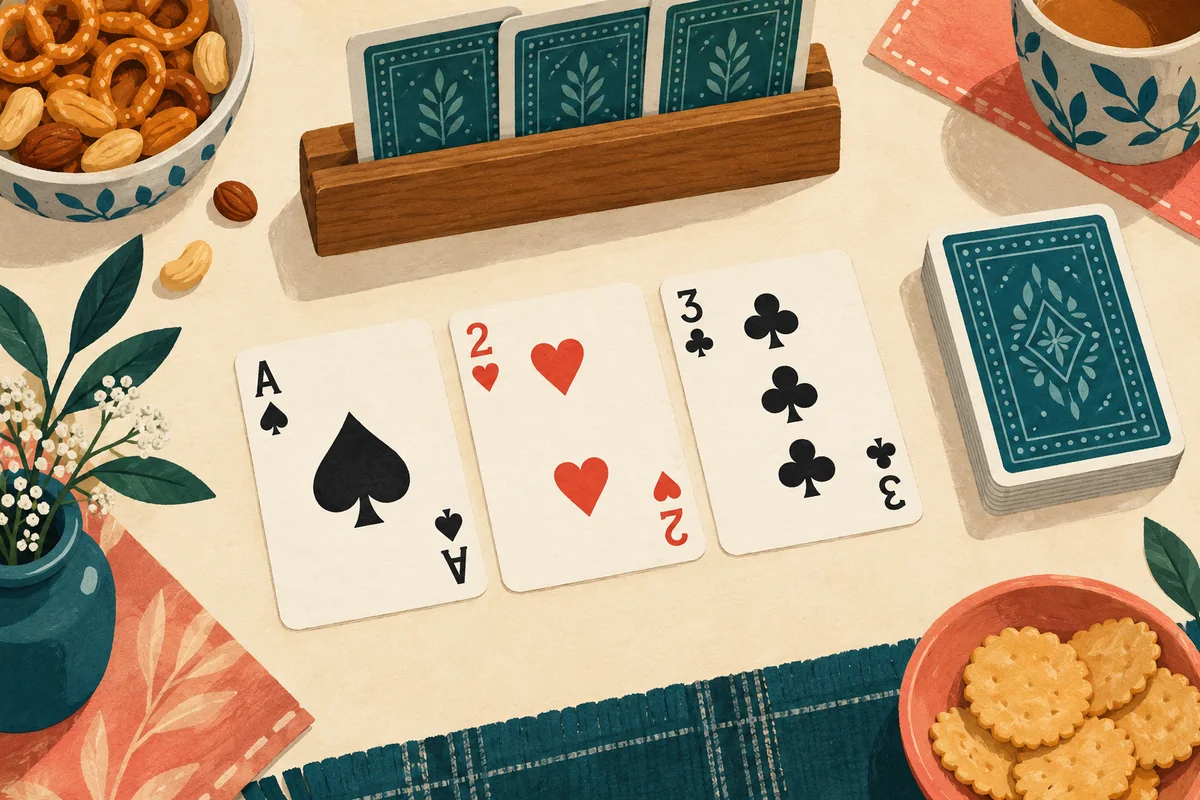
Choose the face layout with the people who will use it—not by the word “large” on the box. For a community-center game night or volunteer thank-you gift, a readable deck needs recognizable ranks and suits both on the table and in a player's hand. A physically bigger card is a different feature from bigger print.
Start by asking which games the group plays and whether participants prefer large print, braille, a card holder or another format. Ask about practical preferences without requiring anyone to explain a diagnosis. For take-home gifts, offer an alternative rather than assuming everyone wants the same deck; our accessible gift-selection guide covers that wider choice.
Separate three specifications that listings can blur
- Card dimensions: the rectangle a player must hold, shuffle and fit into a holder.
- Face and corner markings: the size and placement of the rank and suit. A large central number can be hidden when cards overlap in a fan.
- Tactile information: whether the deck carries braille or another usable tactile system. Enlarging print does not add this feature.
Two current RNIB listings demonstrate why these are separate purchasing decisions. Its large-print deck, GC17-U, specifies 3.2cm print characters on 5.8 × 9cm cards, plus corner rank-and-suit markings for reading a fan. Picture cards use large K, Q and J letters. Its large-print-and-braille deck, GC11R, specifies 1.5cm characters on 6.3 × 8.8cm cards, with braille at opposite corners. The deck with braille therefore is not simply the other deck with dots added.
These are specification examples from RNIB's UK shop, not a Brand Sauce catalog shortlist or a claim that either suits every player. Confirm destination delivery, available variants and any customization separately. A retail listing does not establish a branded supply route; a decorated order remains quote-needed.
Run a short play check, not a poster-reading check
Use a physical sample of the proposed deck with willing participants at the intended table. This is a purchasing exercise, not a vision assessment or a product test we have performed.
- Identify a mixed set. Include all four suits, several numbers and picture cards. Can the player identify rank and suit without someone interpreting the artwork? Do not rely only on distinguishing red from black.
- Deal the real hand size. Use the number of cards the planned game requires. Check whether corner markings remain visible in the player's normal fan or holder. Reading a single card flat does not settle this.
- Check the shared table. Place cards where shared cards will actually sit. Assess readability from the seated position under the room's ordinary lighting; note glare or shadows and try a different position before changing the deck.
- Complete a turn. Pick up, sort, select, play and discard. If the face works but holding the hand does not, trial a compatible holder before defaulting to even larger cards.
- Check tactile use when requested. Have the intended reader review the proposed braille deck and its marking convention. Do not assume that everyone with sight loss reads braille, or that printed enlargement replaces it.
Turn the result into an ordering decision
If single cards are readable but a fan is not: compare corner-index layouts or a holder that exposes the markings. If the fan works but the table does not: trial a clearer central face layout and review the table arrangement. If handling is the barrier: compare card width and a holder with the same game, rather than changing every variable at once. If participants prefer different formats: provide separate suitable decks or an alternative gift instead of declaring one universal winner.
Illustrative example: a volunteer group plays a game with a large hand. A proposed deck has very large central numerals, but overlapping cards conceal them. The buyer keeps that deck under review and compares a layout with clearer exposed corners using the same hand size. The decision turns on playable information, not the largest number printed on the package. This is a hypothetical selection scenario, not customer evidence.
Keep this approval record with the quote
- Game and normal hand size: ______.
- Exact deck/SKU, card dimensions and face-layout version: ______.
- Preferred format and holder, if any: ______.
- Single-card identification / fanned hand / shared table / handling: acceptable or change needed, with notes ______.
- Tactile format reviewed by intended reader, where applicable: ______.
- Branding location, destination country, quantity, confirmed delivery date and quote: ______.
- Decision: approve this specification / compare another sample / offer another gift. Reviewer and date: ______.
After the face layout works, decide where the branding belongs. A branded outer sleeve can preserve the selected retail deck, subject to supplier confirmation; a fully custom deck needs its own sample review. Our card backs, faces and box guide explains those artwork choices. Do not quietly substitute a decorative face design after participants have approved a readable one.
Primary sources checked October 26, 2026. Illustration: AI-generated editorial artwork, not a photograph of the cited products or evidence of testing.