Order dog bandanas by the exact product’s fit instructions, not by breed or the letters S, M and L. A flat scarf measurement and an adjustable collar circumference describe different things. For an apartment community’s dog social or a pet-friendly employee event, collect size selections only after choosing the construction.
The simplest buying rule: a size chart must tell the owner how the item will fit their dog—not merely how large the printed fabric is. If it does not, ask the supplier to clarify before opening reservations.
Two bandanas, two different measurements
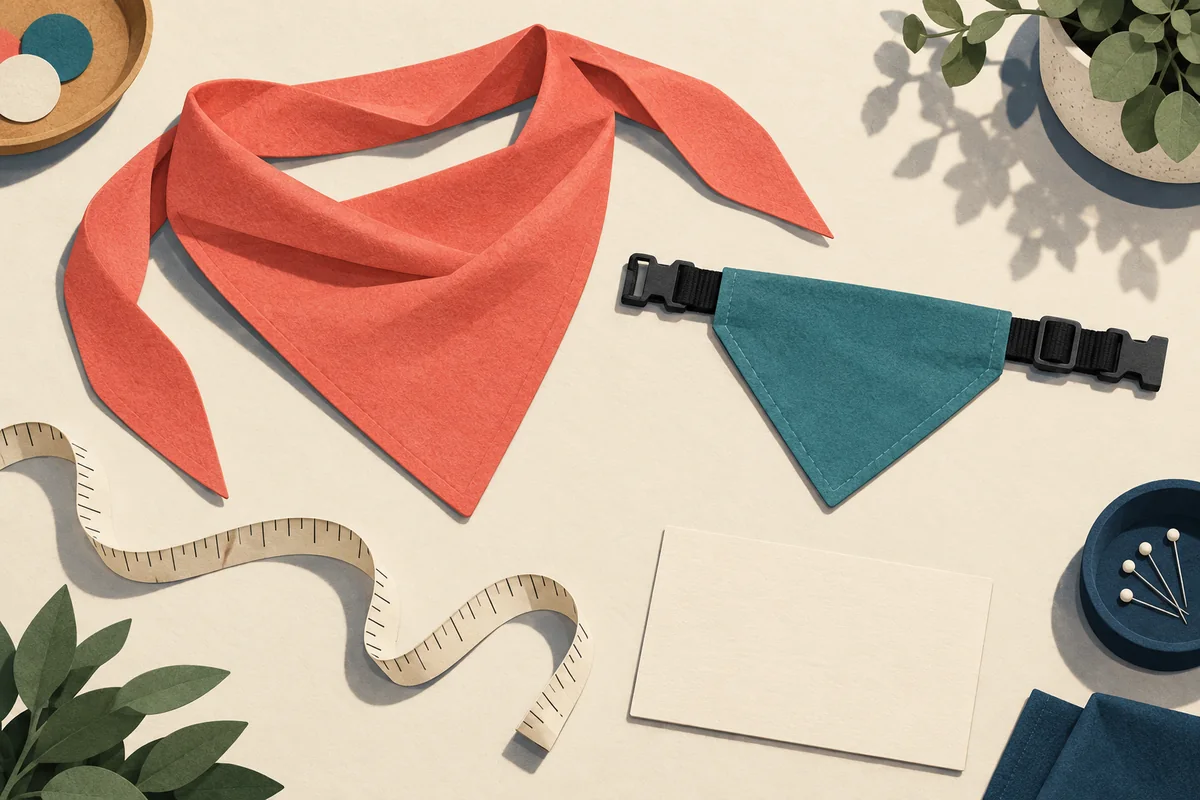
A tie-on scarf uses some of its fabric to fold and fasten. Its edge length is not automatically the usable neck circumference. A bandana attached to an adjustable strap has a separate collar-fit range, plus a fabric panel whose drop determines how much of the chest it covers. Do not copy the size labels from one construction to the other.
For a concrete specification example, Printful’s Pet Bandana Collar lists adjustable collar circumferences of 10–16.75 inches for S and 12–20.25 inches for M. It also lists a possible product-size variation of ±1 inch. The overlapping ranges show why a single circumference does not always select one obvious size; ask for the panel dimensions and model-specific fitting guidance too.
By contrast, Printful’s All-Over Print Bandana is a multifunction scarf. Its listing explicitly says the smallest size is intended for small pets and does not fit an adult person. A matching staff-and-dog design therefore does not mean ordering one universal size.
These live supplier pages were checked October 8, 2026 as specification examples, not as a Brand Sauce product shortlist. Brand Sauce sourcing, decoration, destination availability and delivered price for a proposed order remain quote-needed. Neither example establishes that every dog within a nominal range will be comfortable in that item.
Put these fields on the reservation form
Publish the chosen model’s chart and measurement instructions beside the form. Let owners make the selection; do not have event staff infer it from a breed name or a photo.
- Item: product/model reference and construction—tie-on scarf or bandana with adjustable collar.
- Measurement: the measurement requested by that model’s instructions, with inches or centimeters explicitly selected. Avoid a bare number field.
- Chosen size: the exact supplier size code, plus “I need fitting help” and “No bandana.”
- Quantity: number of bandanas in this size. If a household brings two dogs needing different sizes, use two lines.
- Pickup: reservation name or number, rather than a dog’s name alone.
Keep “needs help” separate from the order totals. It is an unresolved selection, not a medium. State whether size changes can be accommodated at pickup; do not promise exchanges unless you have the relevant spare stock and an agreed process.
Worked order: convert replies into a size split
Illustrative planning example, not a customer result: a community receives reservations for 30 bandanas. Owners select 8 S, 11 M and 5 L; 6 selections need clarification. The ready-to-order split is 8/11/5, totaling 24—not 8/17/5 with every unknown assigned to M. Resolve the remaining six before ordering for a fixed attendance commitment, or clearly offer those households a different giveaway.
If the event needs walk-up stock, budget it as a separate allowance. Do not hide it inside confirmed reservations or use it as evidence of a predictable size distribution. For the wider event, apply the same reservation-first thinking in our guide to avoiding leftover event swag.
Approve the artwork in its worn shape
Request a finished sample in the smallest size you intend to order. Fold or assemble it as directed, then check which part of the design remains visible. A centered logo on an unfolded square can land under a fold or near the fastening area. For an attached panel, review its orientation on the strap and how much space remains clear of the buckle.
Ask for size-specific artwork templates where available. Keep the main mark within the visible panel, and make the remaining area a pattern that can tolerate folds. Our logo-file handoff checklist covers the files to send once that placement is settled.
At handout, provide the exact supplier’s fitting, care and intended-use instructions. Do not describe a decorative accessory as a leash restraint, a breakaway collar or suitable for other species without documentation for that model. Make wearing it optional; a pet event can still feel welcoming when an owner declines the accessory.
Image: AI-generated editorial illustration of bandana constructions, not a supplied-product photograph or fit test.