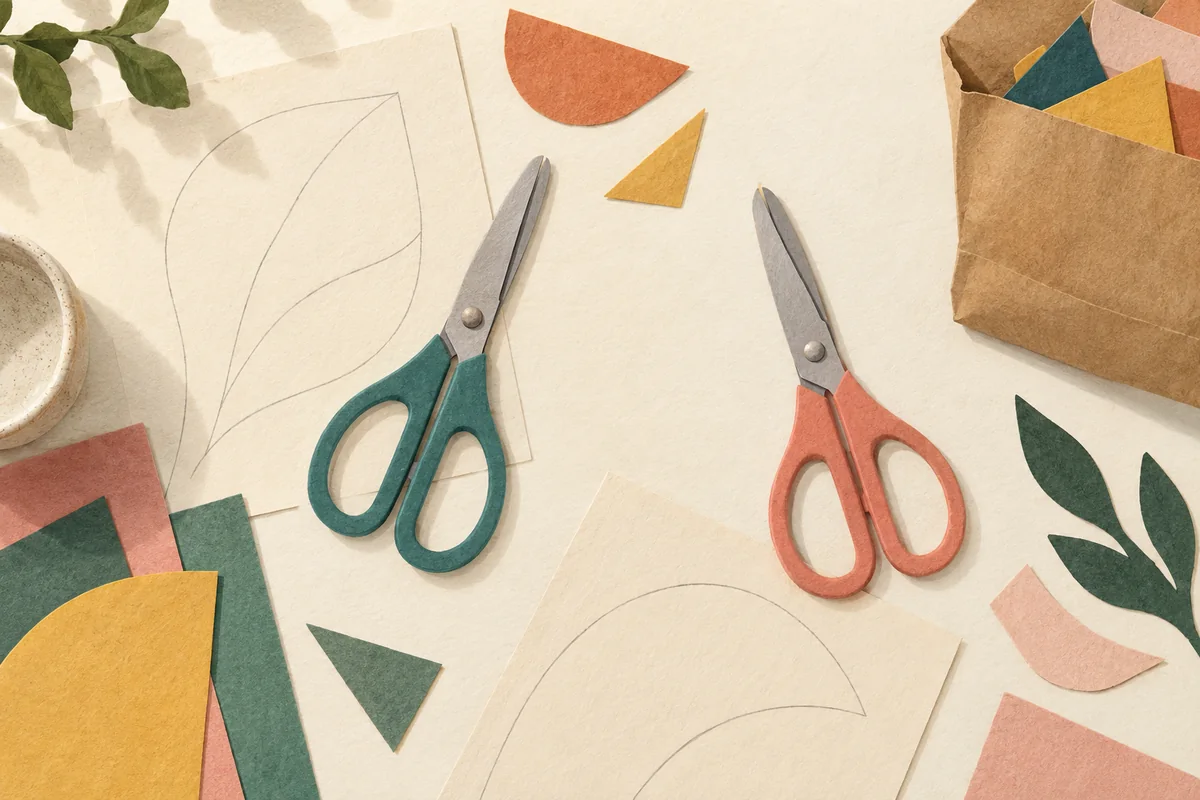
Do not approve branded workshop scissors for left-handed participants from an “ambidextrous” handle claim alone. Ask what the claim covers: the grip, the blade arrangement, or a documented recommendation for use in either hand. For an adult craft session, give participants a way to choose the tool they actually cut with before you print the logo or assemble identical kits.
This is a purchasing question about scissors for paper-based workshops, not a recommendation for children's scissors, fabric shears or specialist cutting tools. Those need their own task and user specifications.
A comfortable handle does not answer the blade question
Read the exact wording. Westcott's 13135 All Purpose scissors are described as suitable for use in either hand. That is a manufacturer use recommendation, but it is not an explicit statement that the blades are reversed. In its left-handed scissors overview, Fiskars specifically describes reversed blades as well as handles made for left-handed users. These are different kinds of product information; do not silently treat them as interchangeable.
That distinction matters when a supplier offers a generic promotional model with a short description. “Comfort grip,” symmetrical loops and the same handle color are not substitutes for an exact model specification. Ask the supplier to identify the blade configuration in writing rather than trying to deduce it from a small catalog thumbnail.
Model exceptions also matter. Acme United's Westcott support page identifies four CarboTitanium models—16445, 16446, 16447 and 16448—as right-handed, then names 16935 as a true left-handed exception. Do not turn a product-family name or the page's broad opening sentence into an all-model rule.
These manufacturer references explain what to verify. They are not a Brand Sauce product shortlist or confirmation that those models can be decorated or delivered in your country. A supplier still needs to confirm the exact item, decoration method, destination availability and quote.
Choose a kit route before placing the order
- Named recipients, take-home kits: ask which scissors they prefer to use—right-handed, left-handed or no preference. Ask about cutting preference rather than assuming it from the hand they write with. Record the selected model against the kit, without making the preference visible on the outside packaging.
- Shared workshop tables: offer clearly identified right- and left-handed options at the tool station. Let participants choose and swap. Avoid assigning a single pair to every seat before people arrive.
- Unknown audience, one promotional model proposed: do not describe it as suitable for everyone until its specification and a representative sample check support that claim. If the supplier cannot provide an appropriate alternative, brand the pouch or paper materials and source the scissors separately.
Do not invent a fixed percentage split from the attendee count. For registered sessions, use actual preferences and decide how you will handle unreported needs. For a walk-in event, keep alternatives accessible and agree a replenishment plan with the facilitator.
Run a short paper-cutting sample check
Before committing to decorated stock, ask willing left- and right-handed adults to try the proposed options using the actual workshop paper. This is a proposed acceptance check, not a product test Brand Sauce has conducted.
- Match the materials. Include the plain paper and card the activity really uses. Do not approve on thin copier paper if the session mainly cuts folded card. Stay within the manufacturer's intended uses.
- Draw two routes. Use one straight line and one broad curve. Have participants cut with their normal scissors hand, at a comfortable pace.
- Ask three practical questions. Can they see and follow the line? Does the paper cut rather than repeatedly fold between the blades? Does the handle feel comfortable through the activity? Record comments, not a made-up performance score.
- Offer the alternative. If a participant struggles, try the appropriate handed option before blaming technique. A successful trial by one person does not prove a universal fit; preserve the ability to choose.
- Recheck the decorated sample. Confirm that branding leaves the gripping surfaces, movement and any model identification usable. Keep decoration away from functional areas unless the supplier specifically approves it.
For example, if a left-handed participant follows the curve comfortably with a true left-handed sample but has difficulty with the proposed shared model, the buying decision is to retain that alternative—not to write “ambidextrous” on every kit. This is an illustrative decision, not a reported customer result.
Copy this approval note into the purchase brief
Adult paper-workshop scissors approval
Workshop materials and typical cutting task: ______
Right-handed option, exact manufacturer and model: ______
Left-handed option, exact manufacturer and model: ______
What any “ambidextrous” claim specifically covers: ______
Manufacturer specification link and date checked: ______
Participant preference collection or on-site choice method: ______
Sample observations and unresolved concerns: ______
Decoration location approved by supplier: ______
Destination availability, quantities and quoted cost: ______
Owner of swaps and replenishment during the session: ______
Keep the cutting-tool choice separate from the rest of the desk kit. Our guide to pens for left-handed note-takers addresses a different problem: writing and smearing. For take-home kits, the broader employee gift preference survey guide can help you collect useful choices without promising an item before availability is confirmed.
Illustration: AI-generated editorial artwork, not a supplied product, technical blade diagram or cutting-test result.