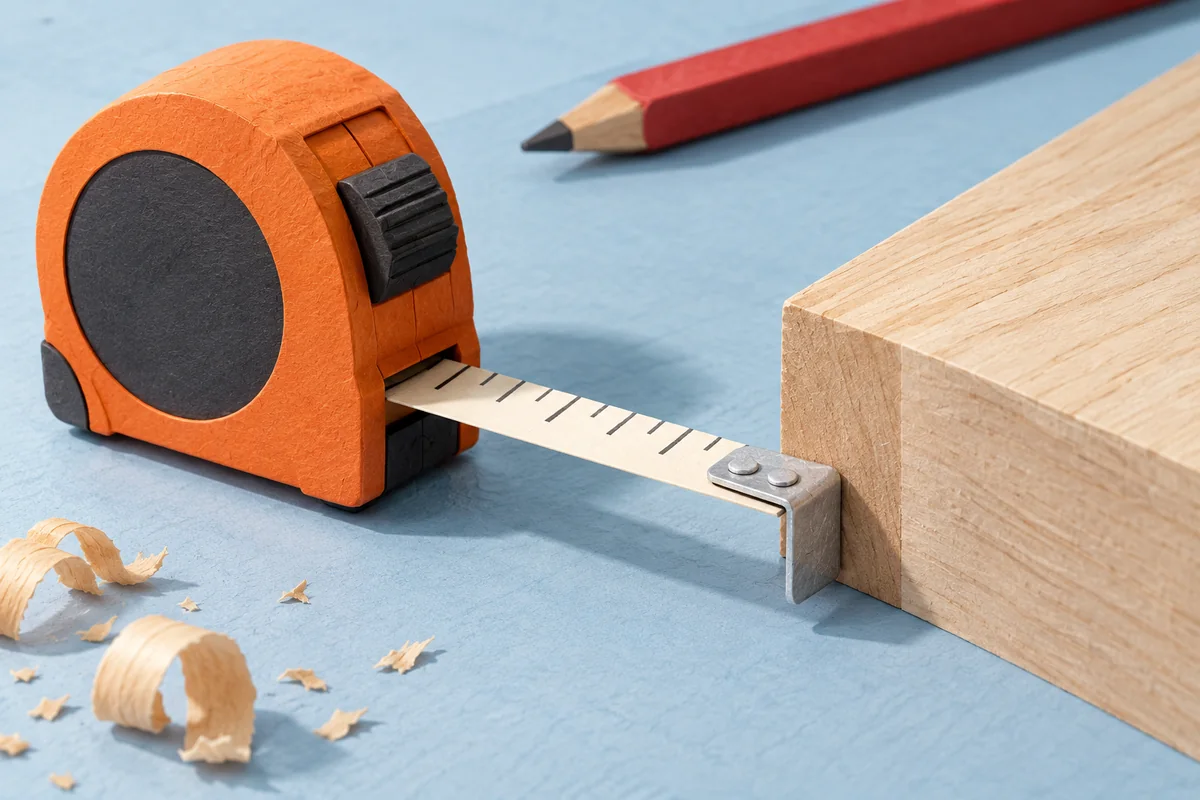
A small sliding movement in a tape measure’s end hook can be intentional—not a reason to reject your branded sample. On a true-zero design, the hook shifts to account for its own thickness when you change between pulling against an outside edge and pushing against an inside surface. But “it is supposed to move” does not excuse a bent hook, a sticking mechanism or inconsistent readings.
For a home-improvement retailer planning customer giveaways, the useful approval question is not “Is the hook completely rigid?” It is “Does this exact model work as specified in both measuring positions?”
What normal movement is doing
STANLEY explains its moving-hook design in terms of hook thickness. When you hook the end over an outside edge and pull, the hook moves outward. When you press it against an inside surface, it moves inward. Those positions compensate for the metal at the starting point.
That is a design explanation, not a universal allowance for every promotional tape. Ask the supplier whether the proposed model has a true-zero hook and what movement is intended. Do not glue the hook in place or tighten its rivets as a cosmetic “fix.” If the sample appears damaged, return it for assessment instead of modifying it before approval.
Separate the hook feature from the rest of the specification
The Komelon Extreme product page, for example, lists a moving true-zero hook, metric and imperial markings, and Class II accuracy as distinct features. One does not prove the others. A moving hook alone tells you neither the accuracy class nor which units a recipient will find on the blade.
That manufacturer example is not a verified Brand Sauce catalog offer. It does not establish availability for decoration, current stock or supply to another country. For a branded order, request the exact SKU, destination-country availability and written accuracy specification. Price remains quote-needed.
A sample-check card you can copy
This is a practical buyer screening exercise, not a calibration procedure or certification. Have the supplier define the model’s acceptable measurement error and the conditions for checking it; do not invent a pass tolerance after seeing the results.
- Identify the sample. Record manufacturer, SKU, blade length, units, sample date and whether it matches the proposed decorated production item. Photograph the markings and hook before use.
- Read the instructions. Confirm the hook design, intended movement, accuracy specification and any special instructions for magnetic or other attachments. Record the supplier’s answer if the product sheet is silent.
- Inspect without adjusting. Look for a visibly bent hook, damaged blade, missing fastener or movement that sticks. Flag anything uncertain for the supplier; do not bend it back and approve the altered sample.
- Compare both measuring modes. Use a suitable known reference and fixture that let you check a pulled outside measurement and a pushed inside measurement. Keep the blade straight and aligned, use the same units, and follow the manufacturer’s method. A randomly cut scrap of wood is not a known reference.
- Record repeat readings. Note the reference length, pulled readings, pushed readings, specified tolerance and reviewer. Repeat each mode to spot inconsistency. Matching readings alone do not establish accuracy: both can be wrong against the reference.
- Check the gift as supplied. Confirm that decoration does not obscure markings or interfere with the lock, clip or retraction. Operate the tape according to its instructions and check that the units are legible for the intended audience.
- Choose an outcome. Approve against the agreed specification / hold for a written explanation or replacement sample / choose another product. Record the approver and retain the approved sample. Do not treat one passing sample as proof that every production unit is identical.
When to hold the order
- The hook slides as documented and the sample meets the agreed checks: movement by itself is not a defect. Keep the approved specification and include the manufacturer’s use instructions with the giveaway.
- The supplier cannot identify the design or accuracy specification: pause any claim that the gift is an accurate working tool. For recipients who will rely on measurements, select a documented model before approving artwork.
- The hook is distorted, sticks, or readings fall outside the agreed specification: hold the sample for supplier review. A polished logo does not resolve a measuring problem.
Illustrative decision: a retailer receives a decorated sample whose hook slides slightly. Instead of rejecting it for looseness, the buyer requests the model instructions and runs the agreed push/pull checks. If the outside readings meet the specification but the inside readings do not, the sample remains on hold. The buyer requests a replacement and an explanation; the logo proof can be correct while the physical product is not approved. This is a hypothetical workflow, not a Brand Sauce product test.
If the gift is intended for a work crew rather than occasional home use, keep the distinction between general merchandise and jobsite requirements explicit. Agree who handles a functional defect using the product-versus-decoration warranty checklist before the order is placed.
Illustration: AI-generated editorial artwork, not a product photograph or a measurement diagram. Manufacturer sources checked October 7, 2026; no physical tape measure was tested for this post.