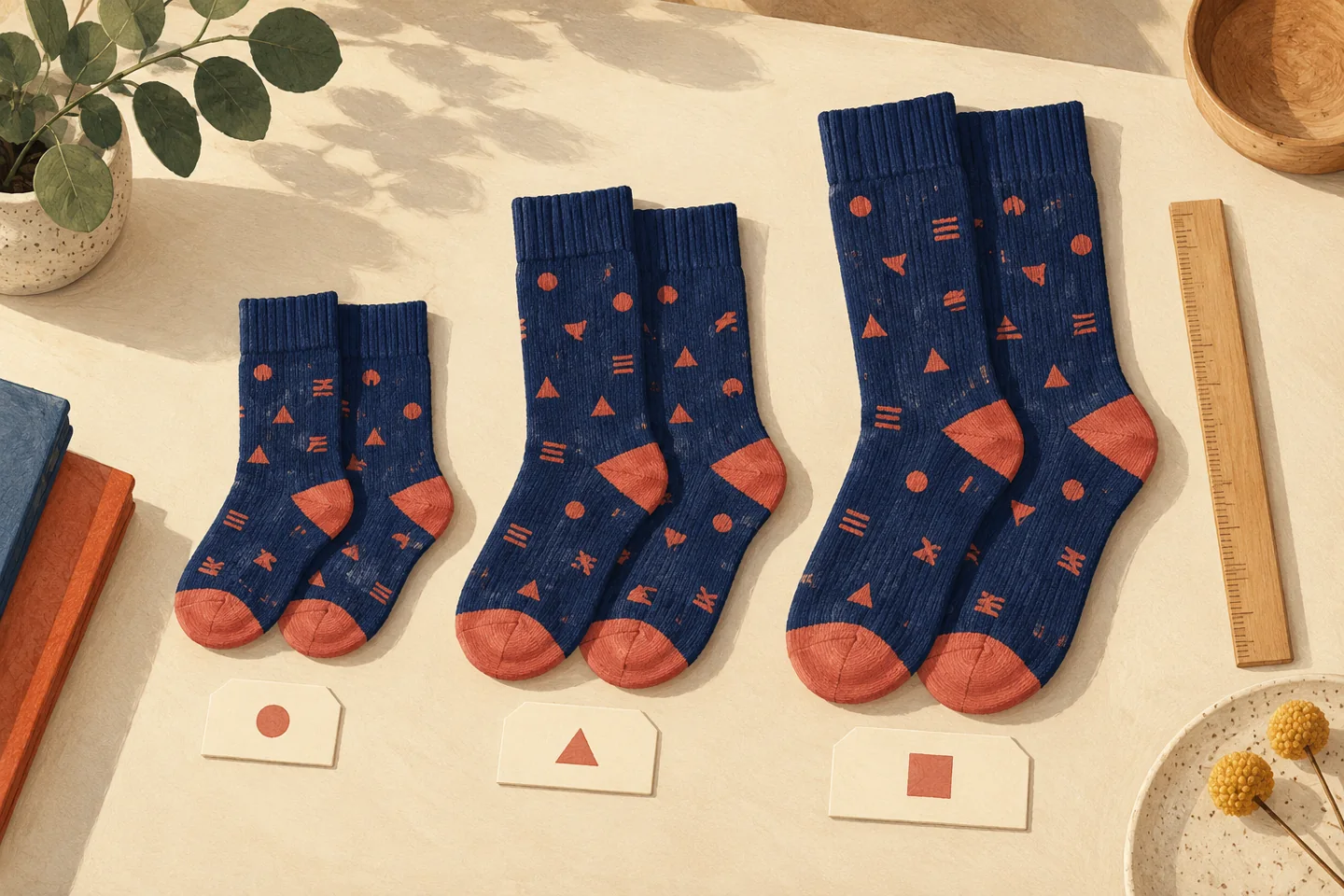
Offer the sizes your recipients need, not a fixed number of sizes for every order. A single broad-range sock can be a sensible optional giveaway. For a promised gift to a known team, check the actual size range first, collect selections and price the smaller size groups before committing.
The catch is that a size split can change the order minimum. “We need 100 pairs” is not enough information for a useful quote if those pairs need three different production sizes.
What does “one size fits most” leave out?
It is a product-specific range, not a promise to fit everyone. For example, Sock Club’s sizing page lists its broad adult option for women’s shoe sizes 7–12 and men’s 6–11, with separate smaller and larger options. Those are that supplier’s published ranges—not a universal sock standard or a Brand Sauce catalog specification. Confirm the shoe-size system with the supplier before copying the numbers into an international order form.
Letter sizes are not universal either. Darn Tough’s chart maps its men’s/unisex medium to US men’s 8–9.5, while its women’s medium maps to US women’s 7.5–9.5. Its chart also supplies UK and European equivalents. The buying lesson is to attach the exact style’s chart, not ask everyone to select “medium” from memory. These manufacturer examples explain sizing; they are not a verified Brand Sauce product shortlist.
Choose your ordering route
- Known recipients, socks promised to everyone: collect selections against the supplier’s chart before the purchase order. Include a route for people outside every offered range.
- Open event, socks are optional: show the range on the display and packaging, let attendees choose, and offer a different item if the available sizes do not suit them. Do not describe one size as fitting every attendee.
- Small group with scattered sizes: compare a broader-size-range product, a different supplier’s minimum structure or a non-sized gift before accepting unwanted extras.
- Adults and children at the same event: separate the choices. Do not treat an adult small as a substitute for a supplier’s youth chart.
For a volunteer appreciation program, this decision belongs before the announcement: promising socks to every volunteer creates a different obligation from putting an optional basket on a check-in table. Our volunteer apparel handout guide covers the related roster and distribution work.
Check whether the minimum applies to each size
Sock Club’s FAQ currently says its bestselling custom crew, ankle and athletic socks start at 30 pairs per design and size, and notes that other styles can have different minimums. That is evidence that per-size minimums exist, not a minimum to assume for every vendor. Ask your supplier to state whether sizes combine toward the minimum and whether each size keeps the same unit price.
Illustrative calculation—not a quote: suppose a nonprofit has 100 volunteers who select 84 standard, 8 smaller and 8 larger pairs. If its proposed supplier requires 30 pairs in each size, the smallest order satisfying those selections is 84 + 30 + 30 = 144 pairs. The 44 extras are 22 smaller and 22 larger pairs, not a useful general-purpose reserve unless the nonprofit has a realistic future use for them.
Price that actual 144-pair mix, including decoration, packaging and delivery, against the alternatives. Do not compare a 100-pair headline price with another supplier’s fully sized order. Prices and destination availability remain quote-needed until the exact specification is confirmed.
A size-selection form you can copy
Use this after the supplier confirms the available ranges. Replace the brackets with the approved product details; do not publish a form with blank ranges.
Volunteer sock selection
Product/style: [exact style]
Size chart: [link to the approved chart, including US/UK/EU labels]
Please choose: [each available sock size with its shoe-size range] / None of these ranges fits / I would prefer the alternative gift.
If you are unsure: [contact or sample-fitting arrangement].
Selection deadline: [date].
Alternative gift: [confirmed option].
Let recipients choose from the chart without requiring them to identify their gender. If you need a shoe size to resolve a question, collect the sizing system too: “9” alone is ambiguous. Do not convert a missing response into the standard size. Resolve it separately or follow the alternative-gift choice you communicated. Set expectations with an appropriately scoped gift survey.
Release the order only when these five points are settled
- Coverage: every respondent has a selected size or a confirmed alternative; unresolved selections are listed separately.
- Fit: review samples in the proposed style, especially for volunteers near range boundaries. Check heel position, excess fabric and cuff comfort with their normal footwear; a chart is a starting point, not a wear test.
- Quantities: show requested and purchased pairs for each size, with the reason for any surplus.
- Identification: confirm how the size will be marked on each pair or its packaging so the handout team can distinguish it without guessing.
- Recovery: confirm how unworn wrong-size pairs will be handled. Do not promise an exchange until the supplier’s terms and any hygiene restrictions are known; use the size-exchange planning guide to document the agreed route.
Bottom line: one, two or three sizes can all be reasonable. The right answer is the smallest workable assortment that covers the actual recipients, with the real per-size economics visible and an alternative for everyone it misses.
Illustration: AI-generated editorial artwork, not a product photograph or evidence of fit testing.