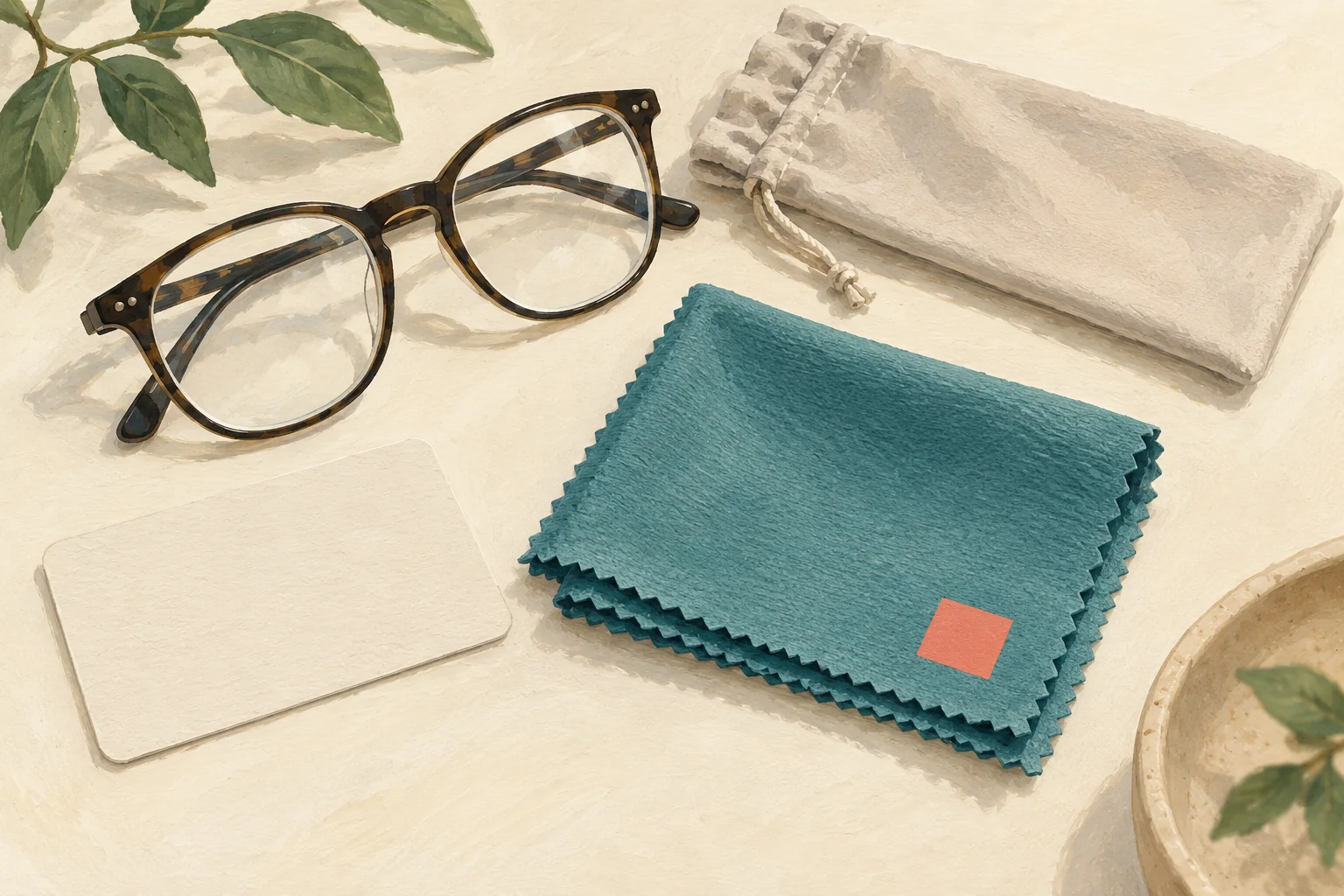
A branded microfiber cloth can be a useful eyeglass giveaway—but “microfiber” alone is not enough to approve it for lenses. Ask the supplier to confirm the intended use of the finished, decorated cloth, provide care instructions and identify any surfaces it should not touch. A soft-feeling sample and a sharp logo proof answer different questions from lens compatibility.
For an optometry open house, benefits fair or employee welcome kit, the useful deliverable is a cloth people can keep clean and use correctly. Start with that job before choosing full-color artwork.
Specify an eyeglass cloth, not an all-purpose wipe
Put “reusable cleaning cloth for eyeglass lenses” in the brief. Ask whether the supplier’s suitability statement covers the actual fabric, edge finish and printing process you are ordering—not just an undecorated blank. If the supplier cannot support the intended lens use, leave that claim off the packaging and do not distribute it as an eyeglass-care item.
This is our purchasing recommendation, not a claim that every printed cloth is unsuitable. The decision depends on the finished item. Record which side, if either, the supplier designates for cleaning, and whether any treatments require special handling. Use our logo-file checklist for the artwork handoff after those functional questions are settled.
Include instructions that survive the first use
Warby Parker’s eyeglass-cleaning guidance recommends rinsing with lukewarm water, using lotion-free dishwashing liquid, rinsing again and drying with a clean microfiber cloth or lint-free towel. It cautions against rubbing dry debris across lenses and recommends washing the cloth often. Fabric softener and dryer sheets can leave residue that causes smearing.
Do not turn that into a universal ban on every dry-cleaning method. ZEISS describes its own microfiber cloth as suitable for dry cleaning or use with its lens spray, and advises washing microfiber cloths at no more than 40°C without fabric softener. These are manufacturer instructions, not proof that a promotional cloth performs identically. For your giveaway, have the supplier approve a care card consistent with the recipient’s eyewear instructions.
Our practical packaging recommendation: include a dedicated pouch or clean sleeve so the cloth is not handed out loose alongside keys, pens and other bag contents. Reserve room for readable care directions, a product reference and a way to retrieve the instructions later. Do not rely on a tiny logo-side paragraph that becomes illegible after folding.
Do not promise one cloth for every screen and lens
“For glasses, laptops, cameras and every screen” is a much broader promise than an eyeglass giveaway needs. A clear exception is Apple’s nano-texture display guidance: it directs owners to use the polishing cloth supplied with the display or a replacement, rather than an arbitrary giveaway cloth.
Keep the intended-use label narrow. If the kit is for a mixed device fleet, check specific device care requirements before adding screen-cleaning claims. The same compatibility-first approach applies to webcam covers in laptop welcome kits. Avoid anti-fog, disinfection or scratch-removal promises unless there is appropriate evidence for the exact finished product; ordinary cleaning and those functions are not interchangeable.
A copyable approval record for your order
Use this record once per cloth construction and decoration method. Mark each line confirmed, unresolved or excluded; unresolved lens suitability means the order is not ready for this use.
- Identity: supplier, product code, dimensions, fabric specification, edge finish and approved sample reference.
- Intended surface: eyeglass lens types or coatings covered by the supplier’s statement, plus explicit exclusions.
- Finished decoration: printing method, artwork version, usable cleaning side and confirmation that the suitability statement includes this configuration.
- Care: washing and drying directions, prohibited additives and any pre-use preparation; attach the approved instruction proof.
- Packaging: clean storage sleeve or pouch, readable instructions and product identification that stays with the giveaway.
- Release: reviewer, date, unresolved questions, destination, confirmed lead time and quoted total. No substitution of cloth or printing process without review.
Supplier request: “Please confirm whether finished item ___ with decoration ___ is intended for eyeglass lenses, including any coating exclusions. Attach the use and washing instructions, identify the cleaning side and confirm the packaging. We will not label it for other surfaces without separate confirmation.”
Worked decision: an optometry open house
Hypothetical example, not a customer result or product test: a practice considers two cloth offers. One comes with a decorated-item suitability statement, care sheet and sleeve. The other offers a larger print area but only says “multipurpose microfiber.” The practice advances the documented option for its optician’s review and holds the second pending clarification. It does not assume that a larger cloth, higher price or brighter print settles the lens-care question.
Ask for the exact item’s availability in the delivery country before final approval. Prices, customization and delivery remain quote-needed; the manufacturers cited here supply care guidance, not a verified Brand Sauce product shortlist.
AI-generated editorial illustration, not a product photograph or cleaning test. Primary sources checked October 4, 2026.