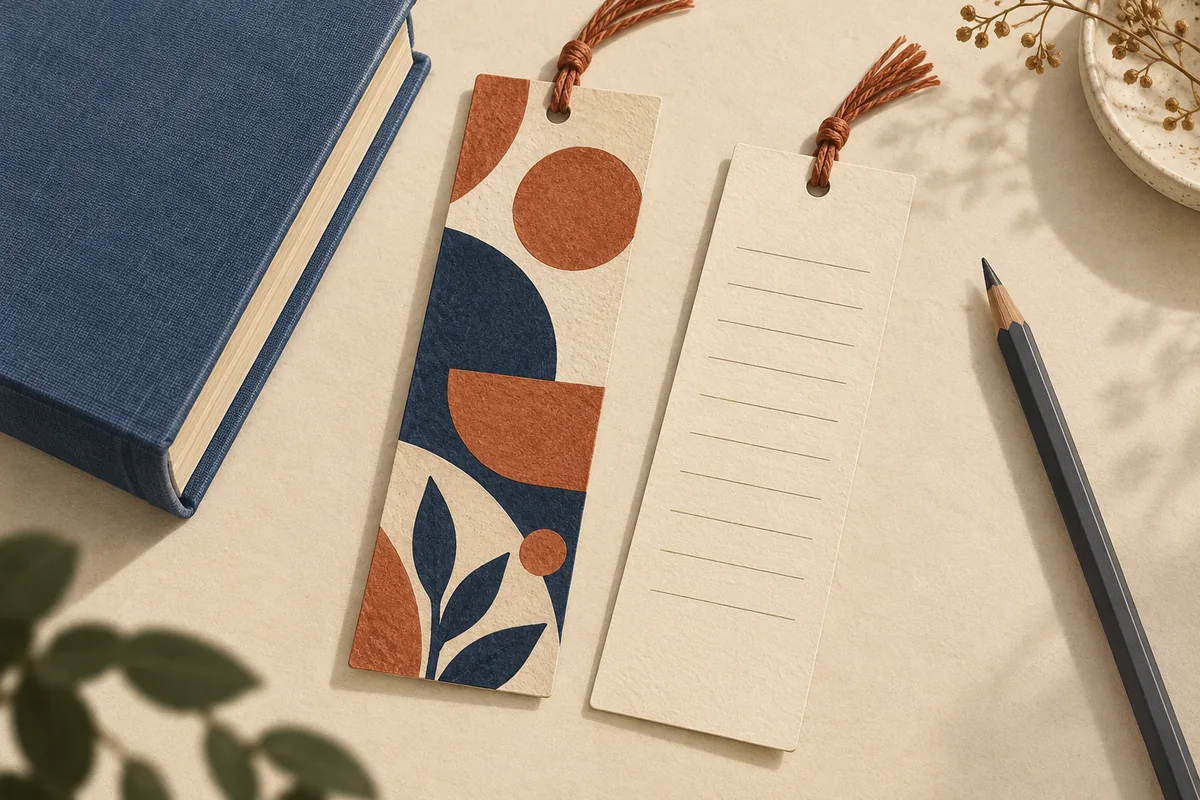
If people will write reading notes, recommendations or challenge progress on your branded bookmark, specify an uncoated writing area and approve it with the actual pen or pencil. A matte appearance alone does not establish writability. For a library or bookstore giveaway, choose the reverse-side task before choosing the finish.
Matte, uncoated and blank are different instructions
A blank back means no printed content; it does not necessarily mean no coating. Likewise, matte describes a finish, not a promise that every pen will work. UPrinting’s bookmark specifications distinguish uncoated stock with excellent writability from matte stock on which oil-based ballpoints and permanent markers work best. Its gloss stock has limited writability with some pens.
PrintPlace’s stock and coating FAQ recommends uncoated stock when writing matters. It says its aqueous-coated stocks accept ballpoint or Sharpie pens, while its UV coating is not writable. These are supplier-specific descriptions, not a rule that every finish with the same marketing name behaves identically.
That distinction matters at a reading table stocked with pencils, or a book club where participants bring assorted gel pens. “Works with a permanent marker” may be technically true and still fail your intended experience.
Choose by what happens after handout
- Readers only mark their place: prioritize readable artwork and the feel of the sample inside a book. A coated finish may suit this job; handwriting need not drive the specification.
- Readers record titles or tick a challenge: start with an uncoated reverse, light writing fields and generous line spacing. Keep decorative ink coverage away from those fields.
- Staff add a handwritten recommendation: specify the exact staff pen and test it on the finished reverse. A small note box that technically fits three lines may still be awkward to use.
- A polished front and writable back are both important: ask whether the chosen item supports different surfaces on each side. Confirm the final combination in writing rather than selecting “blank back” and assuming.
For example, PrintPlace’s bookmark ordering page lists both uncoated stock and stock with an uncoated back. That illustrates why the order needs a side-by-side specification. It is not a verified Brand Sauce catalog recommendation; Brand Sauce availability, destination-country fulfillment and pricing remain quote-needed.
A copyable bookmark specification
Send this brief with your production-ready logo files. Fill in the blanks before requesting a proof:
- Reader task: mark a page / record reading / receive a recommendation / other: ____.
- Finished size and exact stock: ____; printer’s template revision: ____.
- Front: artwork ____; coating or lamination ____.
- Back: printed content ____; coating or lamination ____; area deliberately left free of printed ink for writing ____.
- Writing tools to support: pencil or exact pen model(s) ____.
- Writing fields: labels ____; number of lines ____; checked at actual print size by ____.
- Optional hole or ribbon: none / location ____; confirm supplied components and keep writing fields clear.
- Delivery: quantity ____, destination country ____, required arrival date ____; quote and specification approved by ____.
Run a writing-and-book check before release
A PDF can establish where the lines sit. It cannot show whether the finished surface accepts your chosen ink. Request a sample with the proposed stock and finish, and establish whether a supplied proof actually uses those materials.
- Write the real content. Fill in a full title and a short note at normal handwriting size. Use each tool you intend to supply or explicitly support.
- Check the hand movement. Have a reader complete the fields naturally, including a left-handed check if possible. Watch for smearing while writing, not just after the sample has dried.
- Recreate the handout sequence. Write, wait the amount of time readers realistically will, then put the bookmark in a disposable test book. Record the wait used; inspect the facing pages for transfer. This is a proposed acceptance check, not a test we have performed.
- Check comfort in the book. Close it normally. Decide whether the bookmark’s thickness, corners or any added ribbon interfere with the intended use.
- Record a decision. Approve the exact material-and-tool combination, or change the finish, writing area or supplied pen and repeat the check. Do not carry approval across a substituted stock without checking again.
Worked design example: a book-club recommendation card
Illustrative brief, not a customer result: a bookstore wants one bookmark to hold a staff recommendation and then become the reader’s place marker. Put the logo and a small illustration on the front. On the uncoated reverse, reserve two roomy fields: “Try this next” and “Recommended by.” Test the actual counter pen and a long book title before adding a third field.
If the title only fits in cramped handwriting, remove an element or revise the format. Shrinking the writing lines to squeeze in more promotional copy defeats the useful part of the giveaway. Plan quantities around the handout occasion using the same leftover-aware event planning you would use for other merchandise.
The release rule: approve the surface people will write on, not merely the finish name on the quote.
Editorial illustration is AI-generated; it does not depict a tested sample or a supplier’s exact product.