Stock printed transfers instead of finished shirts when the artwork is stable but the final size mix is uncertain—and a decorator can reliably supply, apply and ship the garments later. Stock finished shirts when immediate handout matters more than flexibility. Order everything on demand when demand or branding is too uncertain to justify buying decoration inventory.
There is a useful middle ground between a closet full of company shirts and producing every component after an employee orders. You can commit to a quantity of printed heat transfers while delaying the choice of garment size. That postpones one decision; it does not eliminate inventory, production work or delivery risk.
This guide addresses the purchasing question: which part of the finished shirt should your company own before someone requests it? It is not a heat-press operating manual.
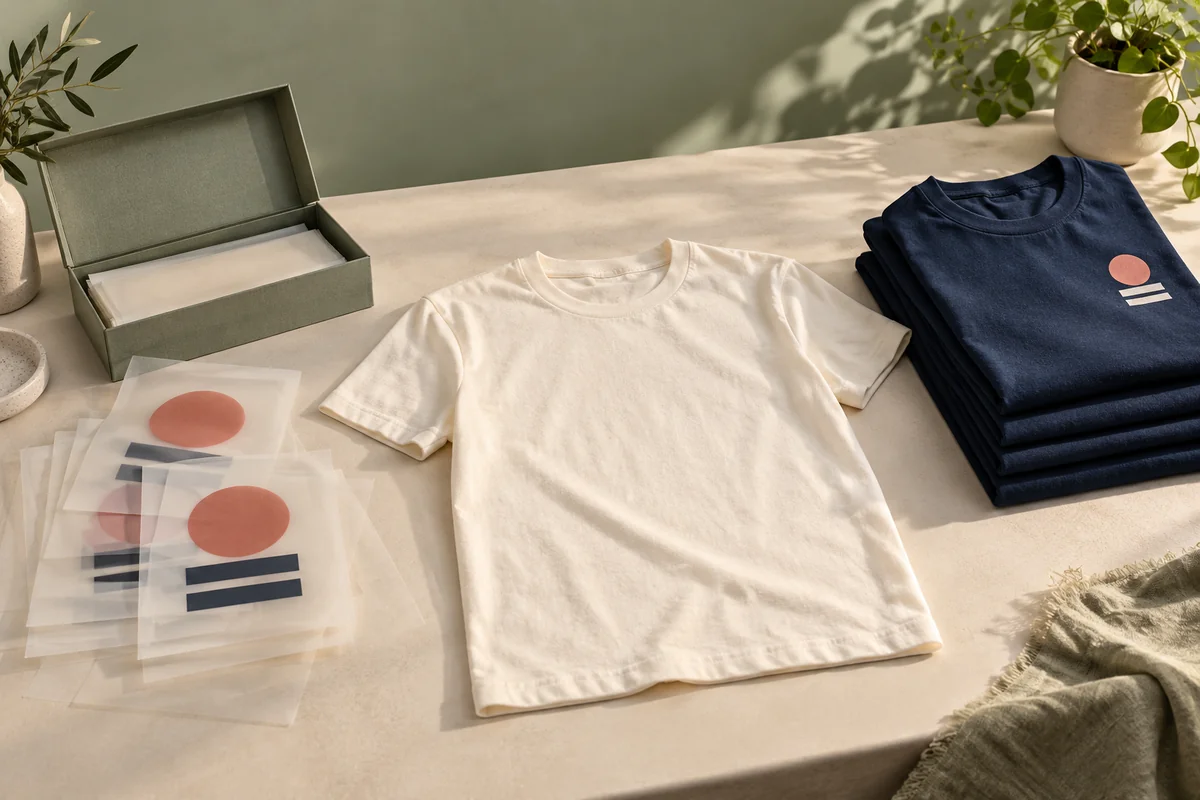
Publisher perspective: Brand Sauce publishes company-merchandise decision guides. This is a model comparison, not a promise that Brand Sauce or any particular provider offers customer-owned transfer storage. Confirm the exact service, product, destination and price by quote. Manufacturer guidance was checked October 11, 2026. The image is an AI-generated editorial illustration, not a tested product photograph.
Compare three ways to hold the commitment
A printed transfer carries a design that a decorator applies to a compatible garment using the specified heat-application process. A screen-printed transfer is not the same thing as printing directly onto the shirt, and a direct-to-film transfer is not interchangeable with every other transfer product.
| Model | What is committed early? | What still happens after a request? | Best reason to consider it |
|---|---|---|---|
| Finished-shirt inventory | Garment style, color, size mix and decoration | Pick, pack and distribution | Known demand or a hard handout date |
| Stored transfers, later garment decoration | Artwork, transfer type, printed dimensions and quantity | Blank sourcing, application, inspection and shipping | Repeat artwork with uncertain wearer sizes |
| Production after each order | Approved specification; financial commitments depend on the contract | Obtain or produce the required components and complete fulfillment | Low or unpredictable demand without a prepaid component batch |
The middle model may also include reserved blank garments. If it does, ask which sizes and colors are reserved, who owns them, and whether unused blanks can serve other orders. Otherwise, a proposal described as “transfer inventory” can quietly include the same size commitments you hoped to avoid.
Our broader on-demand versus bulk guide compares whole-program economics. Here, the distinction is narrower: committing to decoration before committing to the wearer’s garment.
Find the actual limit of the flexibility
A stored design is not a universal decoration token. Its dimensions, colors, transfer system and intended placement have already been chosen. A large back graphic does not become a small chest mark simply because you have not pressed it yet.
Build an approved compatibility list before buying the batch. Record the garment style, color, fabric composition, print location, transfer product and artwork dimensions. If the plan covers several garments, obtain representative decorated samples rather than approving only the most forgiving shirt.
Transfer Express’s application instructions vary by transfer product and sometimes by fabric. They specify different combinations of temperature, pressure, time and peel procedure. The buyer’s takeaway is not to memorize a setting: require the decorator to identify the exact application specification being used.
Polyester adds a particular approval question. STAHLS’ guidance on dye migration explains that garment dyes can discolor a transfer and that behavior can vary between fabric lots. Ask how the selected garment and transfer combination will be evaluated. An approval on one cotton tee does not establish compatibility with a polyester performance shirt.
For the general appearance-versus-method decision, use our embroidery versus printing guide. Do not purchase a transfer batch if the team has not yet decided whether it likes the finished print’s feel, scale or appearance.
Give the stored components a real owner
The box may be small, but it still needs inventory controls. Someone must receive it, verify the design, count usable impressions, protect it, and report what remains. “The printer has our logos” is not a sufficient stock record.
Transfer Express’s storage guidance calls for a climate-controlled, dry environment and retention of the original protective packaging. It also gives additional moisture-control guidance for UltraColor transfers. Those are manufacturer-specific instructions, not proof that every transfer can be stored indefinitely.
Ask the actual supplier for written storage conditions and a review or retest policy for the product being purchased. The manufacturer’s stored-transfer advice recommends testing transfers pulled from storage. Separate physical usability from commercial usefulness: a perfectly usable design can still be obsolete after a rebrand.
- Ownership: who paid for the batch, and who owns unused pieces?
- Identification: artwork version, transfer product, dimensions, receipt date and batch reference.
- Quantity: count usable impressions by design, not merely sheets or boxes.
- Status: available, allocated to an order, consumed, damaged or quarantined.
- Custody: storage location and the person responsible for condition checks.
- Exit terms: return, shipping, disposal and reporting arrangements if the relationship ends.
Count test applications and damaged pieces as consumption. If several designs share one sheet, record the remaining usable designs after cutting; a count of “ten sheets” may no longer describe ten complete order sets. Require a reconciliation when the reported balance and completed orders disagree.
Do not confuse a stored transfer with a ready shirt
Before promising a delivery date, confirm four things: usable transfers, the right blank garments, available application capacity, and the shipping plan. A stock report that confirms only the first is not a fulfillment commitment.
Ask the decorator to explain the order-release sequence. Does a single shirt enter production immediately, wait for a weekly batch, or require a minimum application charge? Who confirms a blank-stock problem before the employee receives an optimistic estimate? What happens if a replacement style needs a fresh sample?
For an urgent first-day uniform, a finished reserve may be the better tool. For an optional employee gift with a flexible delivery window, delayed application may be acceptable. A company can use both without pretending that every order follows the same service level.
A sensible hybrid might keep a deliberately limited finished reserve for urgent needs and stored transfers for routine replenishment. Make the two order routes visible to the administrator so a reserve issue does not also trigger production of a duplicate shirt.
Compare cash committed and cost per usable shirt
Get quotes for the same garment, finished design, destinations and expected service. Include transfer production, blank garments, application labor, setup, storage, inventory handling, spoilage allowance, packaging and freight where applicable. Not every supplier charges these separately; ask what the total includes.
Illustrative arithmetic only—not Brand Sauce pricing, a supplier quote or measured savings: suppose the alternatives below meet the same quality standard. Shipping, tax, storage and program fees are excluded from both, so they must be added before making a purchase decision.
| Planning assumption | Finished batch | Stored-transfer batch |
|---|---|---|
| Initial purchase | 100 finished shirts at $15: $1,500 | 100 transfers at $2: $200 |
| Later garment and application cost | Already included | $14 for each shirt actually produced |
| If 60 usable shirts are needed | $1,500 paid; 40 shirts remain | $1,040 paid; 40 transfers remain |
| If all 100 are needed | $1,500 total | $1,600 total |
At 60 shirts, this example preserves $460 of cash before the excluded costs. It does not prove $460 of permanent savings: the remaining finished shirts may later be used, and the remaining transfers may not. At full use, the finished batch costs $100 less under these assumptions.
The simplified equality is $200 + $14 × quantity = $1,500, or about 93 shirts. That is not an industry break-even point. Change the quotes, add separate shipping or storage charges, or allow for unusable sizes and the result changes. Count usable shirts that reach their intended wearers, not just units ordered.
Also request a fully on-demand quote at the quantities you realistically expect. If demand is tiny, prepaying even a small transfer batch may be unnecessary. If the entire roster is confirmed, bulk production can be both simpler and less expensive.
Use a seven-part approval card
Before releasing money for stored transfers, have the program owner and decorator complete this record. It makes the model reviewable without requiring HR to supervise the press.
- Demand case: intended reorder period, expected users and why sizes cannot yet be committed.
- Approved combination: transfer product, artwork version, dimensions, placement and compatible garment list.
- Sample evidence: physical approval, care instructions and an agreed wash check of the finished combination.
- Inventory terms: owner, storage conditions, count unit, reporting frequency and retest process.
- Service promise: blank sourcing, application schedule, order minimums or charges, and urgent fallback.
- Money: initial commitment, later per-order charges, included freight and unused-stock treatment.
- Change control: who can approve substitutions, retire artwork or transfer custody to another provider.
Start with a bounded pilot and reconcile actual consumption. If twelve orders ship but fifteen impressions disappear, establish whether the difference reflects agreed testing, spoilage or a counting error. Do not replenish automatically until the discrepancy is understood.
Retire old versions deliberately. Separate them physically and in the stock report when a new mark is approved. Our company rebrand transition guide covers the broader changeover; the additional risk here is that outdated decoration can be applied to otherwise current blank stock.
Frequently asked questions
Is storing transfers a no-inventory model?
No. It is component inventory. You may avoid committing to finished garment sizes, but somebody still owns printed material and the obligations associated with it. If blanks are also reserved, document that separate commitment.
Can one transfer design work on every shirt size?
Possibly across an approved range, but do not assume it. Review the fixed artwork dimensions and placement on the smallest and largest offered garments. Different print sizes become separate inventory items even when the underlying logo is the same.
Does this make individual orders faster?
It can remove the need to produce a new transfer for each order. It does not remove blank sourcing, application, inspection or shipping. Ask for an actual service commitment; do not derive a delivery estimate from press-cycle time.
Should we buy a heat press and do this in-house?
Not simply to use up a transfer batch. Compare equipment, workspace, trained staffing, quality control and fulfillment responsibilities with outsourced application. Owning components does not require owning the production process.
When should we reject the stored-transfer option?
Reject it when artwork is about to change, approved garments are unreliable to source, no one will own the stock record, or the deadline requires immediately available finished goods. Choose it only when postponing garment decisions is worth the remaining production work and commitment.